


When it comes to choosing ethically sourced coffee, Fair Trade and Direct Trade are two prominent approaches. Both aim to support coffee farmers, but they work in very different ways. Here's a quick breakdown:
- Fair Trade Coffee: Focuses on protecting farmers through third-party certifications. It guarantees a minimum price (£1.45 per pound) and provides additional premiums for community projects like schools and clinics. Farmers work in cooperatives, and the emphasis is on stable incomes and social protections.
- Direct Trade Coffee: Skips certifications and builds direct partnerships between roasters and farmers. Prices are based on coffee quality, often rewarding farmers with higher earnings for exceptional beans. This model prioritises transparency, quality, and long-term relationships.
Quick Comparison:
| Feature | Fair Trade Coffee | Direct Trade Coffee |
|---|---|---|
| Certification | Third-party (e.g. FLO-CERT) | None; self-regulated by roasters |
| Price | Fixed minimum (£1.45/pound) + premium | Negotiated based on quality (£2.16–£3.60/pound) |
| Entity Traded With | Cooperatives | Individual farmers |
| Focus | Economic stability, social equity | Coffee quality, direct relationships |
| Transparency | Audited standards | Varies by roaster |
Each model has its strengths. Fair Trade offers stability and community benefits, while Direct Trade rewards farmers for quality and ensures traceability. Your choice depends on whether you prioritise social protections or premium coffee quality.
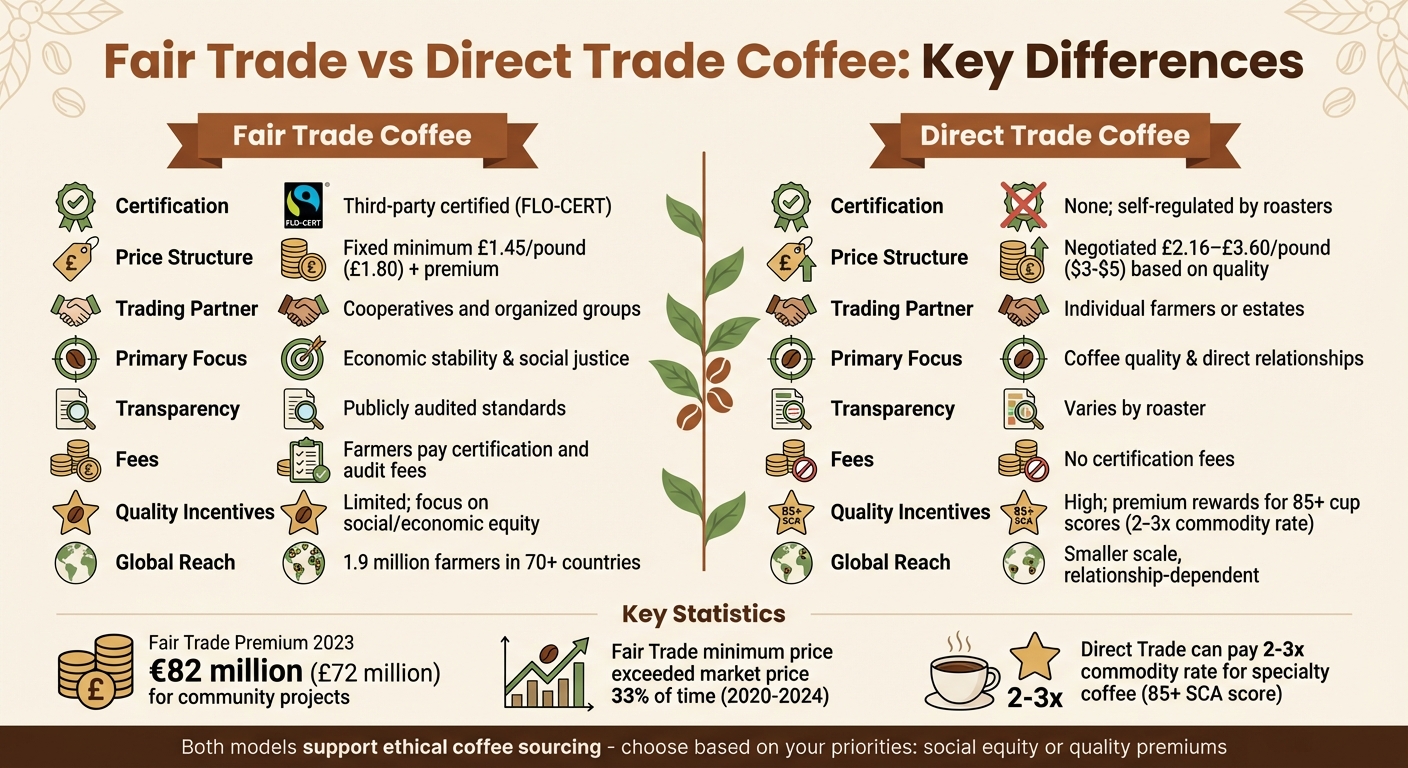
Fair Trade vs Direct Trade Coffee: Complete Comparison Chart
Fair Trade vs. Direct Trade | The Lexicon of Sustainability | PBS Food
What is Fair Trade Coffee?
Fair Trade coffee certification is designed to protect farmers from exploitation while promoting sustainable livelihoods. At its core, the model ensures fair wages, safe working conditions, and adherence to environmental standards for coffee producers.
The certification process is managed by organisations like Fairtrade International, which sets global standards, and FLOCERT, an independent body accredited under ISO 17065. FLOCERT conducts thorough audits that include on-site visits, document reviews, and confidential interviews with workers to confirm compliance. In the United States, Fair Trade USA employs its Agricultural Production Standard (APS), which monitors over 120 performance indicators aligned with the United Nations' 2030 Sustainable Development Goals. Together, these systems form the backbone of Fair Trade's commitment to community development and producer rights.
A unique aspect of Fair Trade is its democratic governance. Farmers and workers hold 50% of the decision-making power within Fairtrade International's assembly, ensuring their voices directly influence policies.
"Fairtrade works to make global trade fairer by ensuring farmers and workers in developing countries receive better prices, decent working conditions and stronger rights", explains the Fairtrade Foundation.
Currently, the Fair Trade system supports over 1.9 million farmers and workers across 70+ countries in regions like Africa, Asia-Pacific, Latin America, and the Caribbean. In 2023, coffee producers earned approximately £72 million in Fairtrade Premium funds, which they collectively decide how to reinvest in their communities.
Key Features of Fair Trade Coffee
The Fair Trade certification is built on three main pillars: economic security, social protections, and environmental responsibility. These elements work together to provide a safety net for coffee producers.
One of the standout features is the Fairtrade Minimum Price, which acts as a safety floor. Currently set at $1.80 per pound (around £1.45 per pound or £3.20 per kilogram), this ensures farmers are protected when global market prices dip below this threshold. Between 2020 and 2024, the Fairtrade Minimum Price exceeded the volatile New York C market price 33% of the time. If market prices rise above the minimum, farmers receive the higher rate.
In addition to the selling price, producers benefit from the Fairtrade Premium, an extra payment earmarked for community development projects. In 2021 alone, Fair Trade coffee partners generated $31 million (approximately £25 million), which farming cooperatives used to fund schools, health clinics, infrastructure upgrades, and farming equipment.
Here’s how these features translate into tangible benefits for farmers:
| Feature | Benefit for Farmers |
|---|---|
| Minimum Price | Provides a guaranteed floor price of $1.80 per pound (around £1.45 per pound), shielding farmers from market fluctuations |
| Fairtrade Premium | Offers additional funds for community projects like schools and health clinics |
| Social Standards | Protects workers by banning forced and child labour while ensuring safe conditions and democratic rights |
| Environmental Standards | Prevents deforestation and promotes biodiversity through agroforestry and intercropping |
| Independent Audits | Ensures compliance through inspections and confidential worker interviews by FLOCERT |
These measures not only secure stable incomes for producers but also empower communities to thrive.
The certification's social standards require farming cooperatives to operate democratically and transparently while strictly prohibiting forced and child labour. On the environmental side, the standards go beyond basic practices, banning deforestation and encouraging biodiversity-friendly methods like agroforestry and intercropping.
Leonardo Mena Arias, a worker and mechanic at UBPC Bermejal, shares: "Fairtrade helps our community become more autonomous and stronger. It allows us to invest money and energy in projects that support our real needs".
Fair Trade’s transparency extends across the entire supply chain. Over 60% of consumers recognise the Fair Trade Certified label, and 74% trust it - proof of the system’s ability to track and document every step of the coffee’s journey from farm to cup.
What is Direct Trade Coffee?
Direct Trade coffee skips over third-party certifications, instead building direct, personal relationships between coffee roasters and farmers. In this system, the roaster and producer negotiate everything themselves - prices, quality standards, and contract terms - without relying on the traditional commodity market.
Unlike the unpredictable nature of commodity markets, Direct Trade allows roasters to pay farmers premiums based on the quality of their coffee, often determined by cup scores. This approach rewards farmers for producing high-quality beans rather than just meeting minimum standards. For example, in 2022, coffee prices hit a 10-year high of over £1.93 per pound but later dropped roughly 40% to £1.30 per pound. By agreeing on quality-based prices in advance, Direct Trade helps protect farmers from these kinds of market fluctuations. Such pricing fosters a more collaborative and open relationship.
"Direct Trade establishes mutually agreed prices and contracts between roasters and producers", says Origin Coffee.
Transparency and regular communication are key to this approach. Roasters often visit farms every two years to review growing conditions, help refine processing techniques, and ensure ethical practices. These visits sometimes include experimenting with unique processing methods, like honey processing or anaerobic fermentation, to create flavours that wouldn’t typically emerge in standard commodity trading.
It’s worth noting that Direct Trade doesn’t eliminate all intermediaries. Exporters and importers still handle shipping and customs logistics. However, by ensuring direct communication and clear pricing, this model opens doors for smallholder farmers, even those who might not belong to cooperatives or meet certification system requirements. These principles form the foundation of Direct Trade, outlined in its defining characteristics below.
Key Features of Direct Trade Coffee
Direct Trade revolves around three main pillars: quality-driven pricing, transparent relationships, and long-term partnerships. These aspects set it apart from both traditional trading and certification-based models.
Quality as the Main Driver:
Farmers who produce specialty-grade beans - those scoring above 85 points - can earn two to three times the standard commodity price. This focus on quality inspires farmers to innovate, invest in better equipment, and improve their farming practices. Roasters evaluate green coffee samples through cupping sessions before committing to purchases, ensuring the beans meet their high standards.
Transparency Across the Board:
Direct Trade roasters often share detailed annual reports, including farm names, lot information, and pricing. For example, Counter Culture Coffee has its Direct Trade practices independently audited each year to ensure accountability and build consumer trust. This self-regulated transparency addresses concerns that "Direct Trade" could otherwise be used merely as a marketing term without proof of fair practices.
Commitment for the Long Haul:
Direct Trade roasters take on shared risks by purchasing crops even during challenging years. This commitment gives farmers the stability they need to plan for the future and make improvements. As Stumptown Coffee puts it:
"Direct trade is our way of saying 'we're in it for the long run'".
Fair Trade vs Direct Trade: Side-by-Side Comparison
Fair Trade and Direct Trade both aim to support coffee farmers, but they go about it in very different ways. Fair Trade relies on third-party certification bodies like FLO-CERT and Fairtrade International to enforce its standards. On the other hand, Direct Trade skips official certifications entirely, with individual roasters setting their own rules and expectations. This means that while Fair Trade applies consistent, audited standards across the board, Direct Trade’s approach can vary greatly depending on the roaster.
The costs of participating in these systems also differ. Fair Trade requires farmers and cooperatives to pay for certification and audits to use the label. Direct Trade, however, doesn’t involve these fees. Fair Trade focuses on organised groups, such as cooperatives, to ensure benefits are shared across communities. In contrast, Direct Trade builds one-on-one relationships between roasters and individual farms.
Pricing is another key difference. Fair Trade guarantees farmers a minimum price of around £1.30 per pound (about $1.80) to shield them from market volatility. On top of that, farmers receive a fixed social premium of 20 pence per pound (approximately $0.20). With Direct Trade, prices are negotiated based on the coffee’s quality, often ranging from £2.16 to £3.60 per pound ($3 to $5) for exceptional microlots.
Marcus Wood, Head Roaster at Old Spike Roastery, explains: "Specialty coffee is driven by quality, so we will reward farmers with a higher price if the coffee tastes good".
These differences illustrate how Fair Trade and Direct Trade impact farmers and influence coffee quality in distinct ways.
Comparison Table
| Feature | Fair Trade Coffee | Direct Trade Coffee |
|---|---|---|
| Certification | Independent third-party (e.g. FLO-CERT) | None; self-regulated by roasters |
| Primary Focus | Economic stability & social justice | Coffee quality & direct relationships |
| Fees | Farmers pay for audits and labels | No certification fees |
| Entity Traded With | Cooperatives or organised groups | Individual farmers or estates |
| Price Setting | Fixed minimum price plus social premium | Negotiated based on quality |
| Transparency | Publicly audited standards | Dependent on roaster's transparency |
| Environmental Rules | Enforced sustainability requirements | Encouraged but varies by roaster |
| Quality Incentives | Limited; focus is on social/economic equity | High; premium rewards for quality |
This table underscores the structured nature of Fair Trade, with its rigorous audits and documentation, compared to the more flexible, trust-based system of Direct Trade, which often involves personal visits to farms.
Nick Martell-Bundock, Head of Purpose at Cafédirect, puts it this way: "The value of Fairtrade is also in the policy and advocacy work... it doesn't really get fully to where the share of value is [with Direct Trade]".
sbb-itb-cca2aed
Fair Trade Coffee: Benefits and Drawbacks
Fair Trade provides a safety net for small-scale coffee co-operatives. Farmers benefit from a guaranteed minimum price of £1.01 per pound (around $1.40), which helps protect them during market downturns. Between 2020 and 2024, this floor price outperformed the New York C market price 33% of the time. Additionally, co-operatives receive a Fairtrade Premium of 14 pence per pound (approximately $0.20), which is invested in community projects.
The Fair Trade model also focuses on empowering farmers. Producers and workers hold 50% of the decision-making power in the Fairtrade General Assembly, giving them a direct role in shaping policies. In 2023, €82 million in premiums funded initiatives such as building schools and purchasing processing equipment. For instance, the Ascarive Co-operative in Brazil, in partnership with Scottish roaster Matthew Algie, used these funds to hire technical agronomists. These experts visit farms to share knowledge on improving coffee quality and environmental care. As member Liliane Eliete explains:
"Fairtrade is a way of adding value, not only to our product, but also to our lives. Fairtrade has changed our lives completely".
However, Fair Trade is not without its challenges. Certification costs can be burdensome for small producers, and the benefits often fail to reach the most vulnerable workers, such as landless migrant labourers. Research in Costa Rica revealed that while farm owners saw income gains under Fair Trade, the poorest workers experienced little to no improvement. Additionally, when market prices rise above the Fair Trade minimum, some farmers sell their best-quality beans on the open market, leaving lower-grade coffee for Fair Trade contracts.
Transparency is another hurdle. Co-operatives decide how to allocate premiums - data from 2020 shows that 50% was spent on member services and 48% on co-operative investments - but tracking the specific outcomes of these funds can be difficult for brands aiming to highlight their impact. Some speciality roasters have criticised Fair Trade for placing more emphasis on social equity than on incentivising top-tier coffee quality. To address this, Producer Networks offer training in advanced processing techniques to help farmers improve both quality and sustainability.
Pros and Cons Table for Fair Trade Coffee
| Advantages | Disadvantages |
|---|---|
| Guaranteed minimum price shields farmers from market crashes | Certification fees can be costly for small producers |
| Premium funds (€82 million in 2023) support community projects like schools and clinics | Limited impact on the most vulnerable workers, such as migrant labourers |
| Farmers have decision-making power through democratic governance | Lack of transparency for consumers seeking proof of direct impact |
| Training from Producer Networks enhances sustainable farming practices | Price guarantees can lead to lower-quality beans being reserved for Fair Trade contracts |
| Some argue the system prioritises social equity over achieving the highest coffee quality |
Fair Trade operates across 70+ countries, supporting 1.9 million farmers globally. While this model delivers stability and community benefits, its challenges highlight the complexities of ethical sourcing. These nuances set the stage for comparing Fair Trade with other models like Direct Trade.
Direct Trade Coffee: Benefits and Drawbacks
Direct Trade coffee is all about cutting out the middlemen, creating a direct connection between coffee roasters and farmers. This approach often results in higher quality and greater transparency. Instead of relying on commodity market prices, roasters pay farmers based on cup scores. For coffee scoring above 85 points on the Specialty Coffee Association scale, farmers can earn two to three times the standard commodity rate. This rewards producers who invest in better equipment and refine their processing techniques.
Another standout feature of Direct Trade is its traceability. Coffee can often be traced back to specific farms - or even individual plots - giving consumers a clear picture of where their coffee comes from. Roasters and farmers often work under long-term contracts, which include pre-financing agreements. These agreements provide farmers with financial stability and the ability to invest in future harvests.
Christine Santos from Tuburan Coffee Farm shares: "We've optimised our cultivation and processing methods to meet the quality standards of our direct trade partners. This has allowed us to enter specialty coffee markets and receive higher prices".
But while Direct Trade has its perks, it’s not without challenges. One of the biggest issues is the lack of an official definition or third-party oversight. This means that standards can vary widely between roasters.
Alex Bravo from Bellwether Coffee highlights this concern: "There is no official industry definition for direct trade... this leaves room for grey areas, unethical practices, and no safety net when trading plans go awry".
Another hurdle is the cost and complexity of logistics. Roasters must handle international shipping, insurance, and customs, which can be a major obstacle for smaller businesses.
Scalability is another sticking point. Direct Trade thrives on exclusivity and small-batch production. Maintaining the necessary relationships requires frequent farm visits, which becomes impractical when considering the 25 million smallholders responsible for 80% of the world’s coffee. Without a governing body to step in, either farmers or roasters must absorb losses if crops are damaged in transit or fail to meet quality expectations.
Pros and Cons Table for Direct Trade Coffee
| Advantages | Disadvantages |
|---|---|
| Farmers can earn two to three times the commodity rate for high-quality coffee (85+ SCA scores) | No standardised definition or third-party certification; relies on roaster integrity |
| Full traceability back to specific farms or plots | High logistical and financial barriers for smaller roasters |
| Long-term contracts provide financial stability and enable farm investments | Difficult to scale due to the need for individual relationships and farm visits |
| Roasters gain control over bean selection, processing, and access to exclusive microlots | Farmers and roasters bear the risk if crops fail or quality doesn’t meet expectations |
| Exceptional flavour clarity and distinct origin characteristics from specialty beans | Benefits tend to favour high-performing farms rather than entire farming communities |
How Creation Coffee Uses Direct Trade for Ethical Roasting
Creation Coffee's Ethical Sourcing Approach
Creation Coffee takes a hands-on approach to sourcing by establishing direct relationships with coffee farmers. By cutting out middlemen, they ensure that more of the money you spend on coffee goes straight to the producers. This approach also allows them to bypass the unpredictable commodity markets, consistently paying farmers prices that are higher than both Fairtrade minimums and C-market rates. The result? Stronger trust and better opportunities for long-term farm development.
They don’t stop there. Creation Coffee works closely with farmers to understand their unique needs, helping them plan for the future while maintaining strict quality standards. Each bag of their hand-roasted coffee is a testament to this dedication, with continuous feedback loops in place to refine and perfect the beans.
This focus on ethical sourcing goes hand in hand with their broader commitment to sustainability.
Sustainability and Community Support
Through their Direct Trade model, Creation Coffee builds respectful, long-term partnerships with farmers, ensuring that working conditions and environmental practices are regularly reviewed and upheld.
But their impact doesn’t stop at fair pay. Creation Coffee also donates 10% of its profits to a children's charity, combining support for farming communities with contributions to meaningful social causes. Whether you’re making a one-time purchase or signing up for a subscription, your choice helps promote sustainable farming methods and uplift communities. It’s coffee with a purpose.
Conclusion
In this article, we’ve explored how ethical sourcing can benefit both farmers and sustainable practices. Fair Trade, with its third-party certification, guarantees a minimum price of £1.80 per pound and funds community projects, while Direct Trade focuses on quality-based premiums by negotiating directly with farmers.
The two approaches prioritise different goals: Fair Trade emphasises social equity, whereas Direct Trade rewards quality and ensures traceability. Neither is inherently better - it all comes down to what aligns with your values. This distinction lies at the heart of ethical sourcing.
Take Direct Trade as an example. If transparency, flavour, and empowering farmers directly resonate with you, this model might be the way to go. Companies like Creation Coffee exemplify this approach by maintaining direct relationships with farmers, paying above-market premiums, and ensuring full traceability. Beyond fair pricing, they also donate 10% of their profits to children’s charities, meaning every cup contributes to farming communities and broader social causes.
FAQs
What are the differences between Fair Trade and Direct Trade coffee in terms of quality and farmer income?
Fair Trade and Direct Trade offer two distinct approaches to influencing coffee quality and farmer income, each with its own strengths and limitations.
Fair Trade is designed to provide farmers with a guaranteed minimum price for their coffee. This safety net ensures they remain financially stable, even when market prices drop. Additionally, farmers receive a community premium, which is often invested in critical projects like building schools or improving infrastructure. While this model supports larger co-operatives and promotes stability, it doesn’t always push for higher-quality coffee production, as the focus is primarily on fairness and security.
Direct Trade, in contrast, skips traditional certification systems and establishes direct connections between roasters and individual farmers. Roasters often pay premium prices for top-notch beans, which motivates farmers to invest in quality-enhancing practices like selective harvesting and precise processing methods. However, this approach tends to benefit a smaller group of producers - those who can consistently deliver exceptional coffee.
To sum up, Fair Trade prioritises income stability and community benefits, while Direct Trade focuses on rewarding quality and craftsmanship, often favouring a select few farmers who meet these high standards. Both systems play a role in shaping the coffee industry, albeit in very different ways.
How do Fair Trade and Direct Trade coffee sourcing compare in terms of environmental standards?
Fair Trade coffee operates under well-defined environmental standards set by the Fairtrade Standard for Coffee. These guidelines focus on maintaining soil health, using water efficiently, protecting biodiversity (such as preserving shade-tree cover), and minimising the use of synthetic pesticides and fertilisers. They also emphasise waste reduction and measures to build climate resilience. To ensure these standards are upheld, independent audits are conducted every year, providing a layer of environmental accountability.
Direct Trade, in contrast, doesn’t adhere to a universal set of verified environmental rules. Instead, sustainability practices are agreed upon directly between the roaster and the farmer. Many roasters promote approaches like organic farming or cultivating shade-grown coffee, but these methods are voluntary and monitored through the roaster's own systems rather than independent audits. As a result, the level of environmental protection can vary widely, depending on the specific arrangements between the roaster and the farmer.
What makes Direct Trade coffee different from Fair Trade, and why might someone choose it?
Direct Trade coffee resonates with those who appreciate exceptional flavour, transparency, and a deeper connection to the origins of their brew. Unlike Fair Trade, which operates through certification standards and fixed pricing, Direct Trade establishes a direct link between the roaster and the farmer. This approach enables roasters to pay higher, market-driven prices that reflect the quality of the beans, ensuring farmers are rewarded fairly for their work.
By cutting out middlemen, Direct Trade offers complete traceability, allowing coffee enthusiasts to know exactly where their beans are sourced. This model not only supports specialty-grade coffee production but also empowers farmers to adopt sustainable practices, creating benefits across the entire supply chain.