


Want coffee that supports farmers and protects the planet? Here's how to choose better:
- Certifications matter. Look for labels like Fairtrade (guarantees minimum prices), Rainforest Alliance (focuses on ecosystems), and Organic (avoids synthetic chemicals).
- Transparency is key. Ethical brands name farms, share pricing models, and publish sourcing details.
- Support farmers beyond pay. Brands investing in community projects, training, or long-term contracts show deeper commitment.
- Consider the planet. Choose shade-grown coffee and recyclable or compostable packaging to reduce waste.
Ask questions like: Where are the beans from? What certifications does it have? How are farmers supported? Check packaging and websites for clear answers.
Your morning coffee can make a difference - choose wisely.
Coffee Certifications Explained
Key Certifications for Ethical Coffee
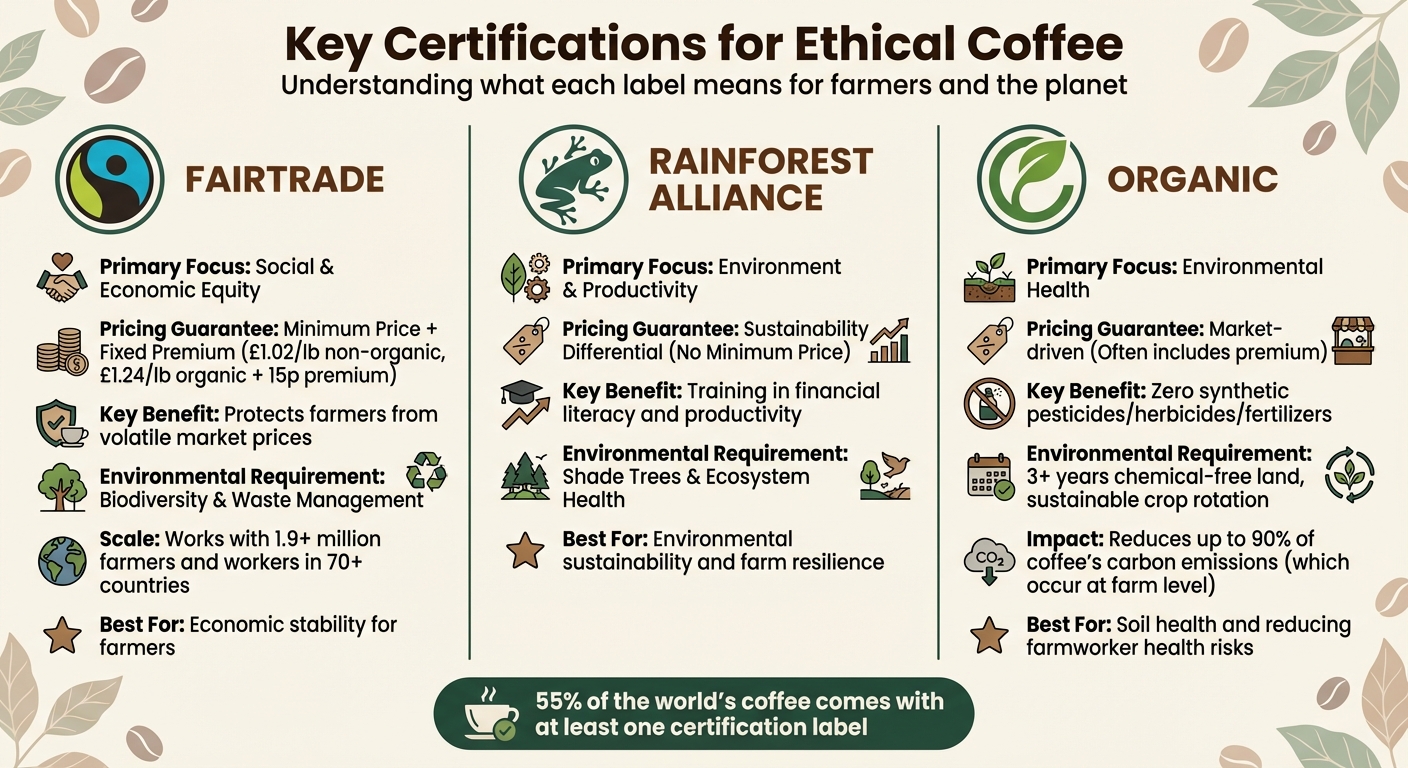
Coffee Certification Comparison: Fairtrade vs Rainforest Alliance vs Organic
Did you know that about 55% of the world's coffee comes with at least one certification label? These certifications make it easier for consumers to identify coffee that aligns with ethical and environmental standards. Among the most recognised are Fairtrade, Rainforest Alliance, and Organic certifications, each focusing on specific aspects like fair pricing, ecosystem preservation, and chemical-free farming.
Fairtrade Certification
Fairtrade is all about ensuring economic stability for coffee farmers. It guarantees a minimum price, tied to the New York Coffee Exchange, to protect farmers when market prices drop. On top of that, Fairtrade includes a fixed premium that goes into a communal fund, supporting local community projects. Operating in over 70 countries, Fairtrade works with more than 1.9 million farmers and workers.
"The Fairtrade standard is unique for its focus on pricing. Volatile prices are very destructive for poor farmers, as it means they cannot know at the time of planting crops what the price will be at harvest." - Ethical Consumer
Fairtrade isn't just about pricing, though. It also enforces social and environmental standards. Farms must meet or exceed legal working conditions and adopt responsible environmental practices. When shopping, look for the FAIRTRADE Mark on packaging as a sign of these commitments.
Rainforest Alliance Certification
The Rainforest Alliance focuses on environmental sustainability and helping farms become more resilient. Its standards cover everything from maintaining shade trees and protecting biodiversity to adopting climate-smart farming methods. Farmers also receive training in financial literacy and productivity, helping them boost profits and achieve self-sufficiency.
Unlike Fairtrade, Rainforest Alliance doesn't guarantee a minimum price. Instead, farmers receive a sustainability differential - a premium above the market price - which is generally lower than Fairtrade's fixed premium. The certification also requires farms to follow international labour standards and avoid practices that harm ecosystems.
Organic Certification
Organic certification takes a hard stance against synthetic pesticides, herbicides, and artificial fertilisers. This protects the soil and groundwater while reducing health risks for farmworkers and nearby communities. To qualify for organic status, land must be free of synthetic chemicals for at least three years. Farms must also use sustainable crop rotation and 100% organic fertilisers to maintain soil health and minimise erosion.
Organic coffee is often shade-grown, which not only helps absorb carbon dioxide but also reduces the need for fertilisers, leading to a smaller carbon footprint. Interestingly, up to 90% of coffee's carbon emissions occur at the farm level. Look for logos like the Soil Association or EU Organic on packaging to ensure the coffee meets organic standards.
| Certification | Primary Focus | Pricing Guarantee | Key Environmental Requirement |
|---|---|---|---|
| Fairtrade | Social & Economic Equity | Minimum Price + Fixed Premium | Biodiversity & Waste Management |
| Rainforest Alliance | Environment & Productivity | Sustainability Differential (No Minimum) | Shade Trees & Ecosystem Health |
| Organic | Environmental Health | Market-driven (Often includes a premium) | No Synthetic Pesticides/Fertilisers |
Transparency in Coffee Sourcing
Certifications alone can't ensure ethical practices - transparency in sourcing is what truly matters. Brands that openly share details about their supply chains show a genuine commitment to fairness. When roasters provide clear insights into their sourcing, it signals they have nothing to hide.
Did you know that smallholders are responsible for a staggering 96% of the world's coffee production, yet they receive less than 10% of its value?. Without transparency, it's almost impossible to know if your daily cup of coffee supports fair wages or contributes to exploitation.
Direct Trade Relationships
Direct trade offers a more direct connection between roasters and farmers, cutting out intermediaries and often leading to much higher payments for coffee producers. Some roasters, for instance, pay between £2.40 and £5.15 per pound for single-origin beans - far above the Fairtrade minimum of roughly £1.03 per pound.
"They're getting two to three times more (with direct trade) than on the open market for their coffees... Direct trade allows farms to become more profitable, re-invest, innovate, and live a more successful middle-class life." - Jeff Babcock, Zoka Coffee
However, there's a catch: the term "direct trade" isn't regulated. Any company can use it without being held accountable. As Kim Elena Ionescu from the Specialty Coffee Association of America points out, "The words 'direct trade' are not regulated at all. So each company can define that term differently, and there's no body that determines what is and is not direct trade".
For a better understanding of a roaster's practices, look for specifics. Do they publish pricing models? Do they visit farms regularly? Are they transparent about paying well above market rates? If their website feels vague, don't hesitate to reach out - ask for farm names, details of their pricing structures, and the last time they visited producers.
Traceability of Coffee Beans
Traceability builds on direct trade by offering a clear view of your coffee's journey - from the farm to your cup. It's the difference between a generic label like "100% Colombian" and one that names the specific farm, producer, or cooperative. Such precision shows the roaster's deep understanding of their supply chain.
"The important thing to us is that we know what the farmer is being paid for their coffee as it leaves the farm, and we know how that farmer is being supported." - Jesse Rabe, Ruby Coffee Roasters
Traceability also allows for valuable feedback loops. Roasters can share quality assessments with farmers, helping them refine their product and negotiate better rates in future harvests. It's not just about fair pay now - it's about fostering long-term partnerships that uplift farming communities.
When you're choosing coffee, take a close look at the packaging. Does it name a specific farm, estate, or cooperative? Check the roaster's website for supply chain transparency, like sustainability reports or detailed maps. Some brands even offer fully traceable options, such as "Grown by Women" beans, which let you trace the product back to individual female farmers in partner cooperatives. These details aren't just marketing - they're a testament to accountability and fairness.
sbb-itb-cca2aed
Roaster Sustainability Practices
When it comes to ethical coffee, the conversation doesn't stop at the farm. The way coffee is roasted plays a huge role in creating a truly responsible cup. From environmentally conscious packaging to reducing carbon emissions, a roaster's sustainability efforts reflect their dedication to both the planet and the people involved in the coffee journey.
Environmentally Friendly Packaging
Did you know that coffee packaging accounts for around 3% of a cup's carbon footprint? While it may seem small, it's one of the easiest areas to improve. For instance, instant coffee jars made of glass or aluminium can be recycled through standard council collections, but whole bean and ground coffee bags often require specialist recycling due to their multi-layer composite materials.
If you're looking to make a better choice, opt for packaging with the LDPE #4 symbol or biodegradable polylactic acid (PLA). These materials simplify recycling and reduce waste. On the other hand, steer clear of multi-layer composite bags that demand specialist recycling services.
Coffee pods are another major concern. With over 500,000 tonnes of capsule waste generated globally each year and 12.5 million UK households owning pod machines, the environmental impact is staggering. Some roasters are now offering home-compostable capsules that can break down in domestic compost bins, while initiatives like the Podback scheme provide free recycling options for popular pod brands.
"One of the easiest changes to make right away would be to switch to compostable or recyclable packaging, such as sustainable coffee bags." - Aidan Gant, Researcher and Doctoral Student, MTPak Coffee
However, be cautious of misleading claims. Some companies have been fined for labelling products as "compostable" when they only degrade in industrial facilities, not in home compost bins.
Carbon Neutrality Commitments
Reducing emissions at every stage of coffee production is key to sustainability. For example, using rail transport instead of road or air can significantly lower emissions. Similarly, cargo ships are a greener alternative to air freight, and supporting shade-grown coffee helps preserve forest canopies, which act as natural carbon sinks.
At the roasting stage, some businesses are switching from gas to electric roasting equipment, which is more efficient. Partnering with renewable energy suppliers is another way roasters are cutting their operational emissions. Some even go a step further by encouraging eco-friendly commuting options, like cycle-to-work schemes for their employees.
Certain roasters are taking a comprehensive approach by exclusively sourcing shade-grown beans, using home-compostable capsules, and publishing detailed sustainability reports that outline their emissions reductions. When choosing a roaster, consider asking about their energy sources, roasting technology, and whether they provide transparency reports.
Community Support and Charity Contributions
Ethical roasting isn't just about the environment - it's also about giving back to the communities that grow coffee. Some roasters establish charitable foundations to back projects that promote sustainable development. Others directly fund infrastructure improvements, such as building schools, upgrading water treatment systems, or providing safety equipment for farmers.
Transparency is a hallmark of ethical roasters. Many publish detailed reports outlining how much they've paid farmers and the specific community projects they've supported. Some even pursue B Corp certification, which legally binds businesses to consider their impact on workers, communities, and the environment.
For a clear sign of genuine commitment, look for roasters that openly share information about the cooperatives they work with and the tangible impact of their contributions.
Questions to Ask Before Buying Coffee
When you're on the hunt for ethically sourced coffee, asking the right questions can make all the difference. Whether you're browsing online or chatting with a barista, these questions can help you navigate beyond flashy marketing and ensure the coffee you choose supports both farmers and the planet.
Where Are the Beans Sourced From?
Look for packaging that specifies more than just the country of origin. Ethical roasters often highlight details like the exact farm, cooperative, or region - and sometimes even the altitude and processing methods.
"A transparent company will openly tell you where their beans are from, who grew them, and what they're doing to ensure fairness all the way through the supply chain." - Ue Coffee Roasters
Check the roaster's website for transparency reports that reveal the exact prices paid to farmers or blog posts documenting sourcing trips. If you're buying in person, don't hesitate to ask about the roaster's relationship with the farm. How long have they worked together? Do they visit regularly? These details can indicate a genuine commitment to traceability.
What Certifications Does the Coffee Have?
Certifications are a reliable way to ensure certain ethical and environmental standards have been met. Look for recognised logos like the FAIRTRADE Mark or the USDA Organic seal, but be cautious of vague claims without proper certification.
For example, Fairtrade certification ensures a minimum price of £1.02 per pound for non-organic coffee and £1.24 for organic coffee, along with a 15p premium dedicated to community development.
If a brand promotes "direct trade" without formal certification, dig deeper. Visit their website to see if they name specific farms, share reports from regular visits, or disclose transparent pricing models. For those prioritising environmental protection, look for Bird Friendly certification. This label guarantees the coffee is both certified organic and shade-grown under a carefully managed canopy, which benefits wildlife and ecosystems.
How Are Farmers Supported Beyond Pay?
Fair wages are essential, but ethical roasters often go further to support farming communities. Ask if the company invests in local projects like schools, healthcare, or infrastructure through programmes such as the Fairtrade Premium, which provides additional funding on top of the coffee's selling price.
Some companies also provide technical training, pre-harvest financing, or long-term contracts to help farmers navigate the uncertainties of the coffee market. These initiatives show a deeper commitment to improving the lives of growers and their communities.
Your Ethical Coffee Checklist
Here's a handy checklist to help you make informed choices when selecting ethical coffee:
-
Check for trusted certifications.
Certifications like the FAIRTRADE Mark ensure fair pricing and community benefits. The Smithsonian's Bird Friendly seal is considered a top-tier standard for environmental responsibility, as it requires coffee to be organic and grown under strict shade conditions. Other certifications to look out for include Rainforest Alliance and Organic, which signal ethical and sustainable practices. -
Look for transparency.
Pay attention to packaging that highlights specific farms, regions, or cooperatives. Dig deeper by visiting the roaster's website to learn about their sourcing practices and how they support producers. -
Ask about farmer support beyond fair prices.
Find out if the company invests in community initiatives or builds long-term relationships with producers. For brands promoting "direct trade" without certification, look for proof of meaningful connections - such as farm names, visit records, or clear pricing disclosures. -
Think about environmental impact.
Opt for shade-grown coffee whenever possible, as it enhances biodiversity and helps with carbon storage. If you use a coffee pod machine, choose home-compostable capsules instead of those requiring industrial composting.
FAQs
How can I tell if a coffee brand is ethically sourced?
To figure out if a coffee brand is ethically sourced, start by looking for certifications such as Fairtrade or Rainforest Alliance. These labels signal that the brand adheres to fair wages and sustainable farming methods. Another clue is the packaging - does it share information about the producers or farms? Brands that are transparent about their supply chain often prioritise ethical sourcing. You can also dig into the brand's efforts to support farming communities and safeguard the environment. Brands committed to ethical practices typically highlight these values in their actions and messaging.
What's the difference between Fairtrade, Rainforest Alliance, and Organic coffee certifications?
Certifications like Fairtrade, Rainforest Alliance, and Organic each address unique aspects of ethical and environmentally conscious coffee production.
Fairtrade centres on fair treatment for farmers and workers. It ensures they receive fair wages, work in safe conditions, and benefit from community development initiatives. The focus here is on promoting social justice and equitable trading practices.
Rainforest Alliance, on the other hand, emphasises protecting the environment. Farms certified under this programme work to conserve biodiversity, safeguard natural habitats, and implement eco-conscious farming methods.
Organic certification highlights farming without synthetic chemicals. It promotes healthier soil and ecological balance, but it doesn't necessarily cover fair labour practices.
Each certification brings something different to the table: Fairtrade advocates for fair treatment, Rainforest Alliance prioritises environmental care, and Organic focuses on chemical-free, sustainable farming.
Why does transparency matter when choosing ethical coffee?
Transparency plays a key role when it comes to choosing ethical coffee. It allows you to follow your coffee's journey - from the farm where it was grown to the cup in your hands. This includes understanding where it comes from, how it's produced, and whether the farmers and workers involved were treated fairly and paid appropriately.
When you prioritise transparency, you're supporting brands that take responsibility for their sourcing practices. This means backing fair wages, decent working conditions, and farming methods that respect both people and the planet. Certifications such as Fairtrade or organic can serve as helpful markers, assuring you that your coffee reflects these ethical principles.
By choosing brands that value transparency, you're not just enjoying a great cup of coffee - you're contributing to the well-being of farming communities and helping to protect the environment. It's a small step with a meaningful impact.
Related Blog Posts
- What Is Ethical Coffee? What The Label Really Means
- Does Your Coffee Give Back? How to Tell the Brands That Mean It From the Ones That Don't
- How Christian Values Shape Ethical Coffee Sourcing
- Single Origin Coffee: A Complete Guide for Beginners
- What Makes Specialty Coffee Different from Regular Coffee
- Coffee Subscription vs Buying in Shops: Which Saves Money
- 5 Ways Roast Profiles Affect Coffee Taste