


Specialty coffee isn’t just a drink - it’s an experience shaped by quality, flavour, and ethics. It’s made from the top 5% of coffee beans globally, scored 80+ on the Specialty Coffee Association’s scale. These beans are carefully sourced, hand-picked, and roasted to highlight their natural flavours, unlike regular coffee, which prioritises cost and mass production, often sacrificing taste and farmer welfare.
Here’s a quick breakdown:
- Flavour: Specialty coffee offers complex notes (e.g., floral, fruity), while regular coffee is often bitter or flat.
- Quality: Specialty beans are defect-free and traceable to specific farms, unlike the bulk-sourced, lower-grade beans in regular coffee.
- Ethics: Specialty coffee supports fair pay for farmers, while regular coffee follows commodity pricing.
- Cost: Specialty coffee costs more (£21.50+/kg) due to its higher standards.
Specialty coffee is for those who value quality and ethical sourcing, while regular coffee suits those prioritising affordability and convenience.
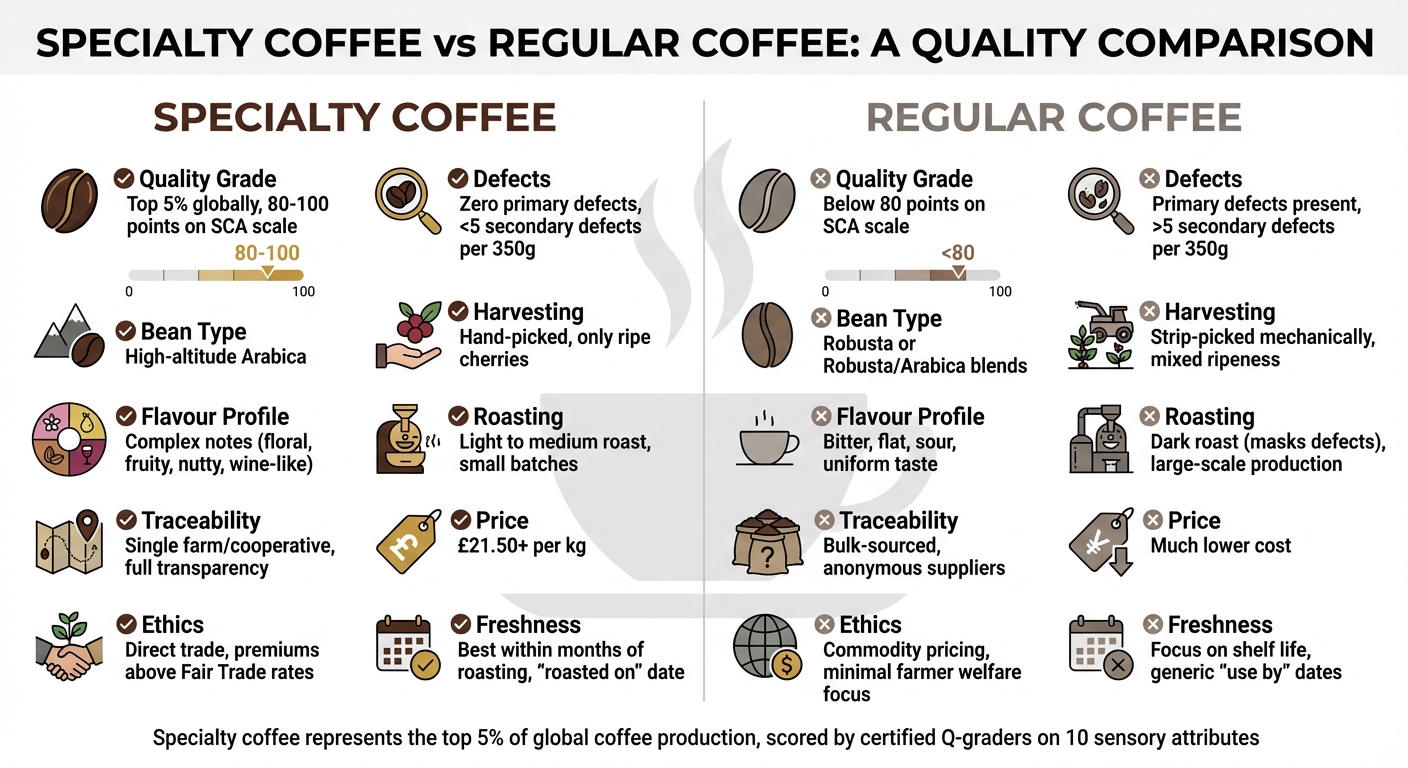
Specialty Coffee vs Regular Coffee: Key Differences in Quality, Cost and Ethics
1. Specialty Coffee
Grading Standards
Specialty coffee undergoes a meticulous evaluation process to earn its title. A 350-gram sample of green coffee is examined, ensuring it has no primary defects and fewer than five secondary ones. After this, it is scored on a 100-point scale established by the Specialty Coffee Association (SCA). The scoring is carried out by Q-graders - certified experts who assess ten key sensory attributes: fragrance/aroma, flavour, aftertaste, acidity, body, balance, sweetness, uniformity, clean cup, and overall impression.
Coffees that score between 90 and 100 points are classified as "Outstanding" and often come from rare micro-lots. Those scoring between 85 and 89.99 are deemed "Excellent", while scores from 80 to 84.99 fall under the "Very Good" specialty grade. Anything below 80 is relegated to the commercial or commodity category.
Bean Quality and Sourcing
Specialty coffee is all about quality, starting with high-altitude Arabica beans, which are prized for their complex flavours compared to the more robust but less nuanced Robusta variety. The sourcing process is equally selective, relying on hand-picking only the ripest cherries. This contrasts with regular coffee, which is often mechanically strip-picked, resulting in a mix of ripe and unripe fruit. Traceability is key here, with beans sourced from single farms, estates, or cooperatives.
The transparency extends to processing methods, which influence the final taste. Washed processing highlights clean acidity, natural processing enhances fruity sweetness, and honey processing delivers a balanced, syrupy profile. Specialty beans are typically grown in the Coffee Belt, between the Tropics of Cancer and Capricorn, at altitudes of 1,200–1,370 metres. These cooler conditions slow the beans' maturation, concentrating their flavours.
Flavour Profiles
The flavour of specialty coffee is heavily influenced by terroir - a term that captures the interplay of soil, climate, and altitude. For instance, Ethiopian coffees are celebrated for their bright, floral notes, such as jasmine and bergamot. Colombian beans, on the other hand, offer a balanced profile with caramel and chocolate undertones. Kenyan coffees stand out with bold, wine-like acidity and blackcurrant notes, while Brazilian coffees are known for their smooth, low-acidity profiles, featuring milk chocolate and toasted nuts.
Processing methods also play a key role in shaping flavour. Washed coffees are known for their clean, bright acidity, natural processing brings out heavy-bodied, fruity sweetness, and honey processing creates a syrupy, well-rounded profile.
Carly Getz, Green Coffee Specialist and Lab Manager at Blue Bottle Coffee, sums it up perfectly:
"Specialty coffee is simple, really. It's well-handled, consistent, and clean coffee. But to make coffee specialty is very, very complicated."
Roasting and Freshness
Specialty coffee roasters often favour light to medium roast profiles to preserve the beans’ natural flavours and origin characteristics. Darker roasts are generally avoided because they can overshadow the delicate nuances with smoky or bitter notes. Roasting is typically done in small batches to maintain quality and ensure freshness.
Freshness is critical when it comes to enjoying specialty coffee. It’s best consumed within a few months of roasting. When shopping, look for bags with a specific "roasted on" date rather than a generic "use by" date - this is a clear indicator of a roaster’s dedication to quality. In the UK, specialty coffee is sold at a premium price.
Ethical Practices
The specialty coffee industry often emphasises direct trade relationships. Roasters work closely with farmers, paying prices significantly higher than commodity market rates or even Fair Trade minimums. This ensures farmers are fairly compensated and helps build lasting partnerships.
These ethical practices resonate strongly with today’s consumers, particularly in the UK’s 18–24 age group, who value sustainability and fair treatment of farmers. Choosing specialty coffee not only guarantees superior flavour but also supports farming communities and promotes environmentally responsible practices. Next, we’ll explore how these high standards compare to regular coffee production.
sbb-itb-cca2aed
2. Regular Coffee
Grading Standards
Regular coffee, often referred to as commercial or commodity coffee, sits on the opposite end of the quality spectrum compared to specialty coffee. It is classified as any coffee scoring below 80 points on the Specialty Coffee Association's (SCA) 100-point scale. Unlike specialty coffee, which must be free of primary defects, regular coffee typically contains noticeable flaws. These can include primary defects like black or sour beans and more than five secondary defects (such as mouldy, insect-damaged, or broken beans) in a 350g sample.
The presence of these defects is largely due to strip-picking, a harvesting method that removes all cherries regardless of their ripeness. This approach leads to inconsistent quality and often results in bitter, sour, or even fermented flavours. These differences in grading standards are a key factor in distinguishing regular coffee from its specialty counterpart.
Bean Quality and Sourcing
When it comes to regular coffee, the focus is on producing large volumes at a low cost, often at the expense of quality. Beans are typically sourced in bulk from a variety of anonymous suppliers, making it nearly impossible to trace them back to specific farms or cooperatives. To keep production costs down, commercial coffee frequently uses Robusta beans or blends of Robusta and Arabica. While Robusta is cheaper and more resistant to pests, it lacks the nuanced flavours often associated with Arabica grown at higher altitudes.
The processing methods for regular coffee are also geared towards efficiency and cost reduction. Instead of controlled fermentation, which enhances flavour, these beans are usually washed and sun-dried using basic methods. This prioritisation of volume over quality and ethics stands in stark contrast to the direct trade practices often seen in the specialty coffee industry.
Flavour Profiles
In terms of taste, regular coffee is often described as uniform and lacking complexity. It is typically characterised by bitter, flat, or overly sour flavours. The vibrant notes - such as floral, fruity, or nutty tones - that highlight a coffee's origin or terroir are absent in most commercial blends. To compensate for the lower quality of the beans, commercial roasters often use darker roast profiles. This helps mask unpleasant flavours caused by defects. As Grind explains:
"Commercial coffees are frequently roasted darker to mask any unpleasant tasting notes, and they lack the vibrant and unique flavours that you find in speciality-grade coffees."
Roasting and Freshness
Another notable difference lies in the roasting process. Commercial coffee is roasted on a large scale, with a primary focus on consistency and shelf life. While dark roasting can help hide flaws in the beans, it also strips away the subtle flavours and aromas that make specialty coffee unique. As a result, regular coffee often lacks both freshness and complexity.
Ethical Practices
The production of regular coffee follows commodity market practices, prioritising cost efficiency over ethical considerations. Unlike the direct trade and ethically driven models of specialty coffee, regular coffee often overlooks farmer welfare and sustainable practices. This approach typically results in lower payments to farmers and little incentive for them to improve the quality of their crops.
What Is Specialty Coffee? How It’s Graded, Grown & Why It’s Different
Advantages and Disadvantages
When it comes to specialty coffee and regular coffee, the differences in quality, cost, and ethical considerations are striking. Understanding these contrasts can help you decide which aligns better with your values and preferences.
After examining how each is produced, the pros and cons become evident.
Specialty coffee stands out for its exceptional quality, traceability, and ethical sourcing. It’s crafted from the top 5% of coffee beans globally, ensuring zero primary defects and offering complex flavour profiles that reflect their origin. On the ethical front, direct trade practices ensure farmers earn premiums well above standard commodity prices, creating what industry professionals call a "virtuous cycle" that promotes both quality and sustainability. However, this level of refinement comes with a higher price tag. Specialty coffee typically costs upwards of £21.50 per kilogram, reflecting the meticulous attention to detail in its production. In comparison, regular coffee is far cheaper but lacks the depth, traceability, and ethical assurances, making specialty coffee more of a luxury than an everyday staple.
Regular coffee’s main appeal lies in its affordability and accessibility. It’s widely available at lower prices, making it a practical choice for households on a budget or those consuming coffee in large quantities. Its dark roasting process creates a consistent, familiar taste that many enjoy. However, regular coffee often falls short in terms of traceability, and the heavy roasting - used to mask bean defects - can result in bitter, flat flavours that lack the complexity of specialty coffee.
Here’s a quick comparison of the key attributes:
| Attribute | Specialty Coffee | Regular (Commercial) Coffee |
|---|---|---|
| Flavour | Complex, distinctive notes (floral, fruity, nutty) | Standardised, often bitter or flat |
| Price Range | £21.50+ per kg | Much lower |
| Traceability | Traceable to a single farm or cooperative | Bulk-sourced from unknown origins |
| Sustainability | Direct trade with premiums above Fair Trade rates | Commodity pricing, minimal focus on farmer welfare |
| Defect Tolerance | High standards, minimal defects allowed | High primary and secondary defects allowed |
Ultimately, the choice comes down to what you value most. If you’re passionate about intricate flavours, ethical sourcing, and supporting sustainable farming, specialty coffee is well worth the investment. On the other hand, if cost and convenience are your top priorities, regular coffee offers a practical alternative, though it compromises on traceability and flavour complexity.
Conclusion
If you appreciate complex flavours, transparency in sourcing, and ethical practices, then specialty coffee is worth the extra cost. As Seven Sisters Coffee Co aptly states:
By choosing ethically sourced specialty coffee, you're not just buying a superior product; you're casting a vote for a more equitable and sustainable coffee industry for everyone involved.
For those mindful of their budget or requiring larger quantities, regular coffee might seem like the practical option. However, this choice often comes at the expense of traceability, nuanced flavours, and fair compensation for farmers.
When purchasing coffee, pay attention to the roast date - specialty coffee’s lively flavours tend to dissipate after a few months. Opt for bags that specify a farm or cooperative, not just a country of origin, and choose whole beans to maintain their aromatic qualities. Whether you're brewing with a V60 or a French press, the quality of your coffee beans - shaped by ethical and sustainable practices - will always be the most critical factor.
FAQs
What defines a coffee as 'specialty' compared to regular coffee?
When a coffee earns 80 points or more on a 100-point scale, it’s officially classified as 'specialty'. This score comes from certified Q-graders who evaluate the coffee based on strict sensory criteria, including aroma, flavour, acidity, body, and balance. The higher the score, the more refined and complex the coffee is.
But there’s more to specialty coffee than just its taste. It also stands out for its focus on ethical and sustainable practices. Beans are often sourced from specific regions with ideal growing conditions, such as high altitudes and favourable climates. Many of these beans come from small farms that prioritise sustainable farming techniques and ensure fair treatment of their workers. To preserve quality, the cherries are hand-picked at their ripest.
The journey doesn’t stop there. Roasting and brewing are carefully calibrated to bring out the coffee’s distinct characteristics, resulting in a flavour experience that’s second to none. Specialty coffee isn’t just about what’s in the cup - it’s a reflection of dedication to quality, sustainability, and ethical principles.
What sets the roasting process of specialty coffee apart from regular coffee?
The roasting process for specialty coffee stands out because it prioritises precision, quality, and flavour. Typically roasted in smaller batches, this approach allows roasters to closely monitor and adjust the process, ensuring the unique characteristics of each bean are highlighted. By fine-tuning elements like temperature and roasting time, they can create a wide variety of flavour profiles - ranging from bright and fruity to deep and rich.
On the other hand, regular coffee is often roasted in much larger batches, with the focus shifting towards consistency rather than exploring individual flavour nuances. The smaller-scale and meticulous attention to detail in specialty coffee not only elevates its taste but also underscores a dedication to craftsmanship and sustainability. Each cup becomes a tribute to the bean's origin and exceptional quality.
What makes specialty coffee more ethical than regular coffee?
Specialty coffee carries a reputation for being more ethical, and there are good reasons for this. It prioritises fair trade, environmental responsibility, and traceability. Typically sourced from small, independent farms, this coffee ensures growers are paid fairly while adopting farming practices that respect and protect the environment. This approach helps farmers sustain their livelihoods without compromising the health of their local ecosystems.
Another key aspect is the focus on quality and transparency. Specialty coffee allows consumers to trace their beans back to the farm, creating a direct link between buyer and grower. This transparency encourages ethical trade and builds long-term, supportive relationships between farmers and coffee buyers. On top of that, the careful harvesting and roasting processes ensure the beans are handled with care, maintaining ethical standards every step of the way.
When you choose specialty coffee, you're not just enjoying a better cup - you’re supporting a system that values fairness, environmental care, and top-tier quality. It’s a more thoughtful choice compared to mass-produced alternatives.