


Roast profiles determine how coffee tastes by controlling heat, time, and other factors during roasting. Each profile influences the coffee's acidity, body, flavour, aroma, and sweetness. Here's a quick breakdown:
- Acidity: Light roasts preserve bright, fruity notes; darker roasts reduce acidity, creating smoother flavours.
- Body: Light roasts feel delicate, while darker roasts develop a creamier texture due to chemical changes.
- Flavour: Light roasts highlight the bean's origin (e.g., floral, citrus), medium roasts balance sweetness and toasted notes, and dark roasts emphasise bold, smoky flavours.
- Aroma: Light roasts retain natural, fruity scents; medium roasts enhance caramel and nutty aromas; dark roasts shift to smoky, bittersweet tones.
- Sweetness and Bitterness: Light roasts are sweeter with minimal bitterness, medium roasts balance both, and dark roasts lean heavily towards bitterness.
Each roast profile offers a distinct experience, making it easier to find one that matches your preferences. Whether you enjoy vibrant, tea-like light roasts or bold, full-bodied dark roasts, the roasting process shapes every sip.
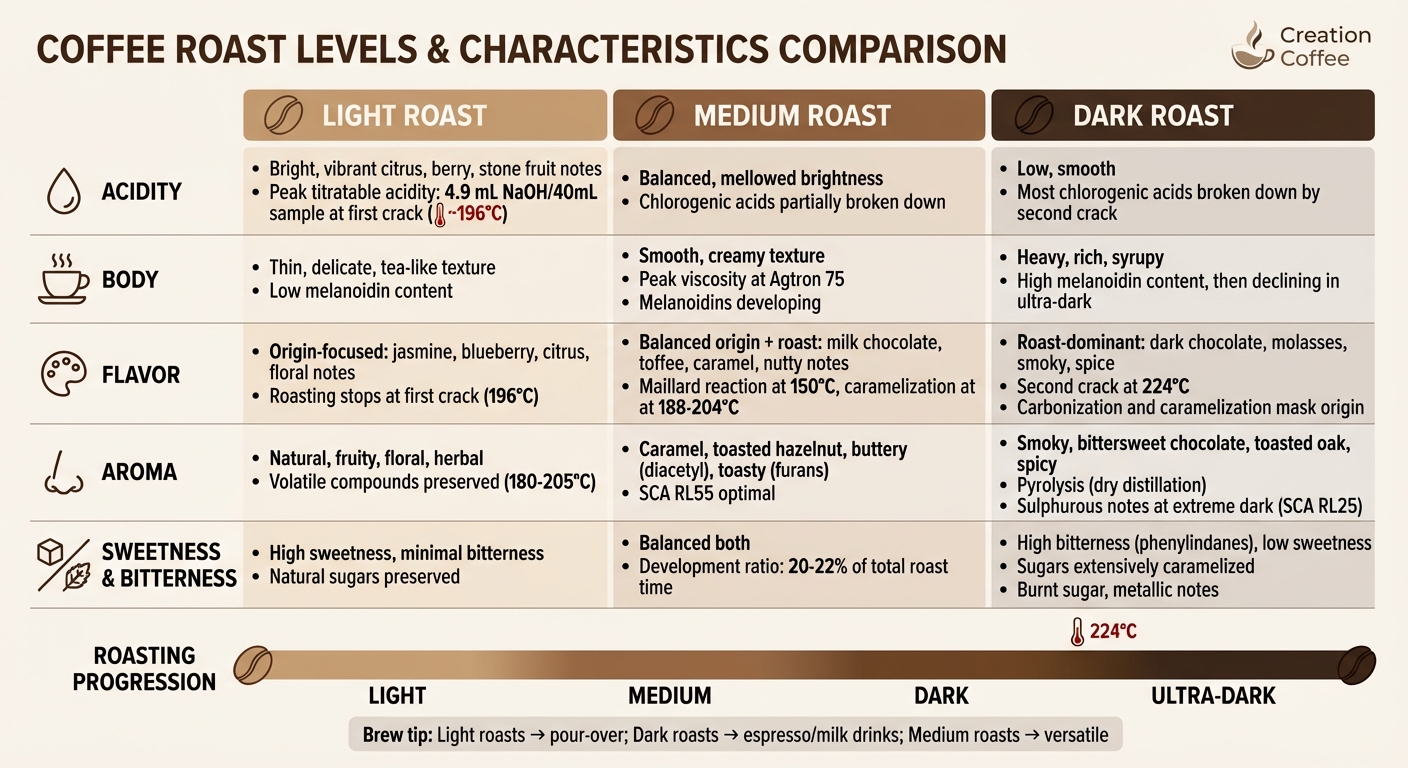
How Coffee Roast Levels Affect Taste: Light vs Medium vs Dark Roast Comparison
Improve Flavors By Changing Your Coffee Roasting Profile
sbb-itb-cca2aed
1. Changing Acidity Levels
When it comes to coffee, acidity isn't about its pH level but the bright, lively sensation it brings to your cup. Light roasts are known for preserving this brightness because the beans spend less time exposed to heat, which helps retain their natural chlorogenic acids. This results in a cup bursting with vibrant citrus, berry, and stone fruit flavours.
As the roasting process progresses, these bright acids start to break down. Research conducted by the University of California, Davis Coffee Center examined 663 samples roasted across seven profiles using a Probat drum roaster. Their findings revealed that titratable acidity reached its peak around the first crack (averaging 4.9 ± 0.2 mL NaOH/40 mL sample) but steadily declined as the roast moved towards the second crack.
By the time coffee reaches a dark roast, most of the bright acids have disappeared. What's left is a richer, smoother flavour profile dominated by notes of dark chocolate, molasses, and a subtle smokiness. Additionally, extended roasting triggers carbonisation and caramelisation, which mask any remaining acidity with bold, roasted tones. These chemical transformations also influence the best brewing methods for each roast level.
For a cup with vibrant, citrusy highlights, light roasts brewed with pour-over or Chemex methods work beautifully. On the other hand, medium to dark roasts are ideal for those seeking a smoother, low-acid experience, especially in milk-based drinks like lattes or cappuccinos.
At Creation Coffee, our small-batch roasting process is designed to preserve these delicate acidity profiles, ensuring a perfectly balanced cup every time.
2. Building Body and Mouthfeel
The body of coffee refers to the weight and texture you feel in your mouth. For example, light roasts often feel thin and delicate, similar to tea, while darker roasts tend to have a richer, creamier texture.
This difference comes down to compounds called melanoidins. These brown polymers, formed during the Maillard reaction, increase the viscosity of the coffee. As Rob Hoos explains, compounds with higher molecular weight contribute to a thicker, more pronounced mouthfeel.
Medium roasts typically deliver a smooth and creamy texture. This happens as sugars caramelise and oils begin to migrate within the bean. As roasting progresses, the breakdown of cell walls creates a velvety or even syrupy texture, as noted by Tom Denton.
Interestingly, research from the University of Copenhagen shows that viscosity peaks at a medium roast level - around Agtron 75 - before declining in ultra-dark roasts. This shift in texture plays a key role in shaping the sensory experience and can even influence the choice of brewing method.
Darker roasts, with their heavier body, pair beautifully with milk-based drinks like lattes and cappuccinos. At Creation Coffee, our hand-roasting process is fine-tuned to develop these textures, ensuring every roast delivers the perfect mouthfeel.
3. Creating Different Flavour Notes
The roast level you choose plays a key role in shaping the flavours that end up in your cup. Light roasts tend to preserve the bean's original characteristics - those natural compounds influenced by its soil, climate, and processing methods. Roasting for light profiles usually stops near the first crack (around 196°C), which keeps bright, delicate notes like jasmine, blueberry, and citrus intact.
"Light roasts showcase acidity and complexity."
As Tom Denton from Hanalei Coffee Roasters explains, shorter roasting times help retain the bean's natural acids and sugars. For instance, Ethiopian beans often reveal floral jasmine and berry-like nuances when lightly roasted, while Kenyan coffees might offer vibrant notes of grapefruit and stone fruits.
Medium roasts, on the other hand, find a middle ground between preserving the bean’s origin flavours and developing sweetness during roasting. The Maillard reaction, which kicks off around 150°C, introduces nutty and toasted notes, while caramelisation above 188°C enhances flavours like milk chocolate, toffee, and caramel. This balance between natural origin and roasted sweetness creates a versatile profile that appeals to a wide range of tastes.
Dark roasts, however, are all about the roasting process itself. As Clive Coffee puts it:
"When coffee is roasted darker, it will inherit more roasty-taste characteristics... resulting from sugar browning, caramelisation of sugars, and dry distillation."
At this stage, the bean’s original qualities take a backseat to bold flavours like dark cocoa, molasses, and spice. By the time the beans hit the second crack (around 224°C), smoky and bittersweet notes dominate. This level of roasting showcases the transformative power of heat, creating a flavour profile that’s intense and robust.
At Creation Coffee, our hand-roasting approach fine-tunes each profile. Whether you prefer the bright, intricate flavours of a light roast or the deep, bold richness of a darker one, every cup reflects our dedication to quality and precision.
4. Affecting Aroma Compounds
Roast profiles do more than just shape the taste of coffee - they also play a big role in crafting its aromatic personality. Through the roasting process, raw green beans are transformed into the fragrant coffee we know and love, thanks to three chemical reactions: the Maillard reaction, caramelisation, and pyrolysis (also known as dry distillation). These reactions produce distinct aroma compounds that define what you smell when you open a bag or brew a fresh cup. Each roast level brings its own signature scent profile.
Light roasts are all about preserving the bean's natural, delicate aromas. These include floral, fruity, and herbal notes that highlight the coffee's origin. By stopping the roast just after the first crack (around 180–205°C), volatile compounds that would otherwise break down under higher heat are retained. The result? A cup brimming with distinct, origin-specific aromas that tell the story of where the coffee was grown.
Medium roasts take things a step further, with caramelisation intensifying between 188–204°C. This creates aromatic compounds like diacetyl (buttery), maltol (caramel), and furans (toasty). Research conducted in October 2024 at the Universidad Técnica Particular de Loja in Ecuador examined the Catimor variety across different roast levels. Their findings revealed that medium roasts (SCA RL55) delivered peak "toasted hazelnut" and "caramel" notes, while extremely dark roasts (SCA RL25) brought out less pleasant "foul" and "sulphurous" odours due to compounds like 4-methylthiazole.
Dark roasts, on the other hand, undergo dry distillation, where plant fibres break down and burn, creating smoky aromas that overshadow the bean's original characteristics. These roasts are characterised by bittersweet chocolate, toasted oak, and spicy scents that dominate the profile. While coffee contains over 1,000 volatile compounds, only about 25 to 34 of them are considered "key aroma-active compounds" - the ones that truly shape what you smell.
At Creation Coffee, we take pride in our hand-roasting process, carefully managing these chemical changes to achieve the desired aromatic profile, whether it’s bright and lively or deep and rich.
5. Adjusting Sweetness and Bitterness
Roast profiles don’t just shape flavour and aroma - they also play a key role in balancing sweetness and bitterness in your coffee. As beans progress from light to dark roasts, chemical reactions either preserve or transform natural sugars, creating distinct taste profiles.
Light roasts tend to highlight sweetness with minimal bitterness. Since the sugars in the beans remain mostly unchanged, these roasts often produce sweet, tart, or floral notes .
Medium roasts, on the other hand, strike a middle ground. At this stage, sugars begin to caramelise, introducing flavours reminiscent of caramel, honey, or toffee. Mild bitterness from quinic acid lactones provides structure without overwhelming the sweetness . Tom Denton of Hanalei Coffee Roasters explains this stage perfectly:
"As roasting continues, sugars start caramelising, acidity begins to mellow out, and body starts to develop. This is the sweet spot for a lot of people - still vibrant, still complex, but with a smoother mouthfeel".
Specialty roasters often aim for a development ratio of 20% to 22% of the total roast time to achieve this harmonious balance.
Dark roasts, however, lean heavily towards bitterness. Here, sugars undergo extensive caramelisation, leading to the formation of phenylindanes, which contribute to a sharp, metallic bitterness. This bitterness is often described as resembling bittersweet chocolate, burnt sugar, or molasses. To soften this intensity when brewing dark roasts, try using a lower water temperature - around 82°C (180°F) - to extract fewer bitter compounds.
Conclusion
Roast profiles are the key to shaping the character of your coffee. From the zesty, citrus-like acidity of light roasts to the rich, full-bodied depth of dark roasts, every choice in the roasting process leaves its mark on the final cup. The balance of flavours, the aroma, and even the interplay of sweetness and bitterness all depend on precise adjustments to temperature and timing.
As Tom Denton of Hanalei Coffee Roasters reminds us, there’s no universal “perfect” roast - it’s all about finding the one that aligns with your taste and brewing style. Whether you’re drawn to the delicate, tea-like complexity of a light roast, the smooth caramel tones of a medium roast, or the bold, intense flavour of a dark roast, each profile offers something distinct.
Now, it’s your turn to explore. With Creation Coffee's ethically sourced, hand-roasted options, you can dive into the world of single-origin coffees to experience how roasting brings out unique terroir characteristics. Or try blends for a consistently balanced flavour across roast levels. Start with a 250g bag, take notes on your tasting journey, and uncover the roast profile that speaks to you.
Your ideal cup is out there - waiting to be discovered, one roast at a time.
FAQs
Which roast is best for espresso?
The best roast for espresso is usually medium to dark. These roast levels are crafted to improve solubility, which is essential for high-pressure brewing. They also bring out the deep, intense flavours that define a great espresso, offering a balanced extraction with bold and layered notes.
How should I brew light vs dark roasts?
To get the best out of light roasts, stick to gentler brewing methods like pour-over or filter brewing. These techniques help bring out the floral, fruity, and acidic qualities that make light roasts shine. On the other hand, dark roasts are better suited to methods like espresso or French press, which enhance their bold, caramelised flavours and richer body. Don’t forget to tweak your grind size and brew time to ensure the flavours are extracted perfectly for each roast type.
Does darker roast mean more caffeine?
When it comes to caffeine content, darker roast coffee beans tend to have slightly less caffeine than lighter roasts. This happens because some caffeine is lost during the roasting process. That said, the difference is barely noticeable when you measure coffee by weight, rather than by individual beans. So, in terms of your daily cup, the variation in caffeine levels is too minor to make a real impact.