


Faith in the workplace is no longer a topic to avoid. With over 80% of the global population identifying as religious, and this figure expected to grow, businesses must address faith as an integral part of Diversity, Equity, and Inclusion (DEI). Here's why it matters and how organisations can support it effectively:
- Faith-friendly workplaces boost trust and engagement: 75% of leaders agree openness about faith improves company culture, yet nearly 40% of employees hide their beliefs due to fear. Addressing this gap can prevent productivity losses (£1.6 billion per day) and absenteeism.
- Leadership shaped by faith drives ethical decisions: Faith-based leadership focuses on integrity, empathy, and wisdom, fostering accountability and moral clarity in decision-making.
- Practical steps for supporting faith: Flexible schedules, floating holidays, prayer spaces, and inclusive catering are simple ways to accommodate religious practices while respecting all beliefs.
- Faith-based programmes enhance retention: Employee Resource Groups (ERGs) like Salesforce's "Faithforce" have shown measurable impacts on recruitment, morale, and productivity.
- Challenges exist, but clear policies help: Conflicts of belief and religious coercion can be mitigated with clear guidelines, respectful dialogue, and anti-discrimination measures.
Faith isn't just a personal matter - it's a driver of organisational trust, ethical responsibility, and employee satisfaction. By creating policies and spaces where faith is respected, businesses can build stronger, more inclusive teams while improving performance.
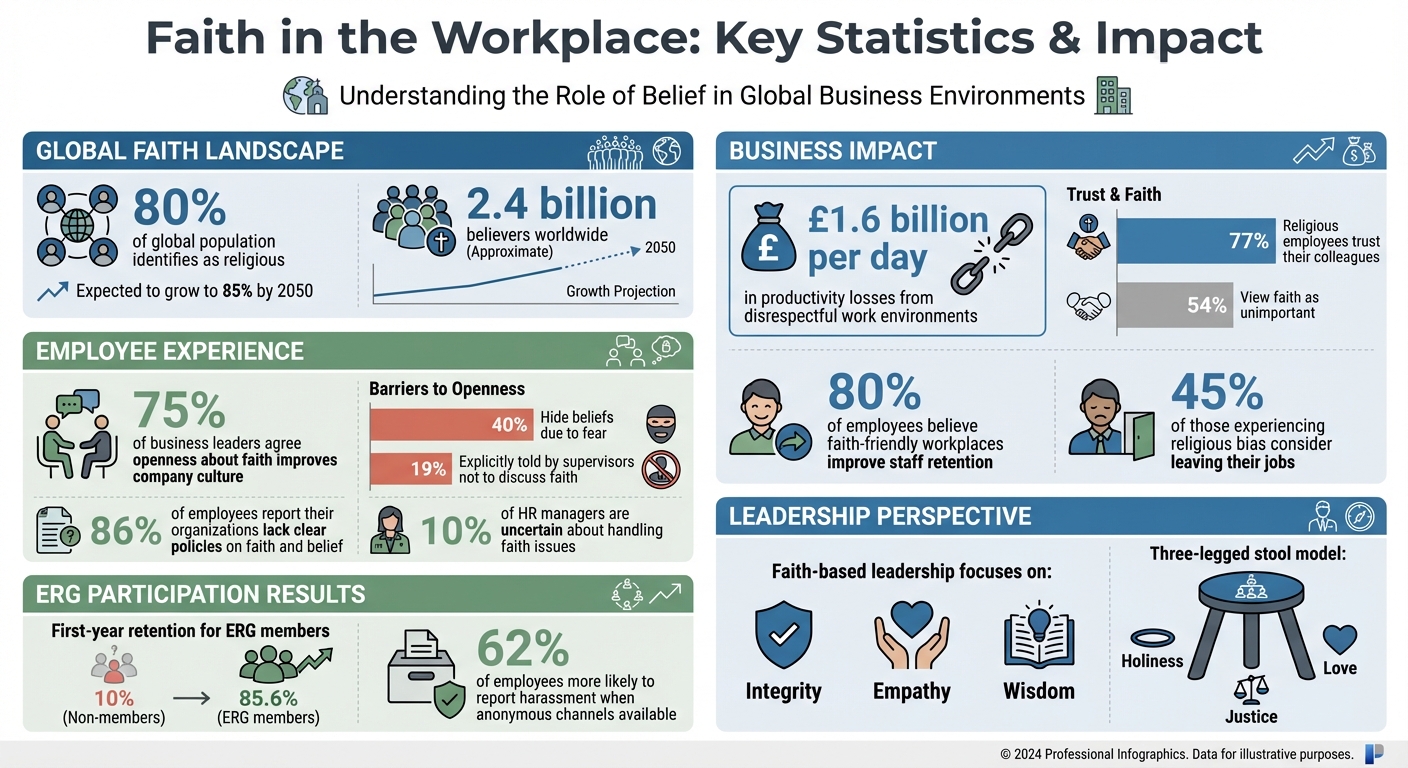
Faith in the Workplace Statistics: Impact on Employee Engagement and Business Performance
4 Ways to Integrate Faith at Work
sbb-itb-cca2aed
How Faith Shapes Leadership
Faith-based leadership reshapes organisations by rooting decisions in enduring principles. It shifts the focus of leadership from authority to service, fostering workplaces built on trust, compassion, and moral clarity. This perspective naturally leads to an exploration of the leadership traits that emerge when faith informs management practices.
Leadership Qualities Rooted in Faith
Leaders guided by faith often embody servant leadership, prioritising the success of their teams over personal recognition. As Bill Yoh, an owner and author at Faith Driven Entrepreneur, puts it:
"The organisation will be successful only if their [the employees'] moves are successful. Serving them and their success is my priority."
This mindset stands in stark contrast to authoritarian approaches.
Faith-centred leadership is often characterised by three key qualities: integrity, empathy, and wisdom. Integrity helps leaders maintain ethical standards, even without external oversight, fostering a culture of accountability. Empathy ensures genuine care for employees’ well-being, while wisdom guides decision-making through prayer and scriptural principles, rather than purely financial metrics. Research based on the Job Demands–Resources model highlights that spiritual resources - like a secure relationship with God - can boost work engagement and reduce staff turnover.
These qualities also form the basis for making ethical decisions, even in difficult situations.
Using Faith to Make Ethical Decisions
Faith provides a strong framework for addressing complex ethical challenges. Rooted in servant leadership, Alexander Hill’s "three-legged stool" model suggests ethical decisions should balance holiness, justice, and love. Overemphasising one aspect - like justice without love - can lead to skewed moral judgement.
Take the example of Wayne Kirkland, a used car dealer in 2008. A customer’s Toyota Camry experienced transmission failure after 22,000 kilometres, well beyond the standard three-month or 5,000-kilometre coverage outlined in New Zealand's Consumer Guarantees Act. While legally he wasn’t obliged to help, Kirkland leaned on his faith to weigh the moral impact of leaving the customer unsupported against the financial cost of assisting.
The "See, Judge, Act" method provides leaders with actionable steps for ethical decision-making. This process involves examining situations through a spiritual lens, evaluating them based on human dignity and the common good, and acting in alignment with servant leadership values. Prayer and scriptural principles also play a crucial role in clarifying moral choices.
Building a Vision Based on Shared Values
Faith helps leaders craft visions that align business objectives with moral principles. It encourages employees to bring their full selves to work, acknowledging each person’s unique talents as a reflection of being created in God’s image. When leaders embrace shared values, they foster meaningful engagement, transforming workplaces into communities where individuals feel valued. Research involving nearly 350 participants found that when employees sense genuine care from their organisations, their trust in leadership and commitment to the company grow significantly.
To make this vision inclusive, leaders are encouraged to express spiritual priorities in everyday language rather than strictly theological terms. The Second Vatican Council aptly warned:
"the split between the faith which many profess and their daily lives... [is] one of the more serious errors of our age."
Faith-based leadership bridges this gap, turning secular work into a mission where the values of approximately 2.4 billion believers worldwide can align seamlessly with their professional lives.
Bringing Faith into Workplace Culture
Supporting faith in the workplace goes beyond tolerance - it can lead to measurable organisational advantages. Studies reveal that disrespectful work environments can cause productivity losses and increased absenteeism. On the flip side, employees who feel secure expressing their religious identity tend to show higher levels of engagement and commitment. David W. Miller, Ph.D., from the Princeton Faith & Work Initiative, describes a "faith-friendly" workplace as one that values all traditions and worldviews equally, creating a positive impact across the organisation. Such practices align with ethical leadership principles and extend faith integration into everyday operations.
Creating an Inclusive and Respectful Environment
Recognising faith as a key aspect of diversity, equity, and inclusion (DEI) is an essential step in fostering an inclusive culture. While over 75% of business leaders believe that allowing employees to express their faith benefits workplace culture, 86% of employees report that their organisations lack clear policies on faith and belief.
Practical accommodations can make a noticeable difference. For instance, offering floating holidays lets employees exchange standard public holidays, like Christmas, for dates that align with their religious observances, such as Eid, Diwali, or Yom Kippur. Openreach's November 2022 initiative to trial hijabs as part of its uniform highlights how thoughtful changes can address specific needs while maintaining safety standards.
Providing physical spaces for prayer or reflection, offering inclusive catering options (e.g., Halal, Kosher, vegetarian), and accommodating religious attire like turbans or jewellery are simple yet impactful ways to show respect. Beyond these adjustments, improving religious literacy among managers helps prevent unintentional exclusion. This could involve avoiding major meetings during fasting periods like Ramadan or engaging with employees to understand their faith experiences without relying on stereotypes. These steps lay the groundwork for more comprehensive faith-based initiatives.
Faith-Based Programmes and Initiatives
Employee Resource Groups (ERGs) have become a powerful way to integrate faith into workplace culture. Participation in ERGs significantly boosts retention rates, with first-year retention jumping from 10% to 85.6% for ERG members. Interfaith ERGs are growing in popularity, allowing different religious groups to support one another while maintaining their unique beliefs.
Salesforce's interfaith ERG, "Faithforce", has reportedly created a "multi-million dollar impact" by improving recruitment, retention, and morale. Sue Warnke, Senior Director of Content and Communications Experience, highlights the benefits:
"Faith inclusion and faith diversity help the business. We have all sorts of data to show that by having a faith group in the workplace, we have improved recruiting, retention, innovation, productivity, and morale."
Employees have even chosen Salesforce over competitors because they feel safe expressing their faith and praying at work.
Starting small is often the best approach. Local HR teams can test pilot meetings before rolling out broader initiatives. Clear guidelines that emphasise respect for all beliefs and prohibit proselytising are crucial. Anonymous reporting platforms also provide a safe way for employees to report religious discrimination, which is especially important given that 45% of those experiencing religious bias consider leaving their jobs.
In March 2024, Rolls-Royce and Baringa received top marks in the first UK Corporate Religious Equity, Diversity & Inclusion (REDI) Index for their structured faith inclusion efforts. Adrian Bettridge, Managing Partner at Baringa, explained:
"By creating a workplace that actively welcomes and supports employees in their faith and beliefs, we are recruiting and retaining top talent, cultivating a distinct and diverse culture, delivering more value for our clients and building a better business for everyone."
One standout example of faith-driven business practices comes from Creation Coffee.
Case Study: Creation Coffee as a Faith-Centred Business
Creation Coffee provides a compelling example of how faith can guide business operations without excluding others. As a Christian-based coffee roaster, the company integrates its values into ethical sourcing, sustainability, and community care - principles that resonate with people of all beliefs.
The company’s direct trade relationships with farmers embody the biblical principle of dignity and fairness. Instead of relying on commodity markets, Creation Coffee builds personal relationships with growers, ensuring fair compensation and sustainable farming practices. This approach aligns with servant leadership, prioritising the well-being of all stakeholders over profit.
In addition to ethical sourcing, Creation Coffee donates 10% of its profits to a children’s charity and encourages employees to bring their whole selves to work. Its focus on craftsmanship - hand-roasting small batches and delivering fresh coffee to customers - reflects a belief that work can express faith while recognising individual talents as part of being created in God’s image.
Supporting Employees' Faith Practices
Creating a supportive work environment involves recognising and respecting employees' faith practices. Surveys reveal that nearly 40% of employees conceal their religious identity due to fear of negative consequences, while 19% have been explicitly told by supervisors not to discuss their faith. This is despite 75% of business leaders acknowledging that openness about faith enriches workplace culture.
Policies for Religious Accommodations
Making room for religious practices requires thoughtful policies. Flexible scheduling is one solution, allowing employees to adjust their working hours or adopt compressed workweeks. This approach enables them to observe daily prayers or religious commitments without compromising their contracted hours. Similarly, offering flexible leave options ensures that employees can honour important religious dates, avoiding the perception that one faith's holidays are prioritised over others.
Providing spaces for prayer and accommodating dress codes are equally important. In 2022, Openreach trialled hijabs as part of their uniform. These hijabs were designed to fit safely under helmets, allowing female Muslim employees to observe their faith while meeting safety standards.
Dress code flexibility has proven to be a critical issue. For instance, United Parcel Service (UPS) faced a £3.9 million settlement in 2018 for failing to accommodate employees whose faith required beards or longer hair. Similarly, Red Robin Gourmet Burgers paid £120,000 to settle a case involving a server dismissed for displaying religious tattoos tied to his Kemetic faith. As the Equality and Human Rights Commission advises:
"The fact that an employee could leave their job if they don't like the rules doesn't excuse the employer from having to seriously consider, and justify refusing, a request".
| Accommodation Type | Implementation Strategy | Key Consideration |
|---|---|---|
| Prayer Breaks | Flexible start/finish times or shorter lunch breaks | Ensure total contracted hours are met |
| Religious Dress | Allow hijabs, turbans, and religious jewellery | Evaluate genuine safety risks, not hypothetical ones |
| Holiday Leave | Use floating holidays or first-come, first-served systems | Maintain minimum staffing levels |
| Dietary Needs | Provide halal, kosher, or vegetarian options | Consider temporary adjustments during fasting periods |
The 2023 Groff v. DeJoy case clarified that "undue hardship" must be substantial within the business's overall context. Adjustments like rescheduling or temporary overtime are generally not enough to qualify as undue hardship. Similarly, UK employers must ensure policies do not indirectly discriminate against specific groups unless justified by health, safety, or legitimate business needs.
Encouraging Open Dialogue about Faith
Formal policies are a strong foundation, but fostering open dialogue can further integrate faith into workplace culture. An interfaith approach can help balance representation and reduce tensions. Many organisations begin with small pilot meetings before expanding to company-wide initiatives, building interest and participation gradually.
Clear ground rules are essential. Multi-faith networks should operate under charters that prohibit proselytising while encouraging members to share experiences and discuss concerns. The U.S. Equal Employment Opportunity Commission underscores this point:
"Title VII is violated when an employer or supervisor explicitly or implicitly coerces an employee to abandon, alter, or adopt a religious practice as a condition of receiving a job benefit or privilege".
A 2018 case highlights the risks of ignoring this principle. United Health Programmes of America was ordered to pay £4.1 million after coercing employees into participating in religious practices, including prayer and spiritual cleansing rituals. One employee was even dismissed for opposing these practices.
Incorporating faith into broader Diversity, Equity, and Inclusion (DEI) training can normalise religious diversity as part of personal identity, much like race or gender, rather than treating it as a separate issue. Managers should be trained to distinguish between genuine disruptions and speculative concerns to avoid denying reasonable accommodations. With 86% of employees reporting a lack of clear policies on faith and belief and 10% of HR managers uncertain about handling such issues, structured guidance is clearly needed.
Anonymous reporting platforms can also play a vital role. Data shows that 62% of employees are more likely to report bullying or harassment when such channels are available. Additionally, rotating the timing of social events can help ensure inclusivity for those observing specific Sabbaths, while using "seasonal" or "end-of-year" themes for celebrations avoids an exclusive focus on Christmas.
Challenges and Solutions for Faith at Work
While we've discussed the advantages of faith-friendly practices, it's clear that challenges persist. Both employees and HR managers often face uncertainty regarding faith-related policies, leading to misunderstandings and conflicts that could have been avoided. Let’s look at how organisations can address these issues with clear guidelines and balanced approaches.
Managing Conflicts of Belief
Even with inclusive policies, conflicts can arise when personal beliefs clash. For example, an employee’s religious views might oppose a colleague’s sexual orientation. While individuals are entitled to their personal convictions, employers must ensure that workplace behaviour remains respectful and non-discriminatory. One way to mitigate such tensions is by establishing clear rules for multi-faith networks. These rules should encourage open sharing of experiences while explicitly banning proselytising or attempts to convert colleagues.
Religious coercion is another area where organisations need to tread carefully. A striking example is the 2018 case involving United Health Programmes of America, which was ordered to pay approximately £4.1 million in damages after forcing employees to take part in prayer sessions and "spiritual cleansing" rituals. One employee was even dismissed for refusing to participate. The U.S. Equal Employment Opportunity Commission highlights this issue clearly:
"Title VII is violated when an employer or supervisor explicitly or implicitly coerces an employee to abandon, alter, or adopt a religious practice as a condition of receiving a job benefit or privilege".
To prevent such issues, organisations need clear behavioural standards and practical measures that balance faith expression with workplace professionalism.
Balancing Faith and Professional Boundaries
Accommodating faith while upholding professional standards requires thoughtful policies. Legal cases like those involving Red Robin and United Health demonstrate that workplace rules should address genuine risks - such as health, safety, or hygiene concerns - rather than superficial or hypothetical issues. Simple adjustments, such as avoiding major meetings during Ramadan or other religious observances, can make a big difference.
When external events heighten religious or political tensions, managers should take a neutral stance, remind teams of the organisation’s commitment to mutual respect, and ensure anonymous reporting systems are in place. Research shows that 62% of employees are more likely to report bullying or harassment when such channels exist.
As the Harvard Business Review notes:
"Accommodating a religiously diverse workplace is not just a nice to have practice; it's increasingly becoming a must have for business and company leaders".
This isn’t just about compliance - it’s also a smart strategy. With 80% of employees believing that a faith-friendly workplace improves staff retention, addressing these challenges helps build stronger, more resilient organisations.
Conclusion: The Benefits of Faith in the Modern Workplace
This guide highlights how integrating faith into the workplace enhances both individual well-being and organisational outcomes. Allowing employees to express their faith at work significantly boosts satisfaction and trust. For instance, 77% of religious employees report trusting their colleagues, compared to just 54% among those who view faith as unimportant.
From a business perspective, the advantages are clear. Faith-friendly workplaces help reduce burnout, build psychological resilience, and encourage ethical decision-making - all of which contribute to stronger organisational integrity. Workplace incivility, which can severely impact productivity, is mitigated in environments that prioritise respect and belonging. This makes fostering a culture of inclusion not just a moral choice but a strategic necessity.
Brian Grim, Ph.D., President of the Religious Freedom & Business Foundation, encapsulates this idea well:
"Supporting religious identity and spiritual expression in the workplace is not an isolated or tradition-specific practice, but a culturally portable driver of human flourishing, organizational trust, and ethical responsibility".
With over 80% of the global population identifying as religious - a figure expected to rise to 85% by 2050 - embracing faith diversity is a smart move for organisations aiming to attract top talent, retain employees, and connect with global markets.
To implement faith-friendly practices, consider steps like creating interfaith groups, accommodating religious observances, and encouraging open dialogue. Start small, secure executive support, and invest in building religious literacy within your teams. Aligning organisational values with these practices not only strengthens ethical commitments but also drives better business performance.
FAQs
What is considered a reasonable religious accommodation at work?
A reasonable religious accommodation enables employees to observe their faith while ensuring it does not impose excessive difficulty or cost on the employer. Examples include offering flexible working hours for religious holidays, modifying dress codes, or providing a designated area and time for prayer. In the UK, the Equality Act 2010 safeguards individuals from religious discrimination, obliging employers to consider such accommodations unless they result in substantial challenges or expenses for the organisation.
How can employers support faith without allowing proselytising or pressure?
Employers can build trust and mutual respect in the workplace by cultivating an environment that values inclusivity and understanding. This means supporting employee resource groups, respecting religious holidays, and accommodating dress codes tied to faith. It's equally important to ensure policies are applied consistently and fairly to everyone. Participation in any faith-related activities should remain entirely voluntary. Additionally, educating staff about religious diversity can encourage openness and foster a workplace where all beliefs are respected without favouring any particular faith.
How do you handle clashes between beliefs and other protected characteristics?
Balancing personal beliefs with other protected characteristics can be challenging, but it's essential for creating an inclusive workplace. The Equality Act 2010 safeguards religion and belief, making discrimination in this context unlawful. Employers must approach conflicts thoughtfully, ensuring any adjustments respect all protected characteristics while avoiding indirect discrimination.
Key to this process is open communication, clear and consistent workplace policies, and a sensitive approach. By fostering an environment where diverse beliefs are recognised and respected within the boundaries of the law, organisations can promote fairness and mutual respect among all employees.