


Consistency in coffee roasting is non-negotiable. Customers expect the same flavour every time, and achieving this requires precise data tracking. By monitoring key metrics like bean temperature, rate of rise (RoR), and first crack timing (around 196°C), roasters can replicate profiles, reduce errors, and honour the hard work of coffee producers.
Key takeaways:
- Why it matters: Consistency builds trust and loyalty. Studies show flavour consistency depends 80% on colour variation and 20% on timing differences.
- Metrics to track: Bean temperature, RoR, weight loss, and development time ratio (DTR) are critical for replicating roast profiles.
- Challenges: External factors like humidity, ambient temperature, and airflow can impact results.
- Tools: Software like Cropster (subscription-based) and Artisan (free, open-source) help track and analyse roast data, offering features like profile comparison and inventory management.
The right tools and disciplined tracking ensure every batch meets customer expectations while reducing waste and costs. Data-driven roasting is about precision, not guesswork.
Roasting Coffee with Artisan Data Logging Software
sbb-itb-cca2aed
Why Roast Consistency Matters
For specialty coffee roasters, consistency isn't just a nice-to-have - it’s the bare minimum. Customers buying from Creation Coffee expect the same flavour profile every single time. As Morten Münchow, founder of CoffeeMind, puts it:
For customers buying roasted coffee, consistency is an expectation, not a benefit. People expect their roasters to reliably reproduce the same flavour profiles again and again.
The importance of this consistency is backed by data. Studies reveal that flavour consistency is influenced 80% by colour variation and 20% by timing differences. Precision matters: achieving an average deviation of only 0.7 Agtron between batches ensures the dependable quality that keeps customers coming back. For small-batch roasters who prioritise ethical sourcing and craftsmanship, this level of precision honours both the hard work of coffee producers and the trust of loyal customers. Consistency, in this sense, becomes the foundation for building lasting customer relationships.
Flavour Consistency Builds Customer Trust
Think about your favourite local café or a coffee subscription service you rely on. Regular customers return because they trust the coffee will taste the same every time. Jacqueline Gutierrez from San Franciscan Roaster Company explains:
Consistency is one of the most prominent driving forces behind customer loyalty.
But what happens when that trust is broken? Coffee consultant Scott Rao shares a common frustration: "There has yet to be a time I loved a coffee from a roaster, ordered a second bag, and was as satisfied with the second bag". A disappointing second purchase can shatter trust, and for brands like Creation Coffee - where 10% of profits support children's charities and ethical sourcing is a core value - trust is non-negotiable. It’s woven into the brand’s identity.
Coffee isn’t just a drink; for many, it’s part of a deeply ingrained daily ritual. Customers depend on that familiar flavour to kickstart their day. When roasters consistently deliver the same quality, they’re not just selling coffee - they’re becoming a part of their customers' routines. Achieving this, however, requires careful control over the many variables that can influence a roast.
Managing Variables in Coffee Roasting
If every roast happened under identical conditions, consistency wouldn’t be such a challenge. But in reality, factors like ambient temperature, humidity, and residual heat can all affect the roast profile. The key to overcoming these challenges lies in rigorous data tracking and precise adjustments to gas and airflow settings.
Data logging allows roasters to monitor and adapt to these ever-changing conditions in real time. A great example comes from September 2023, when Scott Rao’s company Prodigal showcased the power of meticulous data tracking. While roasting Basha Bekele coffee, they achieved an incredibly small weight loss variation of just 0.13% - ranging from 12.0% to 12.13% across multiple batches. This level of accuracy was made possible through strict Between-Batch Protocols (BBP) and detailed data logging, ensuring the roaster’s thermal energy was reset before each new batch.
Key Metrics to Track for Consistent Roasts
When it comes to maintaining consistent roast profiles, tracking specific metrics is absolutely essential. These data points act as a guide for replicating roast cycles and ensuring every batch meets the desired flavour profile. Among these, bean temperature stands out as the primary indicator. It reveals the coffee's position along the roast curve, marking key stages like the Maillard reaction, caramelisation, and the first crack. This data not only forms a digital 'recipe' but also reflects the skill and ethical commitment of the roaster. As Andrew Tucker, UK & Ireland Sales Manager at Volcafe Select, aptly summarises:
Bean temperature is crucial. But in equal crucial measure, it needs to be a clock and stopwatch. Time and temperature is everything.
However, relying solely on temperature doesn’t provide the full picture. The Rate of Rise (RoR) - the rate at which temperature increases, measured in degrees per minute - offers predictive insights. It helps roasters anticipate how the bean temperature curve will evolve, allowing for proactive adjustments. Tucker elaborates:
Without knowing what your rate of rise is, it makes it difficult to shift from reactive to proactive adjustments. I think that's when mistakes occur.
Bean Temperature and Rate of Rise
To ensure consistency, roasters should record bean temperature at critical milestones, such as yellowing, first crack (around 196°C), and the final drop. Monitoring the RoR at 30-60 second intervals is equally important. A drop in RoR might indicate a stall, while a sudden spike could result in scorching. Many roasters prefer 60-second intervals since they align directly with degrees per minute, eliminating the need for extra calculations.
By carefully managing RoR, roasters can control how long beans spend in specific temperature zones - like the Maillard reaction phase - to emphasise certain characteristics, such as body or acidity. Achieving consistency means not only hitting the same final temperature but also replicating the speed at which that temperature is reached across batches. Additionally, precise timing of events like the first crack and total roast duration further fine-tunes the process.
First Crack and Total Roast Time
The first crack, occurring at approximately 196°C, signals the start of the development phase. At this point, tracking the Development Time Ratio (DTR) becomes critical. DTR measures the time from first crack to the end of the roast as a percentage of the total roast time. This metric helps balance acidity, sweetness, and bitterness, ensuring flavour consistency even when external conditions vary and affect roast duration.
Environmental Factors
External conditions such as ambient temperature, humidity, and airflow can significantly influence roasting outcomes. These factors can alter how a roaster performs compared to a reference roast. By documenting these variables, roasters can account for and adjust to environmental changes. For example, in April 2025, Dario Scilipoti, founder of Bluebird Coffee Roastery, used the IKAWA Pro100x humidity sensor to profile a dense washed Ethiopia Idido coffee. By examining the moisture release curve, he identified a "flick and crash" near the first crack, caused by rapid moisture evaporation. This insight allowed him to refine his heat management strategy before starting production, streamlining the profiling process. Scilipoti explained:
The more moisture leaving the coffee at First Crack, the more volatile the change in ROR we should expect.
Another helpful metric is exhaust temperature, which provides additional context about the thermal energy leaving the roaster. For instance, if the bean RoR spikes during the first crack but the exhaust RoR is declining, it indicates there’s still sufficient energy to reach the target end temperature without adding extra heat. This prevents overcorrection and helps maintain control during critical stages of the roast.
Data Tracking Tools and Software for Roasters
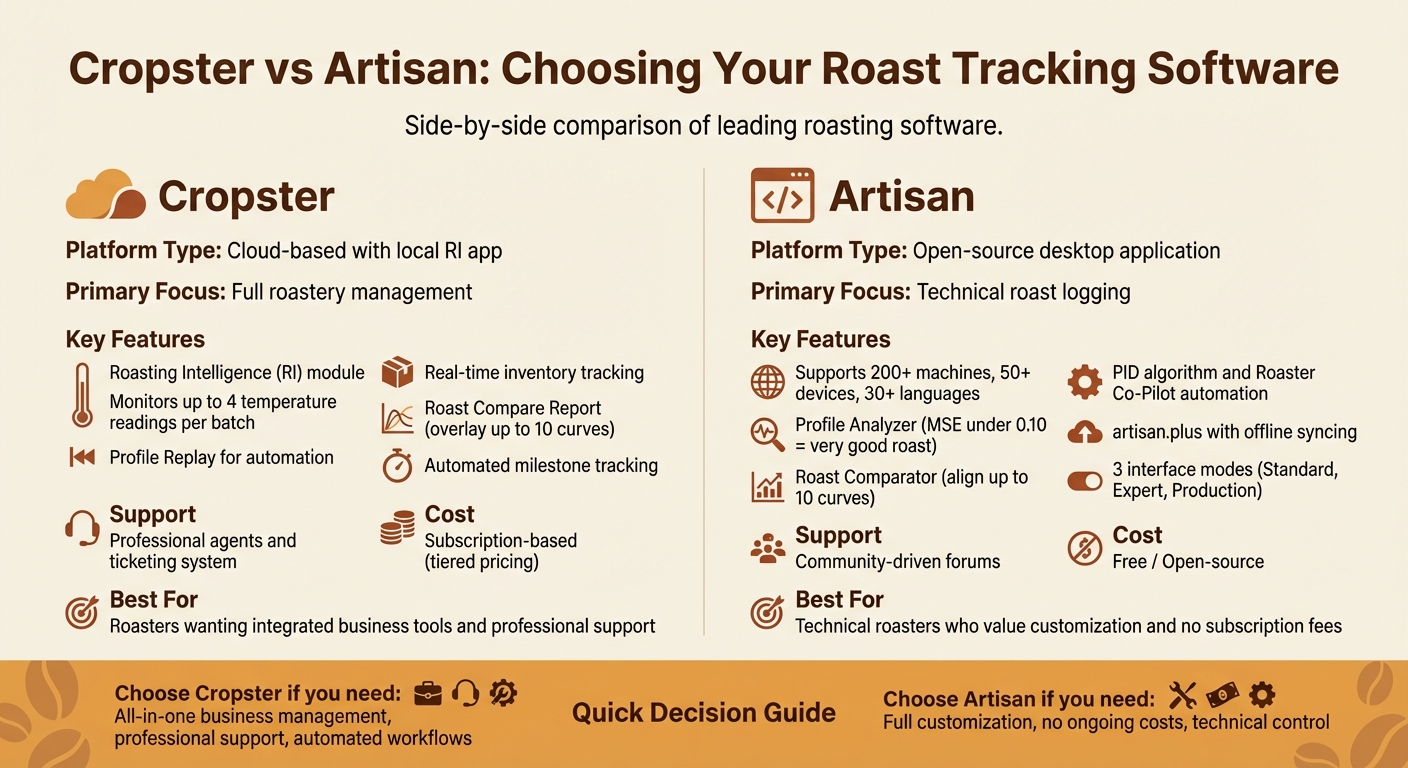
Cropster vs Artisan Coffee Roasting Software Comparison
When it comes to roast metrics, the right tools can help transform raw data into actionable insights. These tools don’t just track numbers - they empower roasters to fine-tune their craft and achieve consistency. Two standout options in the coffee roasting world are Cropster and Artisan. Each caters to different needs, offering unique features and approaches.
Cropster: Comprehensive Roast Management
Cropster is a cloud-based platform that combines roast profiling with inventory tracking, quality control, and scheduling. Its Roasting Intelligence (RI) module monitors key metrics like bean temperature, environmental temperature, and rate of rise in real time, displaying up to four temperature readings per batch. As Cropster puts it:
Roasting Intelligence (RI) is your eyes and ears in the drum.
One of its standout tools, the Roast Compare Report, lets users overlay up to 10 roast curves, connecting physical data with flavour profiles and cupping scores. This makes it easier to pinpoint which variables - like development time or heat energy - lead to the best results. Cropster also automates milestone tracking, logging events like charge, dry end, first crack, and drop without manual input.
For those focused on consistency, the Profile Replay feature is a game-changer. It automates gas and airflow adjustments based on a saved profile, ensuring repeatable results. On the inventory side, Cropster automatically updates green coffee stock as you roast and offers projections based on 32 filterable variables.
The platform operates on a subscription model with tiered pricing options, such as "Roast All" and "Roast Professional", and offers extensive support, including over 100 manuals.
Artisan: Customisable Open-Source Software
Artisan takes a completely different approach. It’s an open-source desktop application that’s free to use, designed for roasters who want full control and customisation without subscription fees. Supporting over 200 machines, 50 devices, and 30 languages, it’s highly adaptable to various setups. Marko, Artisan’s creator, explains:
The Artisan project relies on donations from individuals and companies who value Artisan for its impact on their customers, work, or personal lives.
Artisan excels in detailed analysis. Its Profile Analyzer uses curve-fitting techniques to identify "rises and crashes" in the rate of rise, with an MSE (Mean Square Error) under 0.10 indicating a "very good roast". The Roast Comparator dynamically aligns up to 10 curves, helping users spot deviations from reference profiles. For automation, Artisan offers a PID algorithm and the "Roaster Co-Pilot" for hands-free sessions.
Artisan also provides inventory management through its companion service, artisan.plus, which supports offline roasting. Unlike Cropster, it allows users to upload profiles later when reconnected. Michael Herbert highlights this feature:
artisan.plus... supports offline roasting which Cropster doesn't. Your roasts and profiles are uploaded when you reconnect to Plus.
With three interface modes - Standard, Expert, and Production - Artisan lets users tailor functionality to their skill level.
Comparison of Data Tracking Tools
Here’s how these two platforms stack up against each other:
| Feature | Cropster | Artisan |
|---|---|---|
| Platform Type | Cloud-based with local RI app | Open-source desktop application |
| Primary Focus | Full roastery management | Technical roast logging |
| Automation | Profile Replay, gas control | PID controls, Roaster Co-Pilot |
| Data Comparison | Roast Compare Report | Roast Comparator |
| Inventory | Real-time stock tracking | artisan.plus with offline syncing |
| Support | Professional agents and ticketing | Community-driven forums |
| Cost | Subscription-based | Free / Open-source |
Choosing the Right Tool
The decision between Cropster and Artisan depends on your priorities. Cropster is ideal for roasters who want a straightforward solution with integrated business tools and professional support. On the other hand, Artisan is perfect for technically inclined roasters who value customisation and prefer to avoid subscription costs. Both platforms offer powerful ways to track and analyse roast data, but their approaches to integration and usability set them apart.
How to Add Data Tracking to Your Roasting Process
Integrating data tracking into your coffee roasting routine is essential for achieving consistent results. Here's how to make it part of your process.
Record Every Batch
The backbone of data-driven roasting is meticulous documentation. Start by installing thermocouples in recommended positions, such as placing the BT probe in the lower right and the ET probe in the upper right. Next, connect your roaster to logging software using USB, Bluetooth, or a data bridge like Phidgets.
To ensure consistency, implement a Between-Batch Protocol (BBP), which resets your machine's thermal energy before each roast. This step ensures every batch begins with the same baseline conditions. As Scott Rao explains:
The keys to a successful BBP are the choices for bottoming temperature, gas setting, and charge temperature. Rising too slowly or too quickly to the charge temperature, for instance, will make the BBP ineffective.
Rao's roastery, Prodigal, showcased this principle in September 2023 while roasting Basha Bekele Ethiopian coffee. By adhering to a strict BBP on an IMF roaster, they achieved a weight loss variation of just 0.13% (ranging from 12.0% to 12.13%). For professional roasters, keeping weight-loss variation within 0.25% is a common benchmark for consistency.
Don’t overlook environmental factors like ambient temperature, humidity, and barometric pressure, as they can influence roast times. Automated logging software simplifies this process by recording time, temperature, and Rate of Rise (RoR) every second, allowing you to focus on the roast rather than manual data entry.
With detailed batch records in hand, you can use the data to fine-tune your roast profiles.
Use Data to Adjust Roast Profiles
The next step is to analyse your data to improve your roast profiles. Reference profiles, also known as underlays, act as a guide. By overlaying a successful roast curve during a live session, you can quickly spot deviations and adjust fuel or airflow accordingly.
Keeping an eye on RoR ensures your roast stays on track with the reference profile. After First Crack, adjust the roast duration based on your established curve.
Monitoring bean temperature also allows you to control the Maillard reaction - the phase between yellowing and First Crack. As ROEST explains:
A coffee spent in a longer Maillard reaction can gain more viscosity, and a coffee spent in a shorter response will turn more sweet and acidic.
Tools like Curve Compare let you overlay profiles, making it easier to spot and adjust for changes as coffee ages. Additionally, measuring weight loss before and after roasting serves as a key metric to confirm that your adjustments are maintaining consistency.
Confirm Results Through Cupping
Once you've adjusted your roast profile based on the data, it's time to confirm the results through cupping. While data provides a detailed picture of the roast, the final judgement lies in the cup. As Mill City Roasters aptly puts it:
Roast curve data will be an invaluable tool in your roasting career but the success (or failure) lies in the cup. Roast curves should always be weighed against tasting & cupping notes.
Use triangle or in/out tests to evaluate whether your adjustments deliver the desired flavour changes. Remember, even the most precise curve is only successful if it produces the intended taste. By pairing detailed data with honest sensory feedback, you'll refine roast profiles that excel both technically and flavour-wise.
Conclusion
Data tracking turns coffee roasting from an art of intuition into a craft of precision. By recording key metrics like bean temperature, Rate of Rise, and weight loss percentage, roasters can replicate successful batches with accuracy and consistency. But it’s not just about hitting the right numbers - it’s about respecting the journey of the coffee, from its origins to the final brew.
At Creation Coffee, this dedication to precision reflects a deeper commitment to both quality and ethics. Carefully monitoring every batch ensures that the high-quality beans, sourced through direct trade partnerships, are roasted to their full potential. This process honours the hard work of farmers, ensuring their efforts aren’t undermined by inconsistent roasting. For customers, this means every cup delivers the dependable quality they’ve come to trust.
While the data is essential, it doesn’t replace the skill of the roaster - it complements it. By tracking temperature curves and development times, roasters can experiment with confidence, knowing they can always return to a reliable profile when needed. This balance of craft and measurement helps maintain the artistry of roasting while meeting modern demands for consistency.
For small-batch roasters, the advantages go beyond flavour. Keeping track of data not only improves taste consistency but also reduces green bean waste, cutting it from around 5% to just 1%. This saves money and ensures customers enjoy the quality they expect with less environmental impact.
FAQs
What targets should I set for roast consistency?
To get consistent roasts, pay close attention to important factors like First Crack timing, temperature profiles, and the Rate of Rise. Using tools like data logging and graphical analysis can help you keep track of these metrics and stay in control. By consistently monitoring and adjusting these elements, you can fine-tune your process and achieve high-quality, even roasts every time.
How can I stop RoR “flicks” and “crashes” near first crack?
To minimise "flicks" and "crashes" in the rate of rise (RoR) around the first crack, it's crucial to keep a close eye on how the RoR behaves and carefully manage the heat input. Make adjustments to the gas or heat levels to ensure the RoR remains steady, avoiding any sudden spikes or drops. Tools like automatic first crack detection can be a great help, providing better timing and consistency during this vital phase.
What additional data should I log besides time and temperature?
When roasting, it's not just about time and temperature. Make sure to log key metrics like the rate of rise, colour changes, first crack timing, and bean density. Don't forget to track moisture content and any sensory or visual observations. These details are crucial for fine-tuning your process and ensuring consistent roast quality every time.