


Carbonic maceration is a fermentation process originally developed for winemaking in the 1930s by Michel Flanzy, later becoming central to the Beaujolais wine region of France. This method involves fermenting whole, unbroken fruit in a CO₂-rich, oxygen-free environment, leading to unique flavour profiles. In 2015, it gained global attention when Saša Šestić used it to win the World Barista Championship with coffee processed using this technique. Since then, it has become a sought-after method in speciality coffee production, offering precise control over flavours and creating vibrant, fruit-forward profiles.
Key points:
- Origins: Invented for wine production, particularly for Gamay grapes in Beaujolais.
- Adoption in coffee: Adapted to coffee in the 2010s to address flavour inconsistencies.
- Process: Whole cherries are sealed in CO₂-filled tanks, triggering internal fermentation.
- Flavours: Produces notes of tropical fruits, bubblegum, and wine-like acidity.
- Impact: Allows producers to create high-quality, experimental microlots that stand out in the market.
This method continues to evolve, with producers combining it with other coffee processing techniques and experimenting with variables like temperature and fermentation duration to refine flavours further.
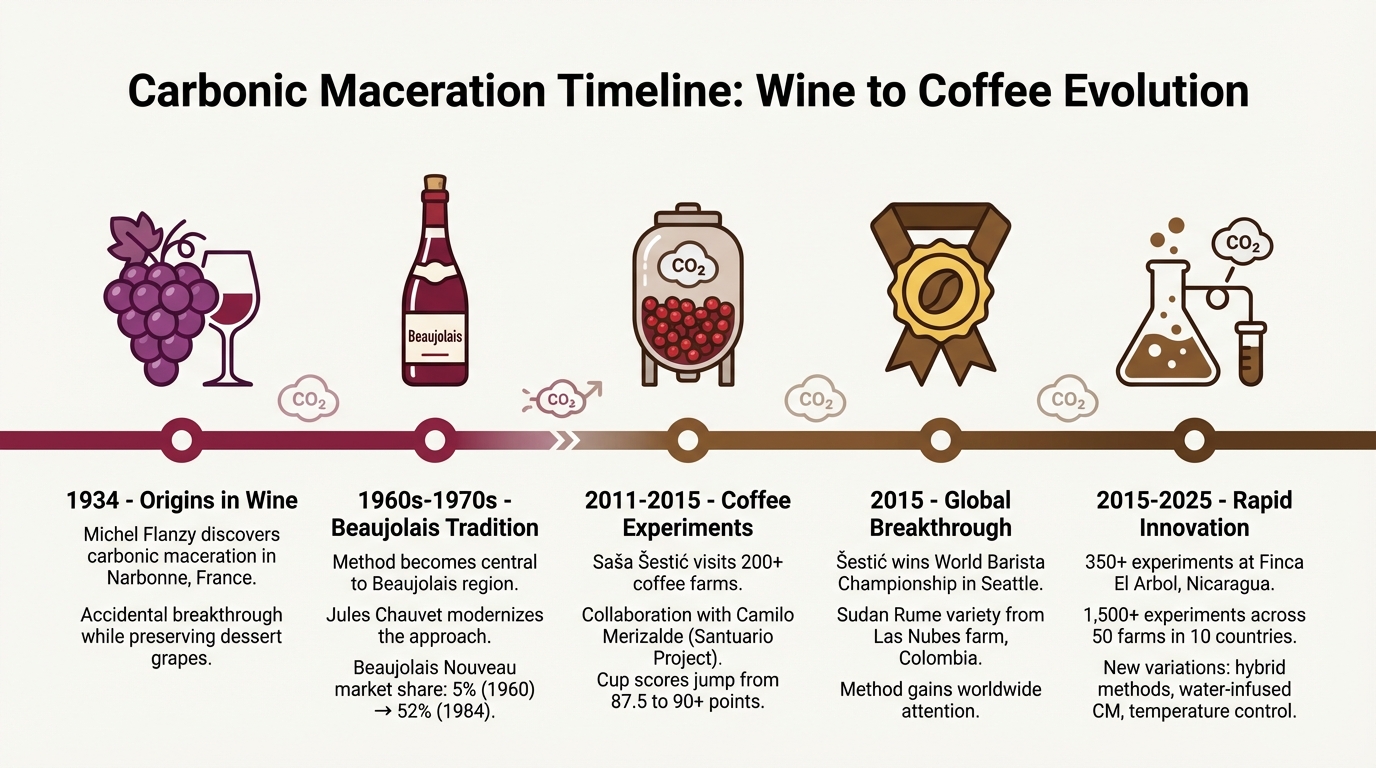
Carbonic Maceration Evolution: From Wine to Coffee (1934-2025)
Origins in Winemaking
The Beaujolais Tradition
Back in 1934, French scientist Michel Flanzy was working in Narbonne, experimenting with ways to preserve dessert grapes by storing them in a low-oxygen, CO₂-rich environment. While the preservation goal didn’t pan out, something unexpected happened: the grapes underwent vinification, resulting in wines with distinct and appealing qualities. This accidental breakthrough would eventually revolutionise winemaking in the Beaujolais region.
Winemakers in Beaujolais quickly saw the potential, especially for the Gamay grape, which was perfectly suited for producing light, fruity wines. The method became a hallmark of the region, thanks in no small part to Jules Chauvet, a chemist and winemaker who modernised the approach. Chauvet’s work helped create accessible wines like Beaujolais Nouveau, which became wildly popular. By the 1970s, this method was central to the region’s identity.
The process itself was innovative: whole grape clusters were placed in tanks filled with CO₂, triggering intracellular fermentation. This allowed the grapes’ natural enzymes to do the work without requiring external yeasts. Impressively, the entire process - from harvest to bottling - could be completed in under six weeks. This speed gave producers a competitive edge, enabling them to meet market demands for fresh, youthful wines. The results were staggering: Beaujolais Nouveau’s share of total Beaujolais wine sales skyrocketed from 5% in 1960 to 52% by 1984.
Key Principles in Winemaking
The Beaujolais tradition didn’t just stop with the basics - it evolved into a refined art. Carbonic maceration, the technique at the heart of this process, fundamentally changed the chemistry and flavour profile of the grapes. In the oxygen-free environment, the berries underwent a unique transformation. During the intracellular fermentation phase, alcohol levels inside the grapes reached about 1.5% to 2% before the cells broke down. This enzymatic activity produced volatile esters like ethyl cinnamate, responsible for strawberry and raspberry aromas, and benzaldehyde, which added cherry and kirsch notes.
This process didn’t just enhance aromas - it also altered the wine’s structure. Malic acid levels dropped, reducing overall acidity, while the pH increased. The result? Wines with bold, aromatic profiles but low tannins. These wines became known for their distinctive bubblegum, banana, and candied fruit flavours.
Interestingly, the success of this method in winemaking eventually caught the attention of coffee producers. Inspired by the way carbonic maceration shaped flavours in wine, they began adapting it for coffee fermentation, aiming to create similarly vibrant and controlled flavour profiles. What started as a winemaking innovation turned out to have far-reaching influence, opening new doors for flavour experimentation in other industries.
sbb-itb-cca2aed
Adoption in Coffee Processing
Traditional Coffee Processing Methods
The traditional ways of processing coffee - washed, natural, and honey - depend heavily on ambient microbes, which means there’s limited control over the final flavour. In the washed process, the fruit layer of the coffee cherry is removed before fermentation, producing coffees that are clean and bright with notable acidity. Natural processing keeps the cherries intact during drying, resulting in coffees with a heavy body and a pronounced sweetness. Honey processing strikes a balance between the two, leaving some of the cherry’s mucilage on the beans while they dry.
However, these methods rely on naturally occurring microorganisms, making the fermentation process unpredictable. This can lead to inconsistencies in flavour between harvests. As speciality coffee buyers began to demand more consistent and distinctive flavour profiles, producers started looking for ways to steer the fermentation process rather than leaving it entirely to chance. These challenges sparked the first experiments that would reshape coffee fermentation.
Early Experiments in Coffee
To tackle the issue of inconsistent flavours, coffee producers began applying techniques from winemaking. Between 2011 and 2015, Australian barista Saša Šestić visited over 200 coffee farms, searching for solutions to the inherent variability in traditional methods. His collaboration with Camilo Merizalde of Colombia's Santuario Project marked a turning point, as they adapted carbonic maceration - a winemaking technique from the Beaujolais region - for coffee.
"We personally believe that the coffee industry is still lightyears behind the wine industry in terms of processing."
– Camilo Merizalde, Founder and Director, Santuario Project
These early experiments required specialised equipment like sealed tanks, pressure-release valves, and CO₂ systems. The risks were high; if the process wasn’t carefully controlled, entire microlots could develop off flavours like vinegar or astringency, rendering them unsellable. Despite the challenges, the potential was clear. In Panama, Šestić worked with Jamison Savage of Finca Deborah to apply carbonic maceration to Geisha coffee varieties. The results were staggering - cup scores jumped from 87.5 to over 90 points, proving the method could dramatically improve quality. These trials laid the groundwork for carbonic maceration’s introduction to the global coffee stage.
Saša Šestić's 2015 World Barista Championship Win

The transformative potential of carbonic maceration reached the global spotlight in 2015. At the World Barista Championship in Seattle, Šestić used a Sudan Rume variety processed with carbonic maceration at Las Nubes farm in Colombia, part of the Santuario Project, to secure victory. The coffee stood out for its intense stone fruit and floral notes - flavours that traditional methods couldn’t achieve.
"Carbonic maceration is a way to target specific microorganisms by controlling different variables during fermentation... allowing us to elevate the flavour profile of the coffee."
– Saša Šestić, 2015 World Barista Champion
Šestić’s win brought carbonic maceration to the forefront of the speciality coffee world. In the years that followed, his team at Finca El Arbol in Nicaragua conducted over 350 experiments to refine the process. Meanwhile, his organisation, Project Origin, carried out more than 1,500 experiments across 50 farms in ten countries. What began as a secret weapon for competition quickly became one of the most sought-after processing techniques in speciality coffee.
Fermenty Experimenty ⚡️ Episode 4: carbonic maceration & skin contact
How Carbonic Maceration Works in Coffee
Building on its role in coffee processing, let’s take a closer look at how carbonic maceration operates step by step.
The Process Step by Step
It all starts with selective harvesting. Only perfectly ripe cherries are chosen because any damaged skin could lead to contamination from external yeasts, which would disrupt the process. After sorting, the whole cherries are placed into airtight tanks made of stainless steel or plastic. These tanks are then filled with CO₂, which pushes out the oxygen and creates an anaerobic environment.
"The current definition of carbonic maceration in coffee refers to whole cherries sealed in a container with Carbon Dioxide (CO₂) actively pumped into it. CO₂ creates pressure and pushes oxygen (O₂) out, resulting in an anaerobic environment." – Taya Brown, Ph.D., Coffee Production Researcher, Cafe Imports
Unlike other methods that rely on external microbes, carbonic maceration uses the fruit’s own enzymes to trigger intracellular fermentation - a process that happens within the cherry itself. This is what gives the coffee its distinctively vibrant flavours. As fermentation progresses, pressure builds up inside the tank. To manage this, producers use one-way valves that release excess pressure without letting oxygen back in.
Throughout the process, producers closely monitor temperature, pH levels, and sugar content (measured in Brix). As Mario Andres Prieto, owner of La Pasion del Barista, points out: "Lower temperatures will develop more acidity, while higher temperatures are likely to enhance the sweetness of the coffee.". The cherries typically stay in the sealed tank for around 60 hours before being moved to raised beds for 10 to 12 days to dry. After fermentation, the coffee undergoes additional processing - washed, natural, or honey methods - to fine-tune the final flavour.
Because the cherry skin remains intact throughout, aromatic compounds stay locked inside the seed. This enhances the fruit notes in the coffee, giving it a pronounced, fruit-forward profile that sets it apart.
This detailed process highlights how carbonic maceration stands apart from traditional methods like anaerobic fermentation.
Carbonic Maceration vs. Anaerobic Fermentation
Now that we’ve broken down the steps, let’s compare carbonic maceration to anaerobic fermentation. While both rely on oxygen-free environments, they differ in how fermentation begins and what part of the cherry is involved.
| Feature | Carbonic Maceration | Anaerobic Fermentation |
|---|---|---|
| Cherry state | Whole, intact cherries | Usually pulped or mucilage-covered seeds |
| CO₂ source | Actively injected from an external cylinder | Produced naturally by microbes during fermentation |
| Fermentation type | Intracellular - inside the fruit cells | Extracellular - microbes acting on the mucilage |
| Duration | Days to weeks (intact skin slows breakdown) | Typically 12–36 hours, though can be extended |
| Common flavours | Red fruit, tropical, bubblegum, winey | Gingerbread, cinnamon, poached pear, liquorice |
Flavour Profiles and Consumer Appeal
Carbonic maceration, with its precise fermentation process, creates a coffee experience unlike any other, offering a flavour profile that is both vibrant and refined.
How Flavours Develop
The distinctive complexity of carbonic maceration coffee comes from intracellular fermentation. This process allows volatile aromatics to remain intact, as the cherry's unbroken skin acts as a protective barrier. The result? Intensely concentrated flavours like strawberry, raspberry, and cherry, complemented by tropical and confectionery undertones. Additionally, the CO₂-rich environment reduces oxidation, leading to cleaner, more fragrant aromas.
Temperature plays a crucial role in shaping these flavours. As Mario Andres Prieto, owner of La Pasion del Barista, explains:
"It is possible to enhance the sweetness of green coffee and even increase the quality of the cup profile through controlled fermentation."
Cooler fermentation tends to highlight acidity, while warmer conditions bring out sweetness. This level of precision simply isn’t achievable with traditional open-air fermentation methods.
Dr. Taya Brown, a coffee production researcher at Café Imports, highlights the impact of this method:
"Leaving the cherry skin intact and enabling intracellular fermentation leads to richer and more unique flavor expressions... deep, sweet, and complex in structure."
These carefully crafted flavours have captivated speciality coffee enthusiasts, showcasing the meticulous processing that roasters like Creation Coffee prioritise when sourcing exceptional beans.
Consumer Demand for Experimental Coffees
The unique flavour profiles achieved through carbonic maceration have positioned these coffees as premium offerings. The process itself requires specialised equipment - stainless steel tanks, CO₂ canisters, and one-way valves - alongside extended processing times and the risk of batch failure. As a result, these coffees are often produced as limited-edition microlots, commanding higher price points.
Yet, consumer interest in these experimental coffees continues to rise. Speciality coffee drinkers are increasingly drawn to sensory experiences that challenge traditional expectations. As Ozone Coffee UK notes:
"These coffees are often described as expressive and experimental, making them a favourite in competitions and among adventurous drinkers."
The wine-like acidity, silky texture, and intricate aromatics appeal to both seasoned coffee lovers and fans of natural wine or craft fermentation. This growing interest aligns perfectly with Creation Coffee's dedication to ethically sourcing and crafting speciality coffees that push boundaries.
For those eager to experience these flavours at home, brewing with a V60 or AeroPress is recommended. Use water heated to 90–94°C and take your time to savour the evolving flavour layers. As the coffee cools, bright tropical notes give way to more subtle hints of stone fruit and spice, offering a dynamic tasting journey in every cup.
Evolution and Experimentation
Since Saša Šestić's 2015 victory, carbonic maceration has transformed into a modular fermentation technique that blends seamlessly with traditional coffee processing methods.
Combining with Other Processing Methods
Carbonic maceration is often used as a pre-treatment before applying washed, natural, or honey processes, offering producers more control over the final flavour profile. Pairing carbonic maceration with natural processing - where coffee cherries are dried whole - can result in bold, tropical flavours with a heavy, almost boozy body. A washed finish, on the other hand, tends to highlight bright acidity and a clean, wine-like character. Meanwhile, a honey process strikes a balance, delivering syrupy sweetness and a complex, fruit-forward profile.
Dr Taya Brown from Café Imports explains:
"Carbonic maceration is just one step and can be combined with several other steps, along with all major processing types - washed, honey, and natural."
Producers have also begun experimenting with entirely new variations, pushing the boundaries of flavour even further.
New Variations and Techniques
Producers are now using hybrid methods and precise temperature controls to refine coffee profiles. For instance, hybrid carbonic maceration techniques are gaining traction. Research published in June 2025 by Reta, Zaimar, and Henny Poerwanty in Coffee Science demonstrated that adding natural inoculants like pineapple, yeast, and sugar at 29°C for four days significantly boosted cupping scores from 79.00 to 85.50.
Another innovative approach is water-infused carbonic maceration. Producer Neel Vohora, working in Tanzania’s Ngorongoro caldera, submerges whole cherries in CO₂-saturated water tanks for five to seven days. The process concludes when the water, saturated with enzymes, foams out of the valve. This method creates a flavour profile featuring ripe berry, browned butter, and maple syrup notes.
Temperature control has also become a powerful tool for fine-tuning acidity and sweetness. Cooler fermentation temperatures (8°C–15°C) tend to enhance acidity and floral clarity, while warmer settings (20°C and above) bring out sweetness and body. These techniques allow producers to achieve levels of refinement that go beyond traditional methods.
Despite their potential, these experimental techniques come with challenges. They require substantial investment in specialised equipment, as previously discussed. Additionally, higher sugar concentrations in the beans make them more heat-sensitive during roasting, demanding precise charge temperatures - typically between 170°C and 180°C - to avoid scorching. For roasters like Creation Coffee, who focus on quality and ethical sourcing, these experimental lots represent the forefront of speciality coffee innovation.
Conclusion
Rooted in its winemaking origins and a legacy of meticulous experimentation, carbonic maceration is now shaping a more refined and purposeful future for coffee. What began in the Beaujolais region in the 1930s has evolved into a transformative coffee processing method. Through intracellular fermentation, this technique reveals aromatic compounds and intricate acids that traditional methods simply cannot achieve.
For small-scale farmers, carbonic maceration offers a lifeline to stability in an otherwise unpredictable market. By producing high-value microlots, they can command premium prices. As Benjamin Weiner, CEO of Gold Mountain Coffee Growers, puts it:
"Experimental processing techniques... allow us to sell coffees at prices that help us survive economically."
This economic benefit aligns with a deeper ethical vision within the coffee industry. For buyers prioritising fairness, carbonic maceration is more than a way to achieve bold, wine-like flavour profiles - it represents a commitment to equitable innovation. With financial backing from roasters and buyers, producers can take creative risks without the looming fear of financial ruin. As Felipe Sardi of La Palma & El Tucán explains:
"Hyper-fermentation will remain relevant, but only if it's used to elevate terroir, not to overpower it. We're entering the era of precision and purpose."
As the industry looks ahead, advancements like thermal shock and lactic fermentation are expected to push the boundaries of coffee's potential. By integrating native microorganisms, producers are crafting coffees that truly reflect their origins. For Creation Coffee roasters, these experimental approaches showcase the perfect blend of artistry, sustainability, and forward-thinking innovation in the world of speciality coffee.
FAQs
Is carbonic maceration coffee safe to drink?
Yes, carbonic maceration coffee is safe to drink. The process involves a carefully monitored fermentation technique, much like those used in winemaking. When managed correctly, it ensures safety while enhancing the coffee's flavour, offering a unique and enjoyable taste experience.
How can I tell carbonic maceration from anaerobic coffee on the label?
Look out for terms like carbonic maceration or anaerobic fermentation on coffee labels. Both methods rely on oxygen-free environments, but they differ in technique. Carbonic maceration involves placing whole coffee cherries in sealed tanks filled with CO₂, allowing fermentation to begin within the fruit itself. In contrast, anaerobic fermentation generally refers to processing coffee in sealed tanks without introducing extra CO₂.
Why is carbonic maceration coffee usually more expensive?
Carbonic maceration coffee often comes with a higher price tag, and it’s not hard to see why. The process involves fermenting whole coffee cherries in a controlled environment filled with CO₂. This method demands specialised equipment and careful monitoring throughout, which naturally drives up production costs. These added complexities in processing are a big reason for its premium pricing.