


Tracing single-origin coffee means understanding exactly where your coffee comes from and how it was produced. This ensures quality, ethical sourcing, and transparency. Here are the 5 steps to follow:
- Verify Origin Information: Check for detailed labels specifying the region, farm, or washing station. Look for specifics like varietal, altitude, and roast date. Labels with vague terms like "Brazil" may lack traceability.
- Understand Processing Methods: Learn how the coffee was processed - washed, natural, or honey. Each method impacts flavour and quality.
- Review Supply Chain Documentation: Request documents like the ICO Certificate of Origin, Bill of Lading, and invoices to confirm traceability.
- Check Ethical Certifications: Look for certifications like Fairtrade or Rainforest Alliance. Alternatively, inquire about direct trade practices and farmgate prices.
- Connect with Roasters and Producers: Engage with roasters about their sourcing practices, pricing transparency, and partnerships with farmers.
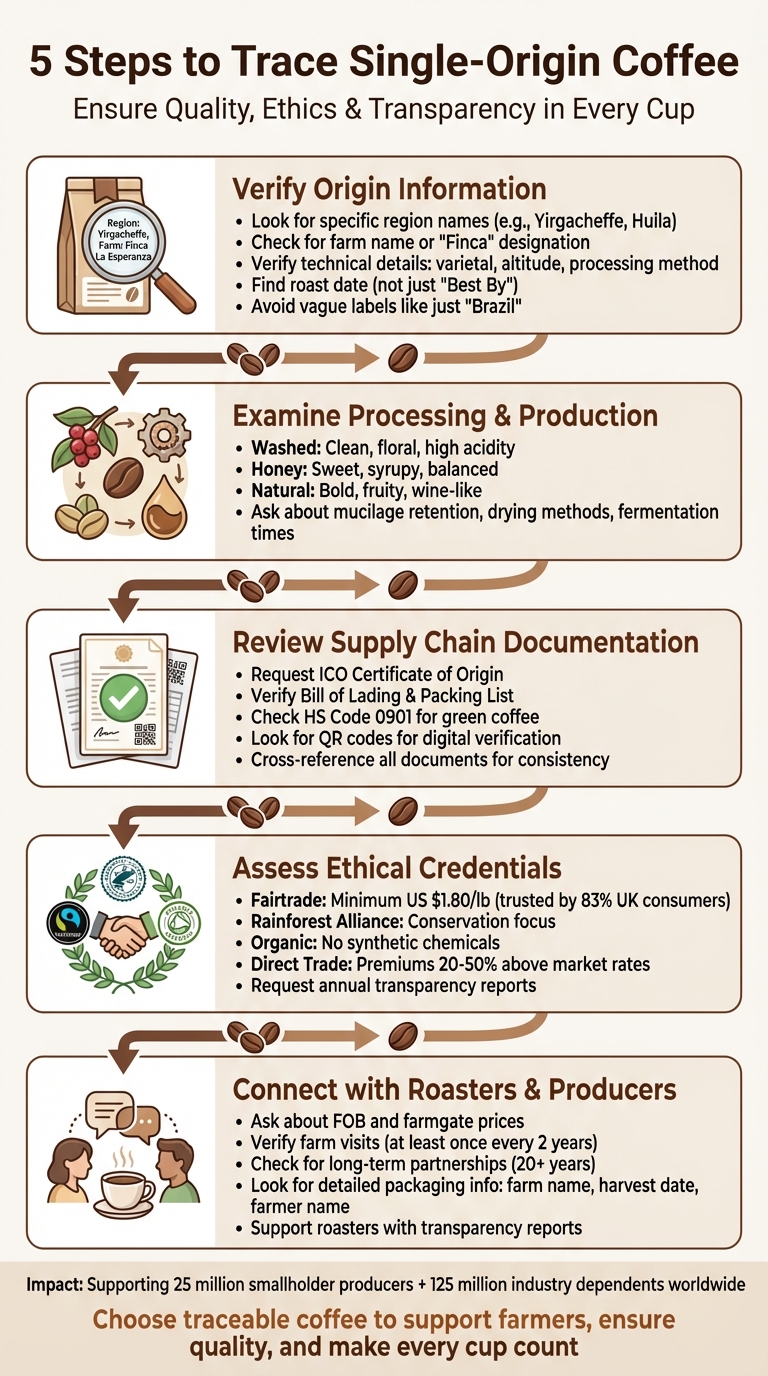
5 Steps to Trace Single-Origin Coffee from Farm to Cup
What is Single Origin Coffee?
sbb-itb-cca2aed
Step 1: Verify the Origin Information
When it comes to single-origin coffee, the first step is to scrutinise the label for specificity. The term "single-origin" isn't regulated and can mean anything from a broad designation like an entire country to a much smaller, more defined area like a single farm spanning just 20 acres. For instance, a label that simply states "Brazil" might represent a blend of beans from numerous farms spread across vast distances. The more detailed the label, the more credible the claim. This precision in labelling forms the foundation for further technical and ethical checks.
Look for packaging that goes beyond naming just the country. Trustworthy labels often specify the region, such as Yirgacheffe in Ethiopia or Huila in Colombia, and may even include the farm name. In Spanish-speaking coffee-producing areas, the word "Finca" followed by the estate name is commonly used. Some roasters take it a step further by listing the lead farmer, cooperative, or even the washing station where the coffee was processed.
Pay attention to technical details like the coffee varietal (e.g., Bourbon, Typica, or Geisha), the altitude at which it was grown, and the processing method (washed, natural, or honey). Additionally, a clear roast date, rather than a generic "Best By" label, indicates freshness and ties the coffee to a specific production cycle.
"Transparency, not geography, is what makes a coffee worth your money." – Ebru Coffee Co.
Beyond geographic details, official documentation such as the ICO Certificate of Origin can provide professional-level validation of a coffee's origin. Some roasters go a step further by releasing annual transparency reports that include farmgate prices and producer names. Checking for these documents not only confirms the origin but also highlights ethical sourcing practices. A roaster's website that includes detailed sourcing information - such as harvest year, altitude in metres, and Free on Board (FOB) price - is a strong indicator of genuine traceability.
Finally, flavour can offer subtle clues about origin. For example, African coffees often deliver bright, fruity notes, while beans from Central and South America tend to have chocolatey and nutty profiles.
Step 2: Examine Processing and Production Details
Once you’ve confirmed the coffee’s origin, it’s time to dive into how it’s processed. The journey from cherry to green bean is crucial, as the processing method - whether washed, natural, or honey - shapes the coffee’s flavour in profound ways. Each method involves distinct steps. For example, washed coffee undergoes depulping, fermentation in water for 12 to 72 hours to dissolve the sticky mucilage, and thorough washing before drying. This technique highlights bright acidity and floral notes. In contrast, natural processing leaves the whole cherry to dry intact for two to four weeks, allowing the beans to soak up sugars and develop bold, fruity flavours like blueberry or strawberry. Honey processing sits between these two: the skin is removed, but some mucilage remains during drying, resulting in a sweet, syrupy profile that balances clarity with body.
"Processing is one of the most influential factors in coffee flavour - right up there with variety, terroir, and roast. It affects everything from acidity and sweetness to body and clarity." – Ozone Coffee Roasters
For a deeper understanding, ask roasters for specific production details. For honey-processed coffee, inquire about the percentage of mucilage retained or its "colour" classification (White, Yellow, Red, or Black), as these factors influence sweetness levels. Find out if the coffee was dried on African raised beds, which provide better airflow and consistent drying, or on concrete patios, which are more traditional but risk uneven results. Fermentation methods are equally important - ask whether it was done "dry" (in air) or "wet" (submerged in water), and for how long. Additionally, look for mentions of optical sorting or density grading during the milling process, both indicators of higher-quality specialty coffee with fewer defects.
Key Processing Features and Flavour Profiles:
| Feature | Washed (Wet) | Honey (Pulped Natural) | Natural (Dry) |
|---|---|---|---|
| Mucilage | Completely removed | Partially retained | Fully retained |
| Flavour Profile | Clean, floral, high acidity | Sweet, syrupy, balanced | Bold, jammy, wine-like |
| Body | Light to Medium | Medium to Full | Heavy |
| Water Usage | High | Low to Moderate | Very Low |
Detailed examples bring these methods to life. At the Bwishaza Washing Station in Rwanda, cherries are floated to check for ripeness, depulped, then dry-fermented and shade-dried before being finished on raised beds until they reach 12% moisture. Meanwhile, at Costa Rica’s San Juanillo farm, a "Red Honey" Marsallesa varietal is hand-picked, floated, and fermented whole before depulping and drying on raised beds, followed by patio drying to enhance structure. These details - like fermentation times, drying techniques, and moisture targets - are essential for transparent sourcing. If a roaster can’t provide such specifics, it’s worth questioning their traceability and connection to their supply chain.
Step 3: Review Supply Chain Documentation
Now it’s time to dig into the paperwork that tracks your coffee’s journey from farm to cup. Documentation is the backbone of traceability - without it, claims about origin can’t be confirmed. These records create an audit trail that links every step, from the farm gate to the roastery door, connecting production details with ethical standards and paving the way for further transparency.
One of the most important documents in this process is the ICO Certificate of Origin (ICO COO). This certificate is essential for green coffee exports, recording weights, lot descriptions, exporter details, and shipment dates. To ensure everything checks out, cross-reference this certificate with other key documents. For example:
- Bill of Lading (B/L): Confirms container numbers and vessel details.
- Packing List: Matches specific bag marks and lot IDs to physical bags.
- Commercial Invoice: Lists prices and quantities.
This cross-checking process can uncover inconsistencies that might indicate problems like rebagging or fraud. For instance, if the ICO certificate describes the coffee as "Bali Kintamani Grade 1" but the packing list shows a different lot description, that’s a red flag worth investigating.
"The ICO Certificate of Origin (ICO COO) is the anchor document for green coffee exports... everything else should reconcile to it: weights, lot description, exporter identity, and shipment date." – Indonesia-coffee.com
Technology is also playing a big role in strengthening supply chain documentation. In December 2024, Technoserve and TraceX introduced a digital traceability system for 3,500 coffee farmers in India’s Araku Valley. Using blockchain technology, they captured real-time data at every step of the supply chain. QR codes on phytosanitary certificates now allow for independent verification - just scan the code to confirm the issue date, exporter, and commodity quantity. Some specialty roasters are even publishing annual transparency reports, detailing the prices they paid at different stages, such as Farmgate Prices (what the producer received) and FOB Prices (which include all costs up to the point of shipping). These reports highlight a commitment to fair practices and visibility across the supply chain.
If you’re buying single-origin coffee, don’t hesitate to ask roasters for documentation. Request drafts of the ICO COO and Bill of Lading, and check that HS Code 0901 (used for green coffee) appears consistently across all forms. The more detailed the paperwork - such as listing farmer names, harvest periods, and sub-village locations - the more confident you can be in the coffee’s traceability. At Creation Coffee, every batch comes with thorough documentation tracing its entire journey from farm to cup.
Let’s move on to the next step in your traceability assessment.
Step 4: Assess Sustainability and Ethical Credentials
Once you’ve reviewed the documentation, it’s time to dig deeper into the coffee’s ethical and environmental standards. This step helps distinguish genuinely responsible sourcing from empty marketing buzzwords. To guide your decision-making, several well-known certifications and verification processes are available.
Third-party certifications can provide a solid starting point. For instance, the Fairtrade mark - familiar to 93% of UK consumers and trusted by 83% - guarantees farmers receive at least US $1.80/lb (approximately £2.95/kg) along with a premium that supports community projects like schools and healthcare. The Rainforest Alliance certification, symbolised by its Green Frog logo, prioritises conservation and biodiversity, although only 30% of the coffee must meet its standards to display the logo. Meanwhile, Organic certification ensures coffee is grown without synthetic chemicals, requiring a three-year transition period before farmers can qualify for certification.
However, certifications may not tell the full story. In Ethiopia, for example, around 90% of coffee is grown organically by tradition, yet only about 20% is officially certified due to the high costs and red tape involved. This is where the Direct Trade model comes in. Many specialty roasters adopt this approach, paying premiums well above certification minimums through direct, long-term relationships with producers. Since "Direct Trade" lacks a legal definition, it’s worth contacting roasters directly to inquire about their FOB (Free on Board) and farmgate prices to ensure farmers are compensated above commodity market rates.
Transparency is key. Seek out roasters that release annual transparency reports. For example, in October 2025, Horsham Coffee Roaster updated its Transparency Report, revealing that over 50% of its roasting volume consisted of coffees with full traceability and financial transparency. The report covered 75% of their yearly production volume and highlighted partnerships like the Kianderi washing station in Kenya, managed by Jean Paul. By using fixed prices based on production costs rather than the unpredictable C market, they provided stable incomes for their partners. Similarly, Ozone Coffee achieved B Corp recertification in 2025, leveraging the framework to evaluate its 27+ long-term producer partnerships in regions such as Ethiopia and Bolivia.
To go further, contact your roaster directly. Ask for their Supplier Code of Conduct, which should outline their social and environmental standards, including labour rights and waste management policies. Request supply chain maps or facility disclosures to verify the origins of their materials. At Creation Coffee, for instance, ethical sourcing through direct trade is a priority, ensuring transparency at every stage. They even use digital tools, like QR codes, to provide real-time information on harvest dates and price breakdowns.
Step 5: Connect with Roasters and Producers
Form meaningful relationships with roasters and producers by engaging them directly about their sourcing practices. When reaching out, focus on specific questions about FOB prices (Free on Board), the frequency of farm visits, and detailed pricing structures. Ethical roasters typically visit their partner farms at least once every two years to maintain trust and ensure quality standards. Make sure to ask about the farmgate price - this is what farmers are paid directly - rather than just the retail price. These conversations help solidify the origin, processing, and ethical details you’ve explored in earlier steps.
Many roasters demonstrate transparency by publishing annual sourcing reports or obtaining certifications like B Corp. For example, sourcing reports from 2025 highlighted over 27 long-term producer partnerships, with some relationships lasting more than two decades in regions like Ethiopia and Bolivia.
Pay close attention to packaging details to cross-check the information you’ve already gathered. Avoid vague labels like "Colombian Coffee" and instead look for specifics such as the farm name, washing station, harvest date, or the lead farmer’s name. Companies like Creation Coffee exemplify this approach by practising direct trade, which ensures transparency at every step and allows you to trace your coffee back to its source with confidence.
These direct connections bring your traceability efforts full circle, preparing you for the final review in the next step.
Conclusion
Tracing single-origin coffee turns your daily cup into an ethical and transparent choice. By verifying its origin, processing methods, supply chain documentation, ethical practices, and direct relationships, you ensure your coffee contributes positively to the world.
The effects go far beyond just taste. Traceable coffee supports the livelihoods of 25 million smallholder producers and 125 million others who depend on the coffee industry. Choosing such coffee can secure farmers premiums of 20–50% above market rates, offering them the financial stability to invest in their communities and refine their craft. Transparency also drives quality: when farmers treat coffee as a premium product, they focus on careful picking and processing, which leads to superior flavours. Specialty coffee - graded at 80 points or higher on the Specialty Coffee Association scale - not only tastes better but also fetches higher prices. This connection between transparency, quality, and sustainability is undeniable.
"For the producer, a traceable coffee system offers the chance of fairer pay, but also the ability to be known in the markets they are serving." – Hermanos Coffee Roasters
To ensure your coffee tells an ethical story, look for labels that specify the farm, estate, or lead farmer. Support roasters who publish transparency reports and maintain long-term relationships with producers. By taking these steps, you can confirm the ethical journey of every cup, from farm to table.
FAQs
What is truly traceable single-origin coffee?
Traceable single-origin coffee means you can follow its journey all the way back to a specific farm or cooperative. This level of transparency ensures you know exactly where your coffee comes from and how it was produced. It’s about more than just taste - it's about ethical sourcing. By building direct relationships with producers, ensuring fair pricing, and prioritising responsible practices, this approach supports both farmers and the environment. Regular updates and clear documentation back up these claims, giving you confidence in both the quality and the ethics behind your cup of coffee.
What documents confirm a coffee’s origin and shipment?
Key paperwork includes the Certificate of Origin, typically issued by organisations like the Uganda Chamber of Commerce, which confirms the coffee's country of origin for customs purposes. Other essential documents include the UCDA Export Certificate, a Phytosanitary Certificate, and a Commercial Invoice. Together, they verify the coffee's origin, quality, pest-free status, and transaction details, ensuring clarity and adherence to regulations during shipping.
How can I check if a roaster’s “direct trade” is genuine?
To check if a roaster’s "direct trade" claim holds up, focus on transparency and traceability in how they source their coffee. True direct trade often involves direct communication with farmers, regular farm visits, and clear details about the coffee’s origins. Some trustworthy roasters even go a step further by publishing transparency reports. These reports can reveal if fair wages were paid and whether ethical practices were followed.
Since "direct trade" isn’t a regulated term, the best way to assess authenticity is by ensuring their actions align with their claims.