


Honey processing is a water-efficient coffee production method that combines elements of washed and natural techniques. Originating in Costa Rica after the 2008 earthquake, it’s now a key alternative to traditional methods, addressing water use and pollution concerns. This process leaves the sticky, sugar-rich mucilage on coffee beans during drying, creating unique flavour profiles like Yellow, Red, and Black Honey.
Key Points:
- Water Use: Cuts water consumption by up to 90% compared to washed methods.
- Flavour Profiles: Balances acidity with sweetness, offering diverse taste notes.
- Economic Impact: Fetches higher prices, supporting small-scale farmers.
- Environmental Benefits: Reduces wastewater pollution significantly.
This technique not only produces excellent coffee but also helps farmers in water-scarce regions. By focusing on precision during drying and fermentation, honey processing creates coffee that appeals to both eco-conscious consumers and speciality coffee enthusiasts.
Why Honey Processed Coffee is ACTUALLY Worth It
Experience these unique profiles yourself by exploring our range of fresh roasted coffee available for delivery.
sbb-itb-cca2aed
The Honey Processing Method Explained
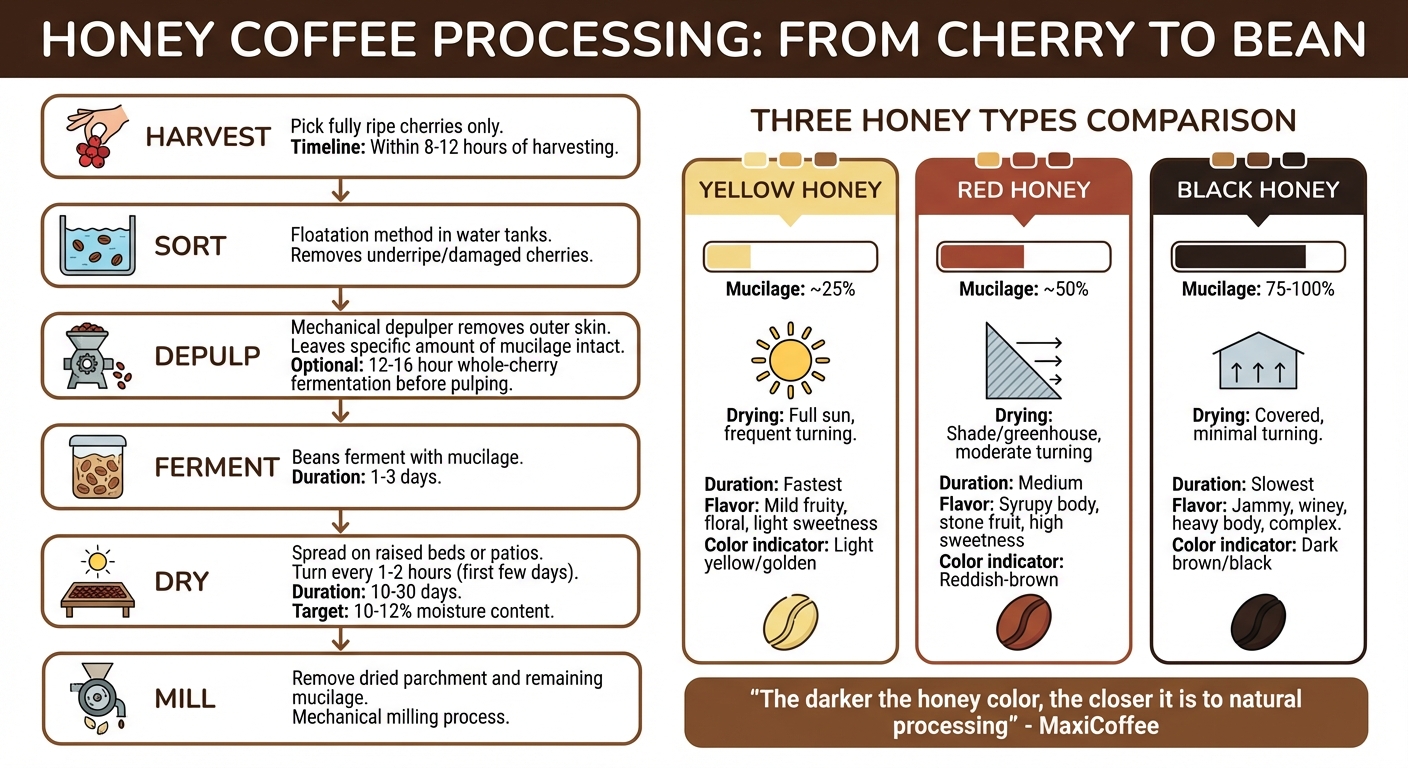
Honey Coffee Processing Step-by-Step Guide with Yellow, Red, and Black Honey Variations
Honey processing is all about precision and timing, from the moment cherries are picked to the final drying stages. The result? Coffee with a balance of environmentally conscious methods and a rich, layered flavour profile.
Step-by-Step Process
The journey begins with picking only fully ripe cherries. Within 8 to 12 hours of harvesting, the cherries are sorted using a floatation method in water tanks, which helps remove any underripe or damaged ones. This ensures that only the best cherries move forward in the process.
Next, a mechanical depulper strips away the outer skin while leaving a specific amount of the sugary mucilage intact. In some cases, producers add an extra step: a 12–16-hour whole-cherry fermentation before pulping to enhance flavour complexity.
After pulping, the beans undergo fermentation for 1–3 days. Then comes the drying phase, which demands careful attention. The beans are spread out on raised beds or patios to ensure even drying. During the first few days, they are turned every 1–2 hours to prevent clumping and unwanted flavours. This drying process can take anywhere from 10 to 30 days, depending on conditions, until the beans reach a moisture content of 10–12%. Finally, the dried parchment and any leftover mucilage are removed through mechanical milling.
For example, Costa Rica’s San Juanillo farm followed this process to create their 2022 Red Honey coffee from the Marsallesa varietal. After sorting, the cherries underwent a 12 to 16-hour whole-cherry fermentation, were pulped, and then dried on raised beds for two days before being transferred to patios.
The nuances in drying conditions and how much mucilage is left on the beans lead to the different types of Honey Processing.
Yellow, Red, and Black Honey Processing
The categories of yellow, red, and black honey aren’t about actual honey. As Tanya Nanetti from Barista Magazine explains:
The honey process has nothing to do with actual honey.
Instead, these terms refer to the amount of mucilage left on the beans and the degree of sugar oxidation during drying.
- Yellow Honey: About 25% of the mucilage is left on the beans, which are dried quickly in full sunlight with frequent turning. This results in coffee with mild fruity and floral notes and a light sweetness.
- Red Honey: Around 50% of the mucilage is retained, and the drying process is slower, often under shade or in a greenhouse with less frequent turning. The result is a syrupy coffee with a pronounced sweetness and rich fruit flavours.
- Black Honey: This method keeps 75–100% of the mucilage. Drying is slow, with minimal turning, and sometimes done under cover to extend fermentation. The result is a coffee with a jammy, wine-like complexity and a heavier body.
| Honey Type | Mucilage (%) | Drying Process | Flavour Profile |
|---|---|---|---|
| Yellow | ~25% | Full sun; frequent turns | Mild fruit, floral, light sweetness |
| Red | ~50% | Shade/greenhouse; moderate turning | Syrupy body, stone fruit, high sweetness |
| Black | 75–100% | Covered; minimal turning | Jammy, winey, heavy body, complex flavours |
Julie from MaxiCoffee highlights:
The darker the colour of the honey (black honey process), the closer it is to a natural process.
However, consistency across the industry remains tricky. Jamie Treby from DRWakefield points out:
The percentage of mucilage left intact, as well as fermentation and drying times, all vary, so what one producer creates as red might be another producer's yellow or black.
Environmental Benefits of Honey Processing
Honey processing isn't just about reduced water use - it also plays a role in preventing pollution. As a more eco-conscious alternative to traditional washed methods, it offers measurable benefits for both producers and the environment.
Water Conservation
Traditional washed coffee processing is water-intensive, requiring around 180 litres per cup. Honey processing, on the other hand, skips the fermentation tanks and extensive washing steps, cutting water usage significantly.
Dulce Barrera, Head of Quality Control at Bella Vista Coffee, highlights this advantage:
"Honey processing uses considerably less water because the washing stage is skipped and much of the mucilage is left intact. This is beneficial for farmers based in countries with drier climates and... is often considered more environmentally friendly than washed processing."
Here's how the water usage and environmental impact compare across methods:
| Processing Method | Water Requirement | Wastewater Production | Environmental Impact |
|---|---|---|---|
| Washed (Wet) | High (~180 litres/cup) | High volume of acidic effluent | High (requires treatment) |
| Honey (Semi-Washed) | Low to Moderate | Minimal to none | Low (eco-friendly alternative) |
| Natural (Dry) | Very Low / Zero | None | Lowest (most sustainable) |
This approach proved invaluable in 2008, when Costa Rican coffee farmers faced severe water restrictions following a major earthquake. By adopting honey processing techniques from Brazil and Africa, they maintained production quality without excessive water use.
Additionally, by reducing water consumption, honey processing prevents the creation of harmful wastewater, protecting surrounding ecosystems.
Eliminating Wastewater Pollution
Another major benefit of honey processing is the elimination of wastewater pollution, a common issue with traditional methods. Washed coffee processing produces untreated effluent rich in organic matter and nutrients, which can lower water pH and harm aquatic life.
Purity Coffee explains:
"If coffee effluent is discharged into nearby water bodies without proper treatment, it can lower the pH of the water, which can harm aquatic life and affect the overall ecosystem."
Honey processing avoids this entirely. The mucilage dries on the parchment and is later removed mechanically during milling, rather than being washed into local water systems . This turns what would have been liquid waste into a manageable solid byproduct .
Flavour Characteristics of Honey-Processed Coffee
Taste Notes and Texture
The honey-processing method gives coffee a flavour profile that stands out. It combines the bright acidity of washed coffees with the natural sweetness and rich body of naturally processed ones. Typical flavours include stone fruits like apricot and peach, alongside berries such as strawberry and blackberry. Subtle hints of honey, cane sugar, and molasses round out the experience.
Colin Dempsey, Owner of Cultura Spirit, notes, "Honey processed coffee completely changes the tasting profile."
What truly sets honey-processed coffee apart is its mouthfeel. The texture is silky and full-bodied - richer than what you’d find in washed coffees. Brandon Pena, Founder of 787 Coffee, explains:
"This sweetness you're tasting? It comes from the coffee cherry's natural sugars that stayed on the bean during processing... No added sugar needed – just pure coffee craftsmanship."
The acidity strikes a perfect balance. It’s brighter than natural coffees but softer than washed ones. Depending on how much mucilage remains on the bean during processing, the flavour profile can range from light and fruity to deep and jammy.
Appeal to Conscious Coffee Drinkers
Honey-processed coffee isn’t just about taste - it also resonates with those who care about sustainability. Its unique flavour attracts consumers who value both quality and mindful production practices. This coffee works beautifully across brewing methods: pour-over brings out its bright fruit notes, while espresso and cold brew highlight its natural sweetness.
Roasters often use honey-processed coffee to educate drinkers about the farm-level decisions that influence each cup. The process requires more labour and time, which often leads to higher prices, directly benefiting small-scale producers.
The method’s reduced water usage - up to 80% less than traditional washed processing - adds to its appeal. At Creation Coffee, we carefully select honey-processed beans to align with our commitment to ethical and sustainable sourcing. Every cup not only delivers a distinctive flavour but also supports responsible coffee production. This method’s reduced environmental impact and exceptional taste make it a forward-thinking choice in today’s coffee world.
Economic Impact on Coffee Farmers
The shift to honey-processed coffee brings not just flavour and environmental perks but also meaningful financial benefits for coffee farmers.
Higher Market Prices for Producers
Honey-processed coffee often fetches premium prices, combining the clean taste of washed methods with the natural sweetness of other processes. Take this example: in 2017, a honey-processed Geisha coffee reached around £66 per pound, and by July 2022, a 60 kg bag sold for over £27,000.
"Honey‐processed coffees typically garner a higher price. Understanding that coffee processing is a large part of the production line and how it has a large effect on how coffee tastes is massive!" – Michael Trevino, Coffee Producer
Farmers can also create unique microlots with this method. For instance, Jorge Raul Rivera, a three-time Cup of Excellence winner from El Salvador, transitioned from mostly washed coffee processing to 80% non-washed methods (including honey processing) to capitalise on higher market rates.
Advantages for Small-Scale Producers
Honey processing offers more than just higher prices - it’s also practical for small-scale farmers. This method requires less water than fully washed processing, cutting down on operational costs and removing the need for expensive wastewater treatment systems. This makes it a practical choice for farms that might not have the infrastructure for more resource-intensive methods.
Compared to natural processing, honey processing also delivers more consistent results with a lower risk of mould or over-fermentation. This reduces the financial risk of losing a harvest. While this approach demands more manual labour - like selective harvesting and regular turning - it provides a way for farmers to increase the value of their coffee without investing in costly wet-mill equipment. For small producers with limited resources, this balance of affordability and premium pricing opens up real opportunities in the specialty coffee market.
Challenges and Practical Guidance for Honey Processing
Common Difficulties in Honey Processing
Processing honey requires careful oversight, as it is highly sensitive to environmental factors. Weather plays a significant role: rain can lead to mould, while excessive heat risks destroying the delicate fruit flavours. Additionally, the sticky mucilage surrounding the beans can cause over-fermentation, rot, and even mycotoxin (Ochratoxin A) formation if not properly controlled.
Labour intensity is another major obstacle. Farmers need to make 6–7 selective harvest passes to ensure cherries are picked at their peak ripeness. Beyond this, honey processing demands more space on drying beds compared to washed coffee and requires specialised pulping equipment that can remove the cherries without damaging the beans. Brandon Pena from 787 Coffee highlights the learning curve:
A farmer attempting honey process for the first time might see a 15–20% loss due to spoilage. Our partner farms? Less than 5%.
Inconsistencies in processing methods also pose a challenge. Jamie Treby, Coffee Strategist at DRWakefield, explains:
The percentage of mucilage left intact, as well as fermentation and drying times, all vary, so what one producer creates as red might be another producer's yellow or black.
This lack of standardisation can confuse buyers and complicate efforts to position honey-processed coffee in the market. These issues highlight the importance of precision and consistency in processing techniques to achieve high-quality results.
Recommended Techniques for Quality Results
To address these challenges, specific practices can enhance the quality of honey-processed coffee. Timing is crucial - cherries should be mechanically stripped within 8 to 12 hours of harvesting to preserve their quality. Sorting cherries by size before pulping ensures consistent fermentation and drying across the batch.
Drying methods should align with the desired honey style. Yellow Honey benefits from quick drying in direct sunlight on tarp-covered patios, while Red and Black Honey develop better in greenhouses or shaded areas, where slower drying enhances complex fruit flavours. During the initial drying phase, frequent turning of the beans is essential to prevent over-fermentation.
Maintaining hygiene is equally important. Workers should wear sterilised boots, and equipment like delivery belts must be sanitised between lots to avoid contamination. The beans should be dried to a moisture content of 10% to 12%, a process that typically takes two to three weeks depending on environmental conditions.
Conclusion: Honey Processing and Coffee's Future
Honey processing blends environmental care with exceptional coffee quality. By cutting water use by 90% to 95% compared to traditional washed methods, it addresses a major ecological issue. Skipping the washing stage not only conserves water but also avoids releasing polluted wastewater, safeguarding local environments. At the same time, this process brings out the complex, sweet flavour notes that speciality coffee enthusiasts cherish.
The method's popularity has surged. In 2023, honey-processed coffee accounted for 34% of global speciality coffee purchases - a massive jump from just 8% in 2015, marking a 325% increase. This growth reflects a rising consumer interest in distinctive flavour profiles and a shift towards farming practices that can withstand water shortages, especially in drought-prone areas.
For farmers, this trend means more than just environmental benefits - it also brings financial rewards. Honey-processed coffee beans command a 20%–35% premium over standard coffee, providing small-scale farmers with better incomes and the means to invest in sustainable farming practices. A striking example of its value was seen at the 2022 Gesha Village auction, where a 60kg bag of Ethiopian honey-processed coffee fetched over £26,000.
To support this sustainable approach, consider purchasing honey-processed coffee from direct trade roasters like Creation Coffee. This ensures that the extra income goes directly to farmers who prioritise eco-friendly practices.
Honey processing, originally developed in Costa Rica in response to water shortages after the 2008 earthquake, showcases how challenges can inspire lasting change. With its environmental and economic advantages, this method is a beacon for the future of coffee production in the UK and beyond. It demonstrates how coffee farming can evolve to respect both the planet and the people who cultivate it, ensuring the industry thrives for generations to come.
FAQs
Is honey-processed coffee sweeter than washed coffee?
Honey-processed coffee stands out for its sweetness, which comes from retaining the mucilage during processing. This layer, left on the beans, boosts the coffee's natural sugary notes and contributes to a richer, more rounded body.
How can I tell if a coffee is yellow, red, or black honey?
The colour of honey-processed coffee varies based on the amount of mucilage left on the beans during processing. Yellow honey coffee retains about 50% of the mucilage, red honey keeps 80–90%, and black honey preserves nearly all of it. Among these, black honey demands the most precise drying process and is the most labour-intensive method.
Does honey processing increase the risk of mould or defects?
When honey processing isn't handled with care, it can lead to problems like mould growth or defects. The fruit material exposed during processing needs to be dried thoroughly to prevent contamination or unwanted flavours. This includes avoiding harmful substances like mycotoxins, such as ochratoxin A. Ensuring quality requires diligent labour and close attention during the drying process.