


Did you know a single cup of coffee takes up to 140 litres of water to produce? Most of this water is used during farming and processing, making coffee one of the most water-intensive crops globally. From inefficient irrigation to water-heavy processing methods, the industry faces serious challenges. But there’s hope. Farmers, processors, and consumers can all take steps to reduce water use and protect resources.
Here’s what you need to know:
- Water Usage in Coffee Farming: Growing coffee cherries uses about 2,500 litres of water per kilogram. Drip irrigation and rainwater harvesting can cut this drastically.
- Processing Methods: Wet processing consumes up to 200 litres per kilogram of coffee, while dry and honey methods use far less.
- Impact on Communities: Over-extraction and wastewater pollution harm ecosystems and local water supplies.
- Solutions: Efficient irrigation, rainwater collection, and closed-loop systems are changing the game. Consumers can help by choosing ethically sourced coffee and reducing water waste at home.
What Solutions Help Coffee Plantations With Water Scarcity? - Central America Uncovered
sbb-itb-cca2aed
Water Conservation in Coffee Farming
Tackling water scarcity in farming is a priority to protect ecosystems and support local communities. Coffee farmers are turning to innovative techniques that dramatically reduce water consumption while maintaining crop quality. Let’s take a closer look at how efficient irrigation and rainwater harvesting are making this possible.
Efficient Irrigation Techniques
Drip irrigation is a game changer. By delivering water and nutrients directly to plant roots at a slow, steady rate, it reduces evaporation, wind loss, and runoff. While traditional surface irrigation systems typically operate at 40–75% efficiency, drip irrigation can reach an impressive 80–95% efficiency.
For example, Kauai Coffee in Hawaii has installed over 2,500 miles (about 4,023 km) of drip tubing, cutting water use by 50% compared to sprinklers. Similarly, at Finca Rabanales in Guatemala, controlled irrigation on a 0.70-hectare plot doubled yields - from 6,802.50 kg to 13,605.00 kg of berry beans.
"Drip irrigation is really useful in saving water, fertilizer and protecting the environment."
– Juliana Armelin, Farmer, Fazenda Terra Alta
Modern systems take it a step further by incorporating moisture sensors and meteorological stations to ensure precise water application. At Ecoagrícola in Brazil’s Serra do Cabral region, farmers used hydric pressure technology and automatic measuring stations to pause irrigation for 90 days (from May to September) before harvest, all without compromising crop health.
Rainwater Harvesting and Water Retention
Rainwater harvesting is another effective strategy, reducing reliance on freshwater sources and providing a buffer during dry spells. When paired with techniques like shade trees, mulching, and cover crops, these methods can lower total water needs by up to 20%.
Shade-grown coffee, for instance, benefits from native tree canopies that shield plants from direct sunlight, reducing evaporation and preserving soil moisture. Windbreaks, such as Norfolk Pine hedgerows, further protect coffee trees by minimising wind-induced evaporation and preventing soil erosion. At the ground level, composting leftover coffee cherry pulp and using pruning mulch enriches the soil, boosting its ability to retain water.
Together, these approaches protect water resources and improve soil health, ensuring long-term productivity for coffee farms.
Water-Saving Coffee Processing Methods
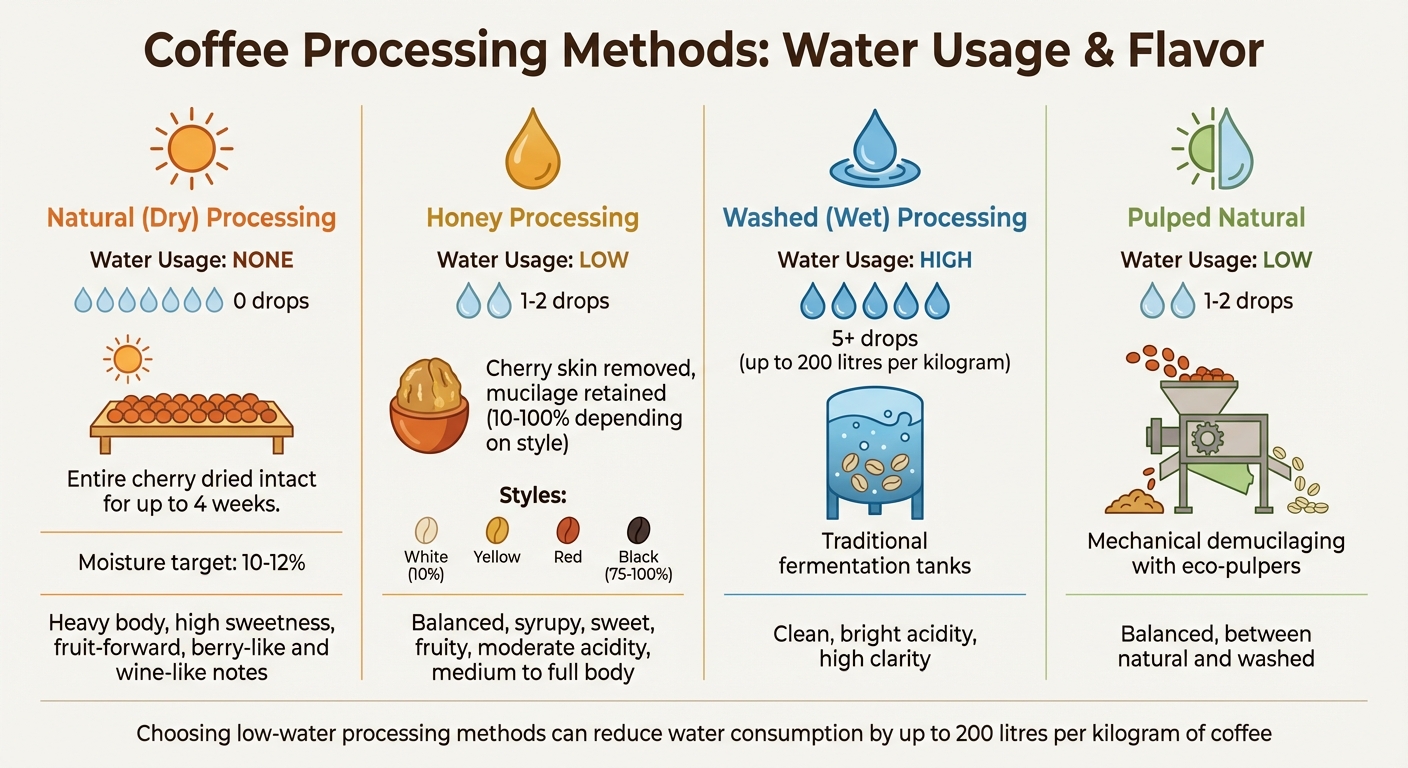
Coffee Processing Methods: Water Usage and Flavor Comparison
After water-efficient farming, the way coffee is processed also plays a big part in cutting water use. Once coffee cherries are harvested, the method used to prepare them for roasting can either conserve or consume significant amounts of water. Traditional wet processing is known for its high water demand, making it one of the more resource-intensive steps. However, there are now several methods that use far less water and are becoming increasingly popular in the coffee industry.
Low-Water Processing Methods
Natural (dry) processing is the most water-efficient option, requiring almost no water at all. In this method, the entire coffee cherry is dried intact - usually over a period of up to four weeks - until its moisture content drops to around 10–12%. After drying, the fruit is mechanically removed, leaving the coffee bean ready for roasting. This process produces a coffee with a bold, full-bodied flavour, often described as having berry-like and wine-like notes. However, it requires stable weather and careful attention to avoid spoilage during drying.
Honey processing (also known as pulped natural) strikes a balance between water conservation and flavour development. In this method, the cherry skin is removed, but varying amounts of sticky mucilage (the "honey") are left on the bean during drying. Depending on how much mucilage is retained, producers can create White, Yellow, Red, or Black honey styles, with Black Honey retaining 75–100% of the mucilage and White Honey around 10%. This technique uses far less water than fully washed processing and results in a coffee with a sweet, fruity flavour and a medium to full body.
Mechanical demucilaging offers another water-saving option. Using machines like eco-pulpers, this method removes mucilage from the beans through mechanical force rather than traditional fermentation tanks. This approach, widely adopted in Brazil for large-scale production, drastically cuts water use and shortens processing times by skipping the fermentation stage altogether.
For producers still using water-based methods, closed-loop systems provide a way to reduce waste and conserve resources.
Closed-Loop and Water Reuse Systems
Closed-loop systems are an effective way to reduce water waste during processing. Instead of discarding "honey water" - the acidic wastewater generated during washing and pulping - these systems collect, filter, and reuse it in the same cycle. This not only cuts down on the need for fresh water but also prevents untreated wastewater from harming nearby aquatic ecosystems. For any water-based processing, it’s essential to treat honey water to neutralise its acidity and organic content before releasing it. This step protects both the environment and local communities.
| Processing Method | Water Usage | Flavour Profile |
|---|---|---|
| Natural (Dry) | None | Heavy body, high sweetness, fruit-forward |
| Honey | Low | Balanced, syrupy, moderate acidity |
| Washed (Wet) | High | Clean, bright acidity, high clarity |
| Pulped Natural | Low | Balanced, between natural and washed |
How Consumers Can Support Water Conservation
Every cup of coffee you enjoy has a ripple effect on water conservation, starting with the supply chain and extending to your own brewing habits. By making thoughtful choices - from the beans you buy to how you brew - you’re contributing to efforts that safeguard one of the planet's most essential resources. Let’s explore how you can make a difference both at the point of purchase and in your kitchen.
Choosing Ethically Sourced Coffee
The coffee you select plays a crucial role in supporting water conservation. Opting for beans from roasters who focus on direct trade and ethical sourcing empowers farmers to adopt water-saving technologies. For instance, eco-mills - funded by higher premiums from ethically sourced coffee - can reduce local water contamination by over 80%.
Certifications are a helpful guide when seeking coffee that prioritises water stewardship. Labels like Rainforest Alliance ensure waterways are protected from pollution, while USDA Organic eliminates harmful synthetic chemicals that could seep into local water supplies. Fair Trade provides financial support for community water projects, and the Water Wise Coffee Initiative specifically addresses water-efficient farming practices.
Processing methods also matter. Choosing beans processed with low-water techniques directly supports reduced water usage on farms. Additionally, shade-grown coffee helps naturally limit water loss, making it a more environmentally friendly option. Roasters like Creation Coffee exemplify this approach by maintaining direct trade relationships and encouraging sustainable practices at the farm level.
Reducing Water Waste When Brewing
Your brewing habits at home also impact water conservation. For starters, using a digital scale (£10–£30) to measure water precisely can prevent waste. Guessing often leads to using more water than necessary, while accurate measurements ensure you brew only what you need.
Different brewing methods require specific coffee-to-water ratios for the best flavour and efficiency. For example:
- French press: 1:15 ratio
- Pour-over (e.g., V60, Chemex): 1:16 ratio
- Drip machines: 1:15 ratio
Single-cup methods like the Aeropress are particularly effective for minimising waste, as they brew just one serving at a time. Additionally, manual brewing methods avoid the energy consumption of automatic machines, which can use up to 10,000 kWh annually in commercial settings.
Switching to reusable components is another way to reduce waste. Metal filters eliminate the need for paper ones, which can release harmful chemicals into the environment when discarded. Reusable espresso capsules are another excellent choice, allowing you to cut down on single-use pod waste while still enjoying your favourite ground coffee. When cleaning your brewing equipment, compost coffee grounds instead of rinsing them down the sink - this not only saves water but also enriches the soil. Using filtered water can also extend the life of your equipment by preventing limescale buildup, keeping it efficient for longer.
Even small adjustments can make a big difference. For example, in the UK, around 2.5 billion coffee cups are thrown away each year, but only 1 in 400 are recycled. By brewing at home with reusable tools and precise measurements, you’re reducing waste across the coffee lifecycle. These mindful choices close the loop on water conservation, ensuring that your cup of coffee supports sustainable practices from farm to table.
New Developments in Water Conservation
The coffee industry is under pressure to find new ways to conserve water as climate change threatens production. With projections indicating a 50% reduction in suitable coffee-growing land by 2050, farmers and scientists are turning to advanced breeding programmes and cutting-edge technologies to address these challenges.
Drought-Resistant Coffee Varieties
Breeders are now focused on creating coffee plants that can thrive with less water. In January 2026, research showed that grafting Robusta scions onto Arabica rootstocks (e.g. S.4595, Sln.5B) significantly improves water retention - maintaining 79.63% relative water content - and increases wax coating to 29.90 µg/cm², reducing moisture loss. Between 2020 and 2023, India's Central Coffee Research Institute found that the S.4595/C×R graft experienced only a 7.7% drop in photosynthesis under drought conditions, compared to non-grafted plants.
Alternative coffee species are also gaining attention. Coffea liberica and Excelsa (Coffea dewevrei) are emerging as strong contenders to traditional Arabica and Robusta varieties due to their ability to handle water variability. Arabica typically requires 1,200–2,200 mm of annual rainfall, while Robusta needs 2,000–3,000 mm. Liberica, on the other hand, is better suited to fluctuating water conditions. This shift is evident in India, where coffee acreage has transitioned from 72% Arabica in the 1950s to 48% Robusta today, largely due to climate-related challenges.
In February 2026, World Coffee Research, in collaboration with the Alliance of Bioversity International and CIAT, launched CafeClima, a free online tool that helps farmers choose the best coffee varieties for their region's projected 2050 climate. The platform combines data on 26 high-performing coffee varieties with advanced climate projections across 18 countries. Dr. Jennifer "Vern" Long, CEO of World Coffee Research, highlighted the importance of this initiative:
"If the industry invests in planting millions of trees today that cannot survive the climate of 2040, we haven't just lost capital - we've lost a crucial decade for coffee sector adaptation."
Efforts to develop resilient coffee varieties are also underway in Peru. In April 2025, World Coffee Research partnered with eight Peruvian organisations to establish 10 new seed lots of IPR107 and Parainema varieties across the Amazonas, Cajamarca, and San Martín regions. These varieties, known for high yields and resistance to leaf rust, aim to revitalise 1,000 hectares of coffee farms annually by 2028, producing four million genetically verified trees each year.
Beyond genetics, precision tools are transforming water management on coffee farms.
Precision Agriculture and Regenerative Practices
Precision agriculture is revolutionising water use with tools that target irrigation more effectively. Currently, farming accounts for nearly 70% of global freshwater consumption, and this demand is expected to rise by 41% by 2050 to meet growing food needs.
One example is the ConSenso project, which in March 2026 deployed 52 solar-powered "ResistiviTree" sensors at the Utengule Coffee Farm in Tanzania. These sensors, led by Massimo Battaglia, monitor soil moisture and plant signals, transmitting data via LoRaWAN technology to a centre in Florence. The findings revealed a strong link between surface humidity and plant health, enabling precise irrigation adjustments. Battaglia described the innovation as game-changing:
"The plant sensors function like heartbeat monitors for trees. They allow us to listen to the plants and respond to their needs rather than imposing solutions blindly."
These technological advancements work hand-in-hand with regenerative farming practices, which improve soil's ability to retain water and reduce erosion. Healthy soil, rich in microorganisms, acts as a sponge, enhancing its water-holding capacity. For instance, one teaspoon of healthy soil can contain up to six billion microorganisms, each contributing to better moisture absorption.
In January 2026, the Brazilian cooperative Expocacer dedicated 21,000 hectares in the Cerrado Mineiro region to regenerative coffee farming. This initiative aims to triple the supply of Regenagri-certified coffees to the UK market by 2025–2026. Similarly, Swedish roaster Löfbergs made its first purchase of Regenerative Organic Certified coffee from Nicaragua in early 2026, following research that showed these practices help mitigate climate stress and soil degradation.
Agroforestry systems also play a key role in conserving water. Coffee grown in shaded systems uses just 0.62 litres of water per day, compared to 1.43 litres in open sun systems - a 40% reduction in daily water needs. By combining shade trees with precision monitoring, farmers can conserve water while building resilience to climate changes.
Conclusion
Protecting water resources in coffee production requires teamwork from farmers, processors, and consumers alike. As Chandra Melo from The Coffee Lab highlights:
"Water consumption in coffee production is a critical issue that requires concerted efforts from both consumers and the coffee industry".
Each group can make a difference. Farmers can use techniques like drip irrigation and shade-grown methods to minimise evaporation and maintain soil moisture. Processors can move away from water-heavy wet processing and adopt dry or closed-loop systems. Consumers can play their part by supporting coffees certified by organisations such as Rainforest Alliance, Fair Trade, or the Water Wise Coffee Initiative. Together, these steps reduce water waste and promote healthier communities.
Every stage of the supply chain offers opportunities for ethical choices, from the irrigation methods used by farmers to the coffee brands consumers purchase. Supporting businesses that prioritise water-saving technologies and transparency not only enhances your coffee experience but also helps ensure clean water remains accessible for coffee-growing regions. Whether it's a farmer practising rainwater harvesting, a processor adopting eco-pulping, or a consumer choosing an ethical brand, these actions collectively build a more water-conscious coffee industry.
FAQs
Why does coffee use so much water in the first place?
Coffee is a thirsty crop, demanding a significant amount of water throughout its journey from farm to cup. In fact, it takes about 140 litres of water to produce just one cup of coffee. Most of this water is consumed during cultivation, with irrigation being a major contributor. Additional water is used in processes like washing and cleaning the beans, as well as during brewing.
This reliance on water becomes even more challenging in regions with scarce rainfall. However, there are ways to address this issue. Approaches like rainwater harvesting and growing coffee under shade can help cut down water usage and lessen the strain on natural resources. These methods not only conserve water but also aim to reduce the broader environmental impact of coffee production.
Which processing method saves the most water without ruining flavour?
The natural (dry) processing method is a great way to conserve water while preserving the coffee's flavour. It involves drying the entire coffee cherry, which uses very little water compared to other methods. However, it demands close attention throughout the process to ensure the quality remains intact. When managed correctly, this approach is both efficient and environmentally friendly.
How can I tell if a coffee brand is genuinely water-conscious?
When choosing coffee brands, focus on those that openly share details about their farming and processing methods. Look for practices such as shade-grown or agroforestry coffee, which support eco-friendly farming, along with water-saving processing techniques and proper wastewater management. Certifications, sustainability reports, or clear messaging about water conservation can help verify their dedication to these efforts. Brands embracing these approaches often show a sincere effort to minimise their water usage.