


Ethical sourcing ensures coffee farmers earn fair, stable incomes by addressing issues like market volatility and middlemen exploitation. This approach focuses on:
- Fair Pricing: Farmers are paid above-market rates to cover production costs and improve their livelihoods.
- Prompt Payments: Immediate payment helps farmers manage cash flow and avoid debt.
- Long-Term Contracts: Predictable income allows farmers to plan and invest in their farms.
These practices reduce income instability, promote better farming techniques, and enable farmers to support their families and communities. Ethical sourcing benefits the entire coffee supply chain by creating stronger partnerships and more reliable production systems.
How Fairtrade Is Supporting Coffee Farmers for a More Sustainable Future
sbb-itb-cca2aed
How Ethical Sourcing Creates Income Stability
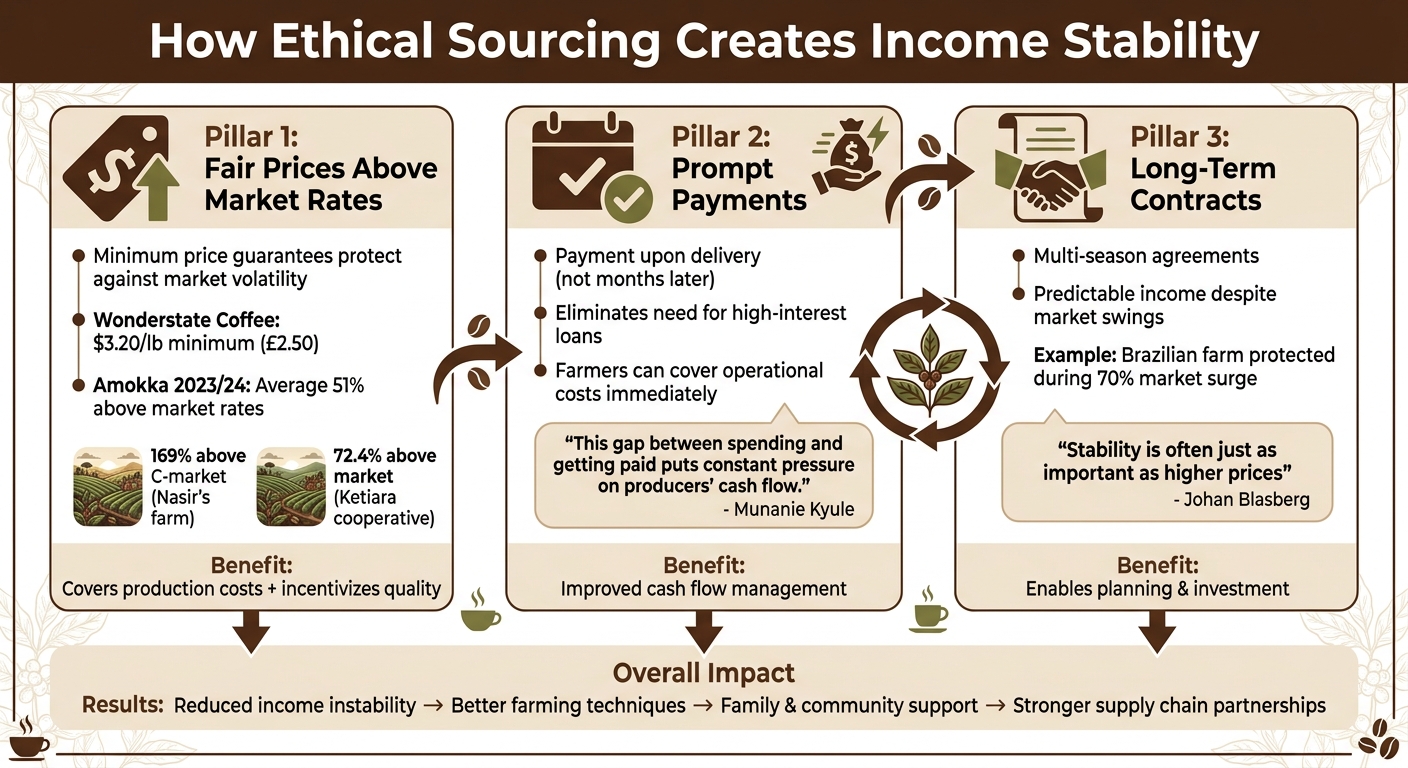
Three Pillars of Ethical Coffee Sourcing for Stable Farmer Incomes
Ethical sourcing provides a way out of the unstable "boom-and-bust" cycle that often dominates traditional coffee trade. By moving away from tying farmers' incomes to unpredictable commodity markets, it introduces three key practices that ensure more stable financial conditions: fair pricing above market rates, prompt payments, and long-term contracts. Together, these strategies help farmers build a more secure and sustainable livelihood.
Fair Prices Above Market Rates
One of the cornerstones of ethical sourcing is securing prices that exceed the volatile rates of commodity markets. These markets often fail to cover the actual costs of producing coffee, leaving farmers struggling to manage basic expenses like labour, fertilisers, and equipment. When prices drop below production costs, farmers can't invest in their farms - or even provide for their families.
Minimum price guarantees offer a safety net against these fluctuations. For instance, in January 2026, Wonderstate Coffee raised its minimum price to $3.20 per pound (about £2.50), giving farmers like Mario Villano in Peru and Sergio Caro in Colombia the ability to manage debts and invest in climate-resilient farming practices, regardless of market downturns. Similarly, during the 2023/24 season, Amokka paid an average of 51% above market rates. In some cases, such as a lot from Nasir's farm, they paid 169% above the C-market price, while coffee from Indonesia's Ketiara cooperative earned 72.4% above market rates.
These premiums not only cover production costs but also act as incentives for quality. Direct trade models reward farmers for producing higher-quality beans, encouraging them to invest in better equipment and processing techniques. This, in turn, supports climate resilience by enabling farmers to implement practices that reduce the risk of crop failures and ensure more consistent yields over time.
Prompt Payments and Cash Flow Management
Fair pricing is only part of the equation - timely payments are just as crucial. In traditional coffee sourcing, payments can be delayed for months, often until after export and quality checks. This delay forces farmers to take on high-interest loans to cover immediate expenses, creating a cycle of financial strain.
Immediate payment upon delivery offers a practical solution. During the 2023/24 season, Amokka's sourcing lead, Johan Blasberg, introduced a system at Nasir's farm where smallholders and neighbours were paid as soon as they delivered their coffee. This approach allowed farmers to cover operational costs without resorting to borrowing, giving them the financial breathing room to plan beyond just the next harvest.
"This gap between spending and getting paid puts constant pressure on producers' cash flow." - Munanie Kyule, Solai Coffee
By shortening payment timelines, farmers gain the ability to invest in their families and farms at the most critical time - immediately after harvest - when funds are needed the most.
Long-Term Contracts and Income Predictability
The third pillar of income stability comes from long-term contracts. These agreements provide farmers with a buffer against market swings by securing predictable prices over multiple seasons. For example, during the 2023/24 season, Amokka negotiated a structured pricing agreement with a Brazilian farm owner. This deal ensured that the farm received above-market prices during low-rate periods, while the buyer benefited from competitive rates even when the market surged by 70%. Such arrangements protect both parties from extreme price fluctuations.
"Stability is often just as important as higher prices... It is not just about paying more, but about ensuring reliability." - Johan Blasberg, Green Coffee Buyer and Sourcing Lead, Amokka
Predictable income allows farmers to plan for the future - whether it's investing in equipment, hiring workers, or covering essential expenses like healthcare and education. Without the fear of income swings, these vital investments become possible, creating a more secure foundation for both their businesses and their families.
Research Findings on Ethical Sourcing and Farmer Incomes
Productivity Gains and Certification Benefits
Ethiopian farmers involved in Voluntary Sustainability Standards (VSS) programmes, such as dual Fairtrade and Organic certifications, often see their yields improve thanks to training, technical support, and better farming techniques.
Although certified smallholders in Ethiopia enjoy higher productivity, better prices, and additional dividends from coffee sales, these benefits come with increased production costs tied to compliance. A significant issue remains with the distribution of quality premiums. In Ethiopia, less than one-third of export-quality premiums actually reach the producers. This means that, even under the best circumstances, an average coffee farmer's income might only increase by about $22 USD (around £17) annually.
These challenges highlight the importance of premium payments and direct trade relationships in providing farmers with more stable incomes.
Premium Payments and Direct Trade Impact
Beyond improving productivity, premium payments and direct trade relationships help stabilise incomes for farmers. A long-term study from 2012 to 2022 revealed that Fairtrade farmers built greater economic resilience and achieved higher savings compared to those without certification. For example, members of the Fairtrade-certified La Florida cooperative in Peru reported earning incomes 50% higher than their non-Fairtrade counterparts.
"In times of crisis, it becomes evident that Fairtrade enhances farmers' economic resilience and supports them in continuing their profession."
– Tatjana Mauthofer, Researcher, Mainlevel Consulting
Research from Costa Rica (1999–2014) further illustrates that Fair Trade certification leads to higher prices, greater sales volumes, and increased revenues - especially when global coffee prices dip below the minimum price floor. Certification also acts as a safety net, reducing the likelihood of business closures, such as the shutdown of coffee mills during tough economic periods. However, while farm owners benefit from these measures, studies indicate that the welfare of unskilled workers, who are often the most vulnerable in the supply chain, shows no noticeable improvement.
Examples of Ethical Sourcing in Practice
Direct Trade Partnerships
Stumptown Coffee Roasters provides a great example of how direct trade partnerships can benefit coffee farmers. In late 2018, after receiving feedback from the El Jordan producer group in Tolima, Colombia, they increased premium payouts from two to three per harvest. By February 2020, an impressive 89% of Stumptown's green coffee was sourced through direct trade partnerships that had been in place for at least three years.
Horsham Coffee Roaster has also embraced this approach, maintaining a direct relationship with the Bwishaza washing station in Rwanda since 2015. This station supports 500 farmers, and by March 2026, Horsham Coffee Roaster achieved 70% transparency across its supply chain, including direct partnerships in Kenya and Costa Rica. By using fixed prices based on production costs, they protect farmers from the risks associated with fluctuating market prices.
Creation Coffee adopts a similar strategy by working directly with farmers to ensure they receive fair compensation. By cutting out unnecessary intermediaries, they ensure a larger share of the profits goes directly to the farmers.
These direct trade models don’t just secure fair pay - they also help establish a foundation for broader community support programmes.
Community Support and Charitable Giving
Ethical sourcing isn’t just about fair pricing; many coffee roasters go a step further by investing in community development initiatives. These programmes address challenges often faced in coffee-growing regions, such as limited access to basic services like healthcare.
For example, Creation Coffee donates 10% of its profits to a children's charity. This approach highlights how ethical sourcing can make a difference not only at the farm level, by guaranteeing fair pay, but also within the wider community through charitable efforts.
Long-Term Benefits for Farmers and Supply Chains
Ethical sourcing doesn't just stabilise incomes - it also strengthens market resilience and fortifies supply chains over time.
Market Resilience and Risk Reduction
One of the key advantages of ethical sourcing is how it redistributes risk across the coffee supply chain. In traditional commodity markets, producers often shoulder the burden of price volatility, forced to accept fluctuating global rates that rarely cover their production costs. When prices plummet, there’s usually no safety net to fall back on.
Models like direct trade and certification aim to change this dynamic. They create long-term purchase agreements and use transparent pricing structures based on actual production costs. This approach spreads market risks more equitably between producers and buyers. For instance, in August 2023, Fairtrade International raised the minimum price for washed Arabica coffee to £1.45 per pound (around $1.80) - a 29% increase. This adjustment provided a critical buffer for farmers during uncertain market conditions.
Such stability benefits the entire supply chain. Consider this: while nearly 62% of specialty coffee shops in mature markets close within five years, those with reliable, ethically-sourced supply chains are better equipped to navigate economic challenges. By sharing risks, these partnerships lay the groundwork for sustained growth and community development.
Farm Investment and Economic Growth
Ethical sourcing also empowers farmers to reinvest in their farms. With stable and predictable incomes, they can afford improvements that would otherwise remain out of reach - like better fertilisers, advanced processing tools, and skilled labour.
Take Ethiopia, for example. Research using Propensity Score Matching revealed that farmers with both Fairtrade and Organic certifications saw notable increases in coffee yields, prices, and dividends, even when factoring in higher production costs. In Uganda, Sucafina’s 2025 programme provided loans to 200 farmers for "stumping" - a tree rejuvenation practice - which boosted yields by 100% to 200% within three years. Similarly, applying lime to address acidic soil improved productivity by nearly 50% in affected regions.
Additionally, ethical sourcing networks are helping farmers access capital. Between 2021 and 2024, participation in Village Savings and Loan Associations (VSLAs) grew by 160%, with annual savings among farmers doubling during this period. These savings enable investments that traditional banking systems might overlook, driving continuous farm improvements and supporting broader economic development.
Conclusion
Ethical sourcing offers lasting advantages for coffee farmers. By replacing unpredictable market swings with transparent, cost-based pricing, farmers gain the stability needed to invest in their land, families, and communities. When pricing reflects actual production costs and long-term contracts replace short-term uncertainty, the foundation is laid for meaningful growth and security.
This approach not only ensures steady cash flow but also spreads risks more evenly across the supply chain. When risks are shared fairly, the entire supply chain becomes stronger and more resilient.
"Farm-direct sourcing steps in where there are problems with pricing and bargaining power. It treats price as something to be negotiated based on real production costs"
By addressing these inequities, farm-direct sourcing fosters trust, reduces exploitation, and builds partnerships that benefit everyone involved.
The impact of these ethical practices goes far beyond individual farms. They strengthen entire communities and create a healthier supply chain. Consumers also play a role by supporting businesses like Creation Coffee, which ensures a larger share of the purchase price reaches farmers and funds community initiatives. Through direct trade relationships, more of your money goes directly to the people growing your coffee, rather than being lost to intermediaries. Plus, with 10% of profits donated to children's charities, every purchase contributes to both farming communities and broader social causes.
As consumers, roasters, and supply chain partners, our choices directly influence farmers' livelihoods. Opting for transparency, fairness, and long-term commitments over convenience and low costs can help create a coffee industry that supports everyone involved. Together, these practices pave the way for a thriving coffee industry that uplifts farmers and brings quality coffee to your cup.
FAQs
What is ethical sourcing in coffee?
Ethical sourcing in coffee revolves around building direct partnerships with farmers, prioritising transparency, quality, and long-term relationships. This approach often incorporates certifications such as Fairtrade, which guarantee minimum prices and provide social premiums aimed at improving farmers' incomes. These efforts contribute to greater stability and support for coffee-growing communities, fostering better livelihoods and sustainable practices.
How do long-term contracts protect farmers?
Long-term contracts provide farmers with a safety net by guaranteeing stable incomes. This financial predictability allows them to confidently invest in enhancing coffee quality and adopting sustainable farming methods. Additionally, these agreements shield farmers from the unpredictability of market price swings, offering greater financial security and supporting their long-term development.
How can I tell if my coffee really supports farmers?
To ensure your coffee supports farmers, pay attention to how it’s sourced. Look for brands that prioritise transparency in their practices. Coffee that’s ethically sourced often involves direct trade partnerships, which help ensure farmers receive fair pay for their work.
Certifications such as Fairtrade are another good indicator. These programmes guarantee minimum prices for coffee and often provide additional support for farming communities.
When choosing your coffee, take the time to check for clear sourcing methods, recognised certifications, and evidence of direct relationships with farmers. Your choice can make a real difference in helping farmers achieve fair and reliable incomes.