


Your coffee choices can make a difference. Many farmers in developing countries struggle with unfair pay and harmful practices in the coffee industry. Christian values like fairness, stewardship, and care for the vulnerable provide a framework for ethical sourcing.
Key points:
- Coffee farmers often earn less than production costs due to fluctuating market prices.
- Ethical sourcing inspired by Christian principles ensures farmers earn 20–40% more.
- Direct trade cuts out middlemen, giving farmers a fairer share of profits.
- Practices rooted in faith promote fair wages, environmental care, and community support.
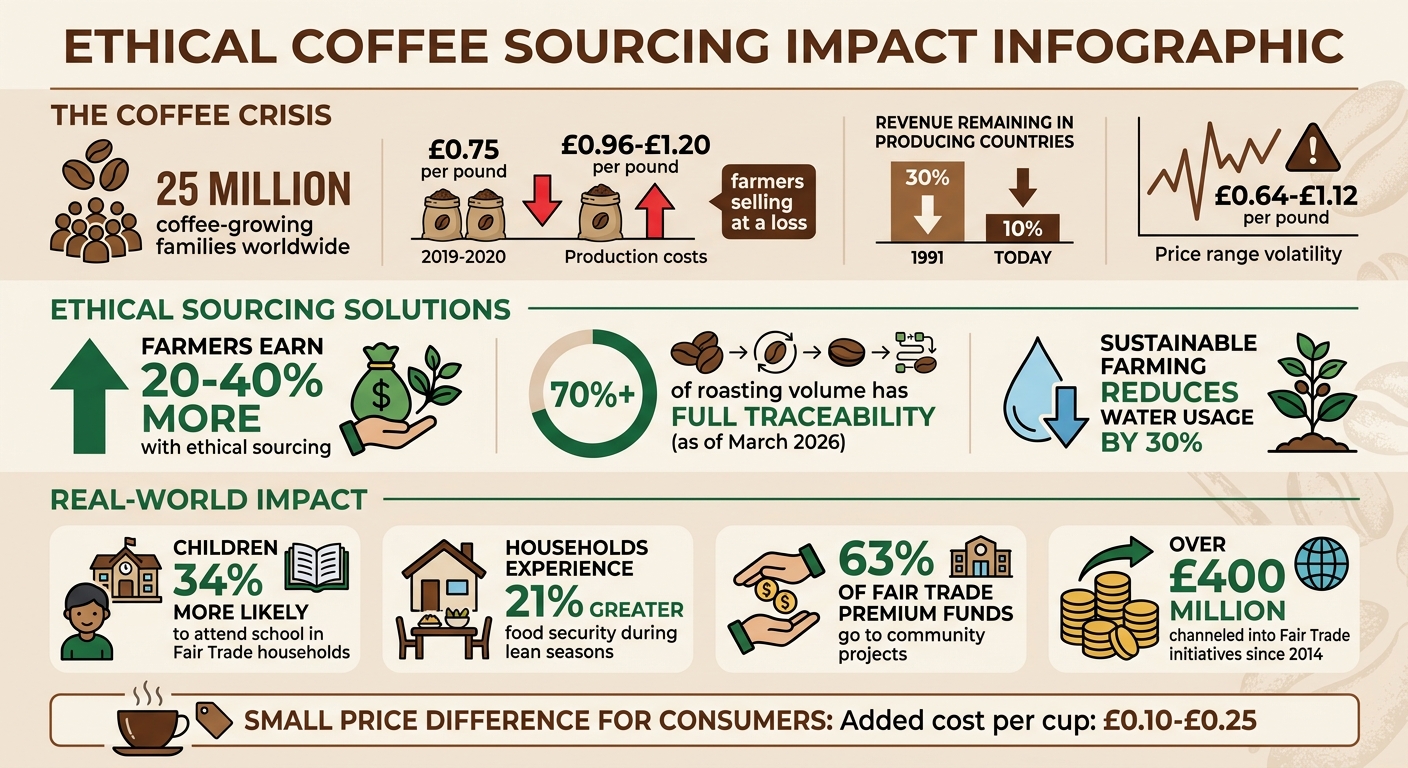
Impact of Ethical Coffee Sourcing: Key Statistics on Farmer Income, Education, and Community Benefits
Problems in Modern Coffee Sourcing
The coffee industry faces serious ethical challenges due to a broken trading system. Most coffee transactions happen on the New York Stock Exchange's C-market, where prices are dictated by stock traders and global supply shifts rather than the actual cost of production. This setup leaves smallholder farmers - who represent the majority of the 25 million coffee-growing families worldwide - with no bargaining power. As a result, these farmers face significant struggles, with their livelihoods often at risk.
During 2019–2020, coffee prices fell to around £0.75 per pound, while the cost of production ranged between £0.96 and £1.20 per pound. This meant many farmers were selling their coffee at a loss. To make matters worse, the portion of revenue remaining in coffee-producing countries has dropped dramatically - from 30% in 1991 to just 10% today.
Low Farmer Compensation
The commodity market treats coffee as just another tradeable good, ignoring the human effort behind its production. Prices vary wildly - recently between £0.64 and £1.12 per pound - and have no connection to the actual costs of sustainable farming. Over the past two centuries, inflation-adjusted coffee prices have fallen by an average of 0.9% annually. This decline reflects what economists call "Dependency Theory", a system that perpetuates poverty among producers in the Global South while concentrating wealth among roasters and traders in the Global North.
Labour Exploitation and Child Labour
When farmers can't cover their costs, the effects ripple through their communities. Families often have no choice but to pull children out of school to help on the farm. The lack of transparency in conventional supply chains makes it nearly impossible to trace the origins of coffee or ensure ethical working conditions. This opacity allows exploitation to go unchecked.
Environmental Damage in Coffee Production
Financial hardship pushes farmers towards environmentally harmful practices. Many resort to clearing forests for sun-grown monocultures, which exhaust soil nutrients and rely heavily on chemical inputs. These methods can also contaminate water sources with pesticide runoff. The environmental impact of coffee farming is significant, yet sustainable practices - such as those promoted by certified programmes - can reduce water usage by up to 30% compared to conventional methods. Unfortunately, without fair compensation, farmers often lack the resources to adopt these more sustainable approaches. Addressing these issues requires a commitment to ethical sourcing that aligns with principles of fairness and responsibility.
sbb-itb-cca2aed
Christian Values as a Foundation for Ethical Sourcing
Christian-led businesses are tackling the unfair practices in modern coffee sourcing by turning to enduring biblical principles. For these companies, faith and ethical responsibility go hand in hand, shaping a way of doing business that prioritises care for creation and fairness over profit margins. By drawing on Christian values, they’re redefining what ethical coffee sourcing can look like.
Biblical Stewardship and Environmental Responsibility
Genesis 2:15 calls on humanity to "tend and keep" the earth, positioning people as caretakers of creation. This idea of stewardship encourages farming practices that safeguard soil health, conserve water, and preserve biodiversity. It’s a reminder that caring for the environment isn't just good business - it’s a moral responsibility that aligns with long-term ecological care.
Care for the Poor and Fair Trade Practices
Leviticus 19:13 emphasises fair and timely payment for workers, a principle that directly challenges systems where farmers are underpaid for their labour. Christian ethics place a high value on economic justice, urging businesses to ensure farmers earn living wages that reflect the true worth of their hard work.
We pay more for coffee than we have to. Could we source cheaper beans and increase our margins? Absolutely. But that would mean paying farmers less than a living wage, and we can't square that with loving our neighbours as ourselves.
Loving Neighbours Through Community Support
The biblical command from Matthew 22:39 to "love your neighbour as yourself" extends beyond fair wages. It inspires investments in community infrastructure like schools, healthcare, and clean water systems. This approach sees farmers not just as suppliers, but as neighbours and partners deserving dignity, respect, and meaningful support.
How Direct Trade Supports Ethical Coffee Sourcing
Direct trade takes a straightforward approach to coffee sourcing, cutting out middlemen and ensuring that farmers receive a larger share of the profits. This model is especially critical given the challenges faced by coffee farmers. For example, during 2019–2020, the C-market price for coffee fell to just £0.94 per pound, while production costs ranged between £1.20 and £1.50 per pound. This disparity drove many farmers into debt.
Removing Middlemen for Fair Compensation
In traditional coffee supply chains, payments are diluted through multiple intermediaries, leaving farmers with only a small portion of the retail price. Direct trade changes this dynamic by establishing price floors that exceed production costs. Farmers involved in direct trade typically earn 20–40% more compared to conventional market rates. This approach resonates with the principle of fair and timely payment, as outlined in Leviticus 19:13.
Building Long-Term Relationships with Farmers
Direct trade isn't just about fair pricing - it's about creating lasting partnerships with coffee growers. These relationships often span years, allowing roasters to provide pre-financing to farmers, which helps them access credit for development. Additionally, roasters can work closely with farmers to improve coffee quality by suggesting better processing or drying methods. When choosing a roaster, it’s worth considering those who can name specific farms or cooperatives they work with and explain the length of their partnerships. This focus on long-term collaboration is a cornerstone of ethical coffee sourcing and is evident in the practices of companies like Creation Coffee.
Creation Coffee's Direct Trade Approach
Creation Coffee serves as a strong example of how direct trade aligns with ethical and Christian values. The company sources its beans directly from farming communities while prioritising environmental care. Beyond fair trade, Creation Coffee donates 10% of its profits to Compassion - a charity that has been working for over 68 years to help vulnerable children escape poverty, particularly in coffee-growing regions. As Creation Coffee puts it:
Through every purchase, you're helping to brew lasting change
Their single-origin offerings, such as Colombia – Planadas (£11.00) and Guatemala Hamacas (£12.00), showcase their commitment to fair pricing while remaining accessible to consumers.
Community Impact Through Charity and Responsible Farming
Fair compensation and long-term partnerships with farmers don't just improve individual livelihoods - they can uplift entire communities.
Supporting Farmer Livelihoods and Combating Child Labour
A living wage does more than just cover basic needs - it can transform lives. When farmers are paid fairly, they’re less likely to face the economic pressures that lead to child labour. For example, in households certified by Fair Trade, children are 34% more likely to attend school. This demonstrates how fair wages open doors to education and brighter futures. Additionally, ethical sourcing practices often include a stable price floor, ensuring that farmers can cover production costs even during tough market conditions, protecting families from financial instability.
Charitable Giving as a Reflection of Faith
Ethical sourcing isn’t just about wages - it’s also a way to live out faith through meaningful community support. Many Christian coffee roasters see charitable giving as a tangible expression of their beliefs. Take Creation Coffee, for example. They donate 10% of their profits to Compassion, a charity dedicated to helping vulnerable children in coffee-growing regions. This aligns with the biblical principle found in Proverbs 14:31:
Whoever oppresses the poor shows contempt for their Maker, but whoever is kind to the needy honours God
. Other roasters share this mission. In 2015, Kingdom Coffee partnered with Toybox to donate £10,000, funding 240 outreach visits to high-risk areas in Guatemala City and providing weekly hot meals to 100 children. Beyond individual efforts, 63% of Fair Trade premium funds are allocated to community projects, such as building schools and improving healthcare services.
Encouraging Responsible Farming Practices
Responsible farming goes hand-in-hand with stewardship, a principle rooted in Genesis 2:15's call to "tend and keep" the earth. By prioritising practices that protect soil, conserve water, and support biodiversity, ethical sourcing ensures environmental and social benefits for future generations. For instance, certified sustainable farming methods have been shown to cut water usage by 30%.
Some roasters take these commitments further. Creation Coffee uses energy-efficient roasting equipment and 100% recyclable LDPE4 packaging. Others focus on community infrastructure: Ethical Addictions installed water pipes directly into 137 homes in Tanzania’s Mweka villages, while Kingdom Coffee funded cooking stoves for 20 families in Guatemala. These stoves not only reduce health risks from smoke but also help combat deforestation.
This combination of fair wages, charitable giving, and sustainable practices demonstrates how ethical sourcing can leave a lasting impact on communities and the environment.
Transparency and Accountability in Ethical Coffee Sourcing
Building on the discussion about community impact, transparency plays a critical role in reinforcing ethical and responsible coffee sourcing practices.
Without clear evidence, claims of ethical sourcing lack credibility. For businesses guided by Christian principles, transparency is more than just a best practice - it embodies honesty and faithful stewardship. When roasters openly share details about their coffee's origin, pricing, and production conditions, they align with biblical values of justice and accountability.
The Role of Transparency Reports
Clear documentation fosters trust. Traceability ensures that both roasters and consumers can verify the ethical production of coffee, confirming that farmers are fairly compensated. Ethical sourcing today involves sharing key details like the coffee's origin, cooperative, and processing method on every bag. By doing so, these reports eliminate the anonymity that often enables exploitation. Furthermore, they provide evidence that farmers are paid amounts exceeding standard market rates. Transparency also supports the recognition of third-party certifications and traceability systems as additional guarantees of ethical practices.
Certifications and Traceability in Coffee Sourcing
Third-party certifications play a vital role in verifying ethical and environmental standards. These independent checks align with Christian values of truth and integrity. For instance, Rainforest Alliance conducts regular farm inspections to ensure practices that protect biodiversity and promote environmental care. Similarly, Organic certification requires annual checks to confirm chemical-free farming and soil health. Direct Trade coffee, while not always certified, encourages consumers to seek specific details, such as the name of the farm or cooperative leader and the exact price paid to the producer.
As of March 2026, over 70% of total roasting volume comes with full traceability and financial transparency. Some roasters even disclose their "Free on Board" (FOB) pricing, which represents the amount paid to exporters at the origin port. Typically, farmers receive about 75% of this FOB price. This level of accountability delivers real results: farmers involved in ethical sourcing programmes earn 20–40% more household income, their children are 34% more likely to attend school, and households experience 21% greater food security during lean seasons.
Conclusion
Christian ethics, with their focus on transparency and accountability, provide a framework that turns coffee sourcing into a way to pursue justice.
Grounded in principles like stewardship, fairness, and care for others, Christian values reshape coffee from a mere commodity into a chance to make meaningful, ethical choices. By fostering direct relationships with farmers, supporting sustainable farming practices, and ensuring transparent pricing, coffee roasters reflect biblical teachings about protecting the earth and treating workers fairly.
Ethical coffee sourcing has measurable benefits: farmer incomes increase by 20–40%, school enrolment rises by 34%, and over £400 million has been channelled into Fair Trade initiatives since 2014. Behind these numbers are families with better food security, children gaining access to education, and communities working toward lasting improvements.
"Buying ethically sourced coffee is one tangible way to ensure your purchasing aligns with values of fairness, justice, and care for others. It's about faithfulness in everyday choices, not legalism."
- Nick Murphy, His Word Coffee
Companies like Creation Coffee allow consumers to align their purchases with their values through direct trade sourcing and by donating 10% of profits to children’s charities. The added cost - often just £0.10–£0.25 per cup - is a small price to pay for the chance to make a lasting difference in coffee-growing communities.
FAQs
How can I tell if a coffee is truly direct trade?
To determine if a coffee is genuinely direct trade, start by examining the origin details. Authentic direct trade coffee will clearly state where it comes from, often down to the specific farm or region. Check for transparent supply chain documentation that outlines how the coffee moves from the farm to your cup.
It's also important to see if the supplier maintains long-term, open relationships with farmers. These relationships should prioritise high-quality beans and ensure farmers receive fair compensation for their work. Lastly, look for signs of ethical practices, such as a commitment to sustainability and initiatives that positively impact farming communities.
What does “living wage” mean for coffee farmers?
A living wage for coffee farmers refers to the income required to support a decent quality of life. This means covering basic needs like food, housing, healthcare, and education, while also allowing for a small financial cushion to handle unexpected expenses. Unlike the usual minimum or market prices that farmers often receive, a living wage ensures they are fairly compensated for their labour.
How does my purchase support farmers’ communities?
Your purchase directly supports farming communities by ensuring they receive fairer prices, usually ranging from £2.60 to £5.60 per pound. This helps improve local infrastructure, enhances access to education, and strengthens economic stability, contributing to lasting positive changes in these communities.
Related Blog Posts
- What Is Ethical Coffee? What The Label Really Means
- Does Your Coffee Give Back? How to Tell the Brands That Mean It From the Ones That Don't
- How to Choose Ethical Coffee: A Simple Checklist
- How Direct Trade Supports Coffee Farmers
- Faith-Driven Coffee: Stories of Community Impact
- How Ethical Sourcing Creates Stable Farmer Incomes