


Direct trade can mean more money for farmers, clearer pricing, and steadier buying relationships. In standard coffee supply chains, a farmer may get as little as 1p from a £2.50 cup, while many smallholders still live below the poverty line. Direct trade tries to change that by cutting out some middlemen and agreeing prices more directly between roasters and producers.
If I boil the article down, the main points are simple:
- Many farmers are paid too little and face sharp price swings
- Commodity prices can sit below production costs, so some farmers sell at a loss
- Farmers often have little say in pricing
- Direct trade links price more closely to quality and cost
- Longer buyer relationships can help farmers plan across seasons
- Clearer sourcing helps UK buyers see where their money goes
- Direct trade is not legally defined, so roasters should explain what they mean by it
Here’s the short version: if a roaster can name the farm, explain the price paid, and show a repeat relationship, that usually points to a more direct buying model. That does not fix every problem in coffee, but it can give farmers a better deal than a long, opaque supply chain.
| Model | Pricing | Transparency | Farmer say | Quality link |
|---|---|---|---|---|
| Conventional trade | Tied to market swings | Low | Low | Low |
| Fairtrade | Floor price + premium | Medium | Shared through co-ops | Medium |
| Direct trade | Agreed more directly | High if disclosed clearly | Higher | Strong |
I see the article as a simple argument: when fewer hands take a cut, and farmers have a direct buyer relationship, more of the coffee price can stay closer to origin.
Part 2 of 5: Smallholder Coffee Farmers and Direct Trade - The Real Cost of “Direct” - Ana Donneys
sbb-itb-cca2aed
The problem: Why many coffee farmers struggle
That system weakens farmers' position before pricing is even set.
Low prices and price swings
Most coffee is priced against the global commodity market, where speculation and market swings often matter more than what it actually costs to grow the crop. Between 2017 and 2020, market prices often stayed below US$1.00 per pound, while the cost of producing washed Arabica in Latin America was usually US$1.20 to US$1.60 per pound. In plain terms, many farmers were selling coffee at a loss.
And the swings can be brutal. Arabica prices climbed 80% between November 2024 and February 2025, then fell 25% in early 2026. For a smallholder farmer trying to plan labour, buy equipment or make basic spending decisions, that kind of movement makes stable planning close to impossible.
But price is only one part of it.
Limited transparency and bargaining power
Smallholder farmers produce up to 80% of the world's coffee, yet buyers usually set the price, not the farmers themselves. Many sell to a local buyer or collector without a clear view of what their coffee could fetch on the open market.
"The established, traditional model only benefits the intermediaries. It is not profitable for producers. They are not aware of the market price of their coffee and instead they just get paid an unfair price which is often dictated by the commodities market." - Jorge Escobar, Owner, Hacienda Montealegre
If farmers can't see how pricing works or shape it in any way, planning beyond the next harvest becomes much harder.
Pressure on quality, farm practices and family income
Unstable income makes long-term spending tough. Replanting ageing trees costs money. So does shifting to regenerative farming. Many farmers simply don't have enough cash to do either.
The strain goes well beyond the farm itself. Around 80% of coffee farmers globally do not earn enough for a decent standard of living, including basics such as food, housing, healthcare and their children's education. Low and unstable income also hits women and younger generations hardest, which speeds up farm abandonment and puts future coffee supply at risk.
These are the pressures direct trade is meant to ease.
The solution: How direct trade works
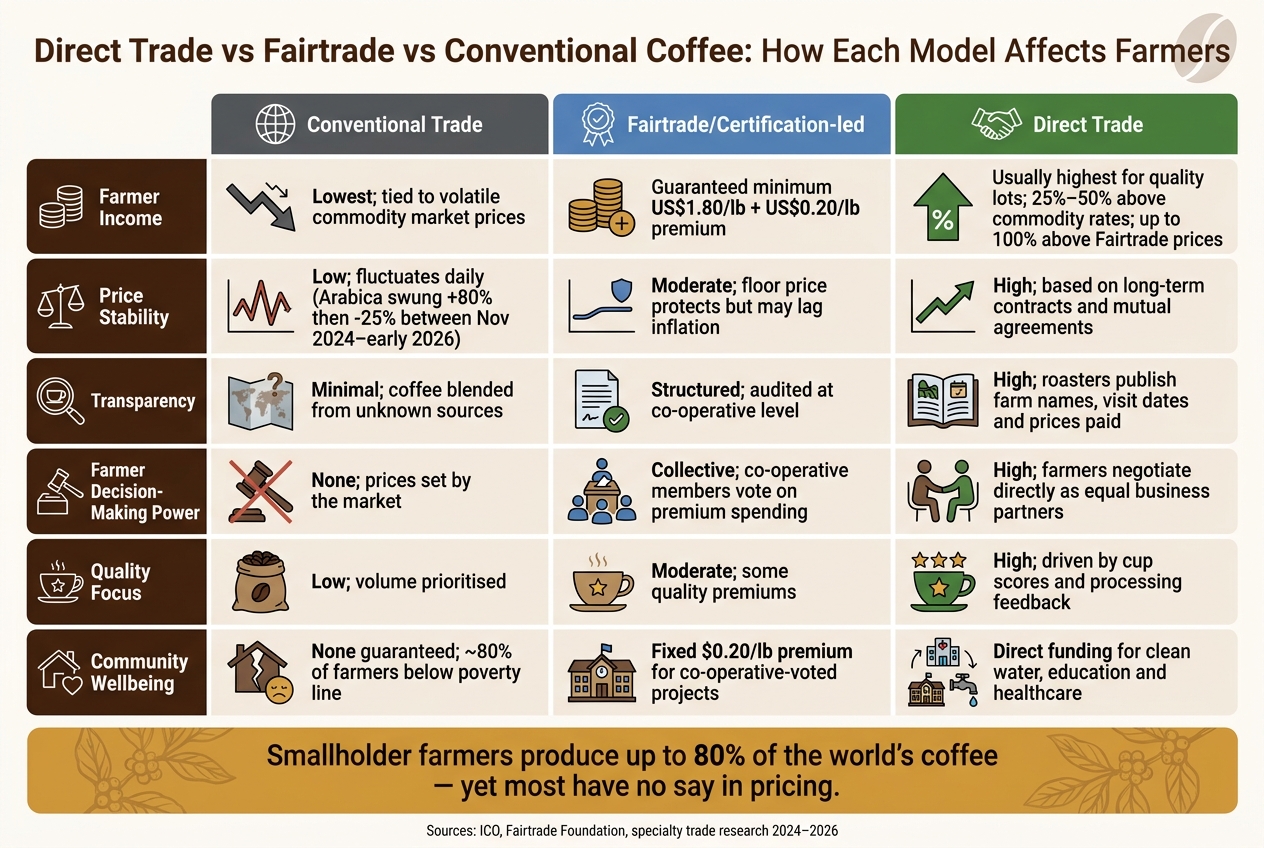
Direct Trade vs Fairtrade vs Conventional Coffee: Farmer Impact Compared
Direct trade responds to those pressures by giving farmers a direct voice in pricing and a buyer relationship they can actually plan around. It removes layers of middlemen, so more of the money goes straight to the people growing the coffee. At its core, direct trade rests on transparency, quality and long-term commitment. That said, the term has no legal definition or governing body, so roasters need to explain clearly what “direct” means in day-to-day practice.
Direct relationships and clear pricing
With direct trade, the roaster and producer agree prices directly. Those prices are based on harvest quality and the real cost of production, not just the commodity market.
Direct trade prices are often 25% to 50% above commodity rates. In some cases, they can be 15% to 100% higher than Fairtrade prices, depending on the quality of the lot.
That changes the conversation. Farmers can see how quality, processing and cup score shape the final price. Roasters, in turn, share feedback on cup scores and processing methods, which helps farmers fine-tune their approach and earn more for stronger lots. Over time, that can mean steadier income, better planning and more room to put money back into the farm.
Long-term partnerships over one-off buying
Price matters, of course. But repeat buying is what turns a decent sale into something a farmer can rely on.
One purchase on its own doesn't shift much. What makes the difference is a roaster returning season after season, with volumes and pricing discussed well in advance. That kind of repeat business gives farmers the confidence to spend on drying beds, training and better farm care.
Some direct trade buyers also help pay for origin infrastructure, including washing stations, drying beds and seedlings.
Comparison table: Conventional trade, certification-led models and direct trade
The differences stand out most clearly when you put the models next to each other.
| Feature | Conventional Trade | Certification-led (Fairtrade) | Direct Trade |
|---|---|---|---|
| Farmer income | Lowest; tied to volatile commodity market prices | Guaranteed minimum (US$1.80/lb) plus a US$0.20/lb premium | Usually highest for quality lots; negotiated based on quality and real production costs |
| Price stability | Low; fluctuates daily based on global stock market speculation | Moderate; protected by a floor price but may lag behind inflation | High; based on long-term contracts and mutual agreements |
| Transparency | Minimal; coffee is often blended from many unknown sources | Structured; audited by third parties but limited to co-operative level | High; roasters often publish specific farm names, visit dates and prices |
| Decision-making power | None; farmers accept prices set by the market | Collective; members of co-operatives vote on how to spend premiums | High; farmers negotiate directly with buyers as equal business partners |
| Quality focus | Low; volume is prioritised | Moderate; some quality premiums | High; driven by quality feedback and cup scores |
How direct trade supports farmers in practice
In day-to-day terms, direct trade turns fairer pricing into something farmers can actually rely on.
Higher and more stable income
Direct trade helps farmers with cash flow because payment is tied more closely to quality and the cost of production. Commodity prices have been highly volatile, which makes planning hard. Direct contracts can soften that risk.
Multi-year contracts matter here. They give farmers space to budget, invest and pre-finance harvests. That kind of steadier income is where direct trade starts to make a difference on the ground.
Better quality, stronger farms and fairer livelihoods
Once income is steadier, farmers are in a better position to improve quality and put money back into the farm.
Direct trade also gives farmers feedback they can use. When a roaster shares specific notes on flavour profiles and processing, farmers can see which changes may lift their lots higher. That can lead to better harvesting, more careful sorting and more refined fermentation techniques, often reaching speciality grade.
Some roasters also co-fund washing stations, seedlings, clean water, education and agricultural training. That support goes beyond the farm gate and helps the communities that rely on coffee.
Sourcing programmes that focus on women-led farms show this clearly. Women make up 70% of the global coffee workforce but own only 20% of farms. Buying choices like these can start to shift that gap.
Comparison table: Quality, farm stewardship and community wellbeing
| Feature | Conventional Trade | Certification-led (Fairtrade) | Direct Trade |
|---|---|---|---|
| Cup quality | Commodity grade; focus on volume over flavour | Variable; certification does not guarantee high cup scores | Speciality grade, improved through feedback on processing and cup profile |
| Farm stewardship | Minimal; farmers often lack funds to reinvest in the land | Audited environmental and labour standards | Collaborative; roasters co-invest in climate-smart techniques such as shade-growing and terracing |
| Community wellbeing | None guaranteed; farmers often remain below the poverty line | Fixed $0.20/lb premium directed into co-operative-voted projects | Direct funding for clean water, education and healthcare |
What this means for UK coffee buyers
For UK buyers, the main issue is simple: how much of the price actually gets to the farmer? That’s why transparency and named sourcing matter so much.
If a roaster can name the farm, explain the price paid, and describe the relationship behind the coffee, that’s a strong sign of direct trade in action.
Creation Coffee as a UK example
One UK example is Creation Coffee. Creation Coffee is a UK roaster that sources small-batch coffee ethically through direct trade and donates 10% of profits to a children’s charity.
Conclusion: Better sourcing leads to better livelihoods
Conventional coffee supply chains often leave smallholder farmers exposed to volatile prices, weak transparency, and little bargaining power. Direct trade addresses those problems with clearer pricing, longer-term relationships, and income linked more closely to quality than market speculation. For UK buyers, direct trade connects each cup to clearer pricing, stronger farmer income, and better livelihoods at origin.
FAQs
How can I tell if a coffee is truly direct trade?
Because direct trade isn’t a regulated certification, there’s no official logo or governing body that can confirm a roaster’s claims. That means the clearest signal is openness about the supply chain.
Look for details like:
- the price paid to farmers
- the specific farms or co-operatives involved
- how long the partnership has been in place
- origin details such as the farm name, processing method, and elevation
Does direct trade always mean farmers are paid more?
Not always. Direct trade is meant to help farmers earn more by removing middlemen and setting prices around quality, not the ups and downs of the commodity market.
That sounds good on paper. But there’s a catch: direct trade is not a regulated certification. There’s no single industry definition, and there’s no independent audit to check how each company uses the term.
So the actual upside can vary quite a bit. It depends on how open the roaster is and how they handle sourcing in practice.
Can direct trade improve coffee quality as well as farmer income?
Yes. Direct trade can improve coffee quality and farmer income by cutting out extra middlemen, so more of the final sale price goes to the farmer.
Payment is often tied to quality. That gives farmers a clear reason to put money back into their farms, whether that means better processing, better picking, or better equipment.
It can also lead to closer working relationships. Instead of a distant, one-off transaction, direct trade often creates a partnership built on feedback, shared know-how, and joint investment in equipment or infrastructure. That kind of support can lift crop quality and help farmers build more stable income over time.