


If you want a short answer: higher-grown coffee often tastes brighter, sweeter, and more floral, while lower-grown coffee often tastes softer, heavier, and more chocolate-led.
When I look at altitude on a coffee bag, I treat it as a fast flavour clue. A farm at 1,800 m+ will usually have cooler air, slower cherry ripening, and denser beans. That can mean more acidity, more aroma, and a cleaner cup. Lower sites, often below 1,000 m, tend to ripen fruit in about 6 months, which can lead to rounder body and lower acidity.
Here’s the article in plain terms:
- Single-origin means coffee from one named place, such as a farm, co-op, or region.
- Altitude is listed as MASL: metres above sea level.
- Temperature tends to drop by about 0.6°C per 100 metres.
- Arabica often grows best around 18°C to 21°C.
- Higher altitude can mean:
- slower ripening
- denser beans
- more citric and malic acidity
- floral, citrus, berry, or tea-like notes
- Lower altitude can mean:
- faster ripening
- softer acidity
- more nuts, cocoa, and chocolate notes
- Altitude is only part of the story. Soil, variety, processing, roasting, and farm work all shape flavour too.
- Processing shifts the cup:
- Washed: cleaner and brighter
- Honey: sweeter and more syrupy
- Natural: fruitier, heavier, and less clear
- Regional patterns often follow altitude:
- Ethiopia: jasmine, bergamot, lemon
- Kenya: blackcurrant, grapefruit, wine-like acidity
- Colombia: caramel, red berries, gentle citrus
- Guatemala: cocoa, spice, bright fruit
- Costa Rica: honey, caramel, tropical fruit
| Altitude band | What I’d expect in the cup |
|---|---|
| Below 1,000 m | Low acidity, more body, nuts, cocoa, chocolate |
| 1,000 to 1,800 m | Balanced sweetness, caramel, hazelnut, stone fruit |
| Above 1,800 m | Brighter acidity, jasmine, citrus, berries, tea-like finish |
The main point is simple: altitude helps explain flavour, but it does not decide it on its own. I’d use it as a guide, then check the origin, process, and roast date before buying.
How altitude changes the bean and the cup
Cooler temperatures and slower cherry maturation
Cooler air at higher elevations changes the way a coffee cherry ripens. It ripens more slowly, and that extra time affects both the bean itself and what ends up in the cup.
The day-to-night shift matters as well. During the day, the plant photosynthesises and makes sugars. At night, colder conditions slow metabolism, so more of those sugars stay stored in the bean.
"High-grown coffees mature more gradually in cooler temperatures and colder nights, giving the coffee cherry extra time to develop sugars, acids, and all the tiny compounds that shape flavor." - Val Newhouse, Stone Creek Coffee
At 2,350 metres, minimum daily temperatures can average as low as 9.5°C, with a daily swing of 12 to 15°C. That sort of gap between day and night is a major reason these coffees often show more layered flavour.
Bean density, acidity and sweetness
Slower ripening tends to produce beans that are smaller, harder and denser. More solids build up inside a smaller seed. In many origin grading systems, bean hardness is also used as a sign of quality, so denser beans are often graded more highly.
These denser beans also tend to hold higher levels of malic and citric acids. That is what gives high-altitude coffees the bright, lively acidity people often talk about. Longer ripening gives sugars more time to develop too, which can lead to more layered sweetness and cleaner floral or fruit notes.
Research from 2025 found that total phenol content rises by about 0.8 mg/g for every 100 metres of elevation gained.
That said, altitude does not shape flavour on its own.
Why altitude is only one part of flavour
Altitude is a helpful clue, but it never tells the whole story.
Soil chemistry has a big effect. Volcanic soils rich in potassium and magnesium, common in places like Guatemala and Ethiopia, support sugar synthesis and can add mineral-led complexity. The coffee variety matters just as much. A Gesha and a Bourbon grown at the same elevation can taste very different. Then there is farm management. A well-run farm at lower altitude can outdo a poorly managed farm much higher up.
Altitude shapes the base profile, but processing, variety and farm work complete the picture. Next comes the flavour range linked to different altitude bands.
sbb-itb-cca2aed
How Coffee Growing Altitude Affects Flavor
Altitude bands and typical flavour profiles
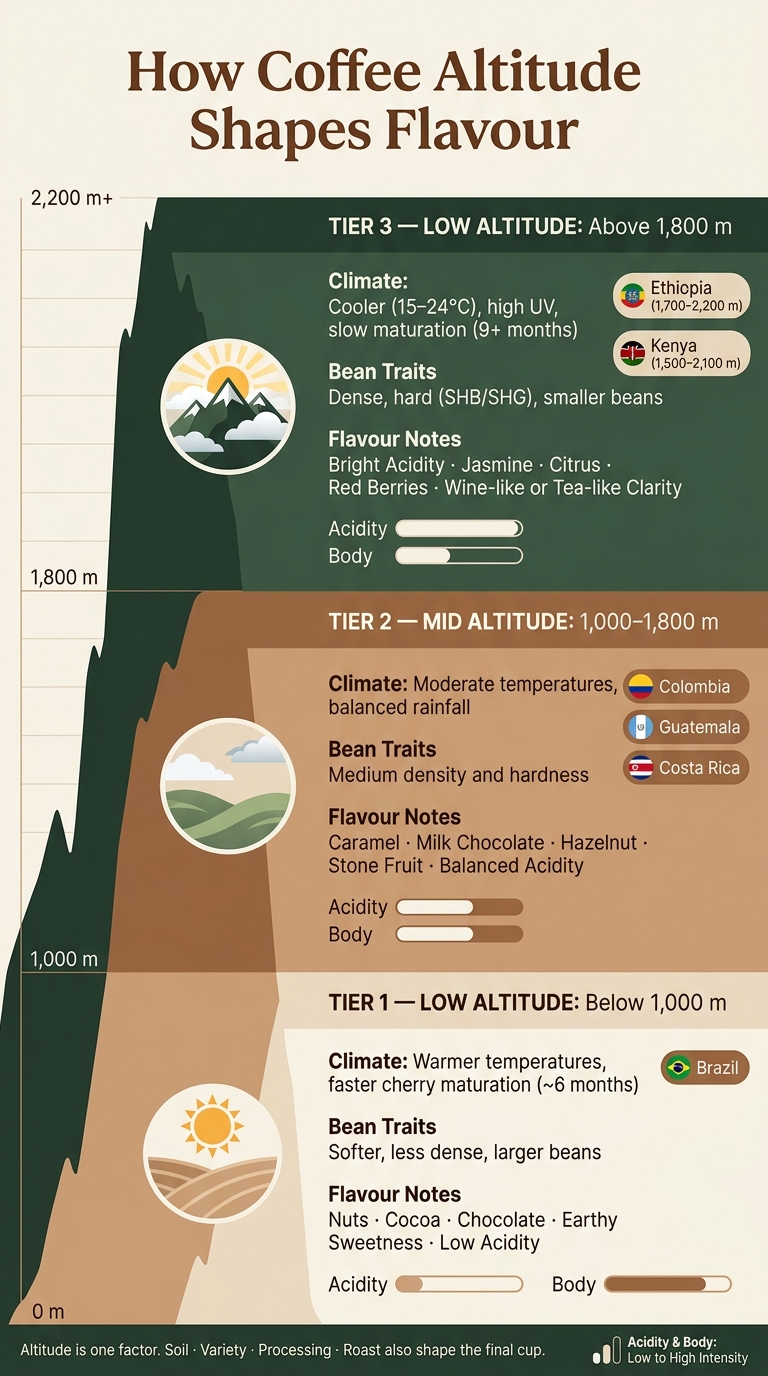
Coffee Altitude Bands: Flavour, Bean Traits & Regional Profiles
Altitude bands are a handy starting point, but they’re not a promise. Latitude, shade, and local microclimates can all nudge flavour in different directions, even at the same height. So it’s best to use these bands as a guide, then check how those traits show up in the cup.
Low-altitude coffees: below 1,000 m
Lower elevations are warmer, so coffee cherries can ripen in about six months. In the cup, these coffees often lean towards a heavier body and softer acidity, with notes of nuts, cocoa, chocolate, and earthy sweetness.
Mid-altitude coffees: 1,000 to 1,800 m
At mid elevations, conditions are more moderate, which often leads to balanced cups with rounded sweetness. You’ll often find caramel, milk chocolate, hazelnut, and stone fruit such as peach or apple. Many of these freshly roasted coffees also work well for espresso and milk drinks.
High-altitude coffees: above 1,800 m
Above 1,800 m, coffee tends to mature more slowly. In some cases, that stretch can run to nine months or more. That slower pace produces dense, hard beans, often graded as Strictly Hard Bean (SHB). Stronger sun exposure can also sharpen brightness and add more complexity in the cup.
The flavour profile often changes in a clear way: brighter acidity, floral aromatics like jasmine, citrus, red berries, and at times a wine-like or tea-like clarity.
| Altitude Band | Climate Conditions | Bean Traits | Common Flavour Notes |
|---|---|---|---|
| Below 1,000 m | Warmer, faster maturation (~6 months) | Softer, less dense, larger | Nuts, cocoa, chocolate, earthy sweetness, low acidity |
| 1,000–1,800 m | Moderate temperatures, balanced rainfall | Medium density and hardness | Caramel, milk chocolate, hazelnut, stone fruit, balanced acidity |
| Above 1,800 m | Cooler (15–24°C), high UV, slow maturation (9+ months) | Dense, hard (SHB), smaller | Bright acidity, jasmine, citrus, berries, wine-like or tea-like clarity |
These patterns stand out more when you compare coffees from different origins grown within the same altitude band.
Regional examples: how altitude shows up across different origins
Altitude starts to make more sense when you look at actual coffee-growing regions. That’s where the idea moves from a number on a label to something you can taste in the cup.
Ethiopia and Kenya: high-altitude clarity and brightness
Ethiopia and Kenya are both high-altitude origins. Ethiopian farms usually sit between 1,700 and 2,200 m above sea level, while Kenyan farms tend to range from 1,500 to 2,100 m.
In the cup, Ethiopian coffees often lean floral and delicate. Think jasmine, bergamot, lemon, and stone fruit, often with a tea-like clarity. Kenyan coffees can feel bolder and more intense, with notes of blackcurrant, grapefruit, and wine-like acidity.
Even when the altitude range looks similar on paper, the flavour can shift quite a bit once origin, variety, and processing come into play.
Colombia and Central America: balanced sweetness at mid to high elevations
Colombia, Guatemala, and Costa Rica are often grown between 1,200 and 2,000 m. Coffees from these elevations often deliver a more balanced cup, with clearer sweetness and less pointed acidity than many East African coffees.
Colombian coffees are a good example. You’ll often find caramel sweetness, red berries, and gentle citrus acidity in the cup. Guatemalan coffees often bring cocoa and subtle spice, along with bright fruit acidity. Costa Rican lots often move towards honey, caramel, and mild tropical fruit.
In Central America, you may also spot SHB (Strictly Hard Bean) or SHG (Strictly High Grown) on the bag. Both terms point to coffee grown at higher elevations.
How UK roasters describe these profiles
Roasters often turn those regional patterns into short tasting notes on the bag. So when you see words like jasmine, bergamot, or citrus, that often suggests a high-altitude East African coffee. Notes like caramel, red berries, and chocolate are more common in Colombian and Central American coffees.
The table below gives a quick side-by-side view:
| Region | Typical Altitude (m a.s.l.) | Common Flavour Notes |
|---|---|---|
| Ethiopia | 1,700 – 2,200+ | Jasmine, bergamot, lemon, stone fruit, tea-like clarity |
| Kenya | 1,500 – 2,100 | Blackcurrant, grapefruit, wine-like acidity, bold complexity |
| Colombia | 1,200 – 2,000 | Caramel, red berries, balanced citrus, medium body |
| Guatemala | 1,200 – 1,900 | Cocoa, subtle spice, rich chocolate, bright fruit acidity |
| Costa Rica | 1,200 – 1,700 | Honey, caramel sweetness, mild acidity, tropical fruit |
This is the useful part for buyers in the UK: altitude isn’t just about elevation. It often gives you a clue about the kind of cup you’re about to brew.
Processing, roasting and ethical sourcing at altitude
Altitude sets the stage. Processing and roasting decide how much of that promise ends up in your cup.
How processing affects altitude-driven flavour
Altitude shapes what's inside the bean, but processing controls how those flavours show up once brewed. The same high-altitude Ethiopian coffee can taste quite different based on what happened after picking.
Washed processing removes the fruit before drying. That usually gives you clearer acidity and more defined floral notes. It works well for high-altitude Ethiopian and Kenyan coffees, where clean, precise flavour is often the point.
Natural processing dries the bean inside the whole cherry. As it dries, the bean takes on sugars from the fruit. The cup tends to have more body and deeper, jammy fruit notes, while some of the sharper acidity gets toned down.
Honey processing sits in the middle. Some of the sticky fruit mucilage stays on the bean during drying, which adds syrupy sweetness and more body, while still holding onto some acidity.
| Processing Method | Acidity | Sweetness | Body | Clarity |
|---|---|---|---|---|
| Washed | High / Bright | Refined / Clean | Light to Medium | Very High |
| Honey | Moderate | High / Syrupy | Medium | Moderate |
| Natural | Low / Muted | Very High / Jammy | Full / Heavy | Low |
That denser bean structure also changes the way the coffee needs to be roasted.
Roasting denser high-altitude beans
High-altitude beans are denser, so roasting them takes tighter heat control. They're often marked SHB (Strictly Hard Bean) or SHG (Strictly High Grown), which are terms used for denser coffees grown at higher elevations.
Speciality roasters often begin with higher heat, then manage it with care so the outside doesn't scorch while the centre is still developing. Giving the coffee more development time after first crack can help soften the bean's natural acidity and bring out more sweetness.
Most roasters working with high-altitude single-origin coffees stick to a light or medium roast. That helps keep the floral and citrus notes that altitude can produce. Go darker, and those finer details often get buried under bitterness.
What to look for when buying single-origin coffee
High-altitude coffees often come from steep farms where the work is slow and hands-on, so sourcing matters just as much as roast style.
Many of these farms are smallholder operations on steep ground, where machines can't do the picking. That often leads to more selective hand-picking, but it also means more time and labour. Direct-trade sourcing can send more money back to the farm.
When you're choosing a single-origin coffee, pay close attention to the altitude, the processing method and the roast date. Those three details usually tell you more than tasting notes on their own.
FAQs
Does higher altitude always mean better coffee?
No. Higher altitude can add more complexity because cooler temperatures slow cherry maturation. But that doesn't mean the coffee will always be better.
Quality also depends on things like soil, rainfall, varietal, and processing. And altitude means different things in different regions and climates. In the end, “better” comes down to personal taste, because lower-altitude coffees can offer a smoother, more balanced cup.
How much does processing change altitude-led flavour?
Processing can shape the final flavour profile almost as much as origin. Altitude helps build the bean’s core character, developing sugars and acidity through slower maturation. Processing then acts as the last step, either bringing those traits forward or shifting them in a different direction.
Methods like washed or natural drying play a major part in how the coffee’s underlying potential shows up in the cup.
What should I check on the bag besides altitude?
Beyond altitude, look at the origin, variety, processing method, roast date and roast level.
Origin and variety help set expectations for flavour. Processing method affects both texture and taste. Roast date gives you a sense of freshness. And with roast level, it’s worth paying attention: darker roasts can sometimes hide the more delicate qualities that develop at high altitude.