


The short answer: roast level changes what you taste more than most people expect. From the same beans, a light roast often tastes brighter and more fruit-led, a medium roast tends to taste sweeter and rounder, and a dark roast usually tastes heavier, more bitter, and more roast-led.
If I had to sum it up in a few lines, I’d put it like this:
- Light roast keeps more acidity and more of the bean’s original taste
- Medium roast brings the best mix of sweetness, body, and balance
- Dark roast lowers acidity and pushes smoke, cocoa, and bitterness to the front
- First crack starts at about 196°C
- Second crack starts at about 224°C
- Coffee often moves from about pH 4.8–5.2 in light roasts to pH 5.2–5.6 in dark roasts, so it may taste less bright as roasting goes on
- Caffeine stays fairly steady, so “stronger” usually means more bitter or heavier, not much more caffeine
What matters most is simple: more roasting means less origin detail and more roast taste. So if you want citrus, floral, or berry notes, I’d look at light roasts. If you want caramel, chocolate, and a smoother cup, I’d go medium. If you want smoke, dark chocolate, and a heavier finish, dark roast is the one.
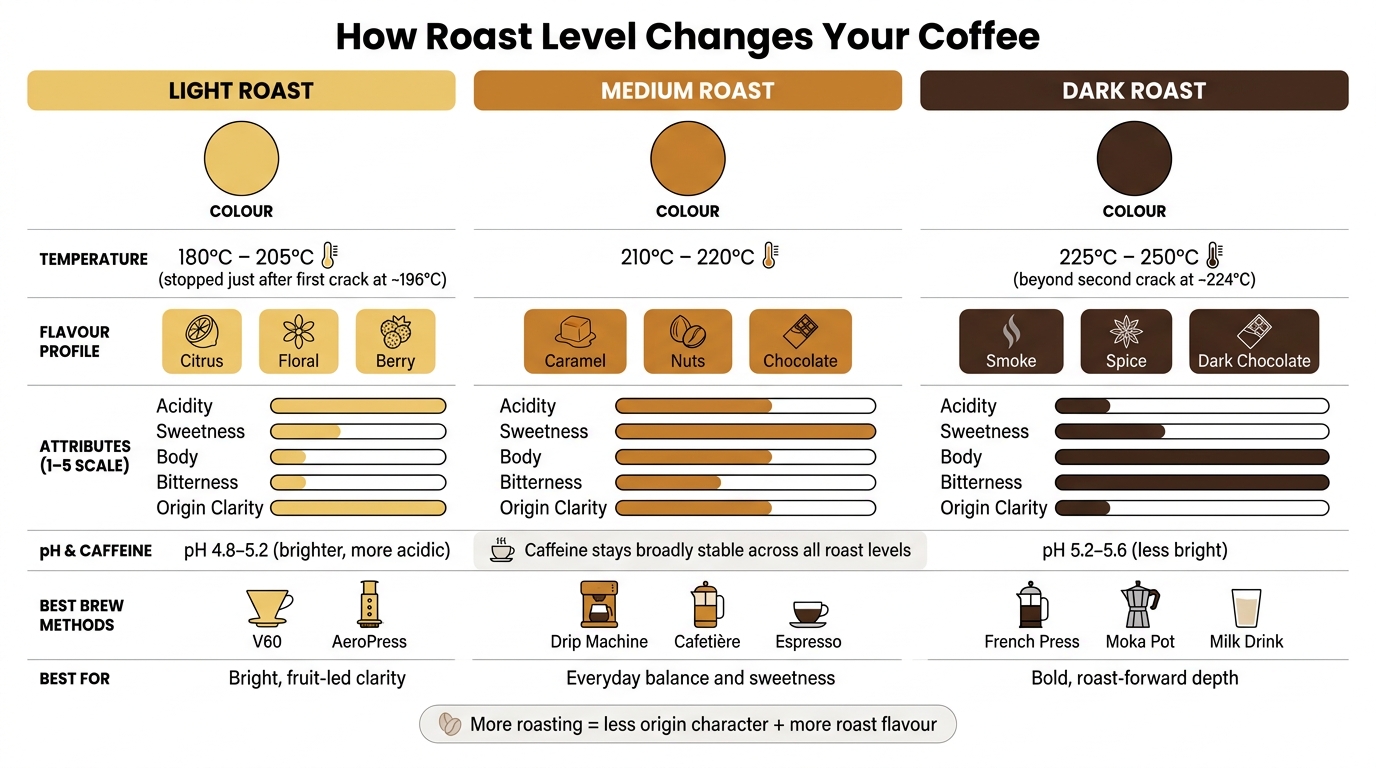
Light vs Medium vs Dark Roast: Flavour, Acidity & Body Compared
The Difference Between Light and Dark Roast
sbb-itb-cca2aed
Quick comparison
| Roast level | Main taste | Acidity | Sweetness | Body | Bitterness | Best for |
|---|---|---|---|---|---|---|
| Light | Citrus, floral, berry | High | Light, honey-like | Light, tea-like | Low | Clear, fruit-led cups |
| Medium | Caramel, nuts, chocolate | Medium | Highest | Round, smooth | Medium | Everyday balance |
| Dark | Smoke, spice, dark chocolate | Low | Bittersweet | Heavy, syrupy | High | Bold, roast-led cups |
So when I choose a roast, I’m not asking which one is best. I’m asking: do I want brightness, balance, or depth?
What Happens to Coffee During Roasting
Green coffee beans smell grassy before roasting. Once heat comes in, the beans go through a series of chemical and physical changes that build aroma and flavour.
How heat and time shape flavour
Two main reactions drive a lot of what you taste: Maillard browning and caramelisation.
The Maillard reaction takes place at roughly 150°C to 200°C. This is when sugars and amino acids react and form hundreds of aromatic compounds. That’s where notes like nut, caramel and toast start to show up. Caramelisation also breaks down sugars, which adds a toffee-like sweetness, especially in medium roasts.
At about 196°C, first crack starts as steam and CO₂ escape and the bean expands. This is the point where development begins. Development time has a direct effect on acidity, body and sweetness. In the cup, this is where brightness, sweetness and body start to move.
Those shifts show up most clearly in acidity, sweetness, body and bitterness.
At around 224°C, second crack begins. At this stage, cell walls fracture and oils move to the surface. With higher heat, pyrolysis breaks down organic compounds and adds smoky, burnt flavours. Past this point, roast notes take over: smoke, dark chocolate and carbon.
The flavour markers to look for in the cup
These markers help show how roast level changes what ends up in the cup:
| Flavour Marker | What It Means | Roast effect |
|---|---|---|
| Acidity | Brightness or "sparkle" - citrus, apple, berry | High in light roasts; fades as roasting continues |
| Sweetness | Honey, caramel and chocolate notes | Builds through medium roasts |
| Body | The weight and texture on the palate | Light and tea-like at first; rounder and heavier with more development |
| Bitterness | Drying, roast-driven bitterness | Low early on; rises as chlorogenic acids break down |
| Finish | The aftertaste after swallowing | Underdeveloped coffee drops away quickly; well-developed coffee finishes more smoothly |
These markers set up the differences between light, medium and dark roasts. You see them most clearly when you taste those roast levels side by side.
How Light, Medium and Dark Roasts Taste Differently
As roast level goes up, the cup changes with it. The markers above don’t stay fixed. They move, sometimes quite a lot, as the beans spend more time in the roaster.
Light roast: brighter acidity and clearer origin character
Light roasts are stopped just after first crack, usually at internal temperatures between 180°C and 205°C. This is where the bean’s origin comes through most clearly. You’ll often get high acidity, a cleaner profile, and very little roast flavour getting in the way.
Medium roast: balance, sweetness and a smoother texture
Medium roasts reach internal temperatures of about 210°C to 220°C. This is the middle ground. You still get some origin character, but now it sits alongside more roast sweetness. The result is often more caramel-like sweetness and a body that feels fuller and smoother.
Dark roast: lower acidity and deeper roasted flavours
Dark roasts go beyond second crack, reaching 225°C to 250°C. At this point, roast flavour takes over. Origin notes become harder to pick out, acidity drops, and bitterness climbs as organic compounds break down.
| Characteristic | Light Roast | Medium Roast | Dark Roast |
|---|---|---|---|
| Acidity | High, bright, citrusy | Moderate, balanced | Low to none |
| Sweetness | Delicate, honey-like | Pronounced, caramel/toffee | Bittersweet, molasses |
| Body | Light body | Medium, rounded | Heavy, syrupy |
| Bitterness | Minimal | Mild to moderate | High, smoky |
| Aroma | Floral, citrus, berry | Nutty, chocolatey, sweet | Smoky, spicy and toasted |
| Origin Clarity | High - origin-driven | Moderate - balanced | Low - roast-driven |
These changes help explain what each roast level adds to the cup, and what gets left behind as roasting carries on.
What You Gain and Lose at Each Roast Level
Each roast level gives you one thing and takes away another. Roast a coffee longer, and you usually get more body and more bitterness. Keep the roast lighter, and you hold on to more acidity and more of the bean's original character.
Here’s how those trade-offs tend to show up in the cup.
| Characteristic | Light Roast | Medium Roast | Dark Roast |
|---|---|---|---|
| Flavour strength | Low - delicate, nuanced | Moderate - balanced | High - bold, robust |
| Origin character | High - clearly origin-driven | Moderate - balanced | Low - roast-led |
| Sweetness | Low - floral, honey-like | High - caramel, milk chocolate | Moderate - bittersweet, molasses |
| Bitterness | Minimal | Moderate | High |
| Body | Light - tea-like | Medium - rounded | Heavy - syrupy |
Medium roasts usually strike the best balance between sweetness and restraint.
Why acidity drops and bitterness rises as roasting continues
This shift comes down to what heat does to the bean’s acids and sugars.
As roasting goes on, coffee’s natural acids start to break down. Light roast coffee usually sits at a pH of about 4.8–5.2, while dark roast coffee moves up to 5.2–5.6. So even though the pH rises, the cup tends to taste less bright and less sharp.
At the same time, more sugar and acid breakdown brings more bitterness and a deeper roast taste. The cup starts to feel heavier, and the roast character takes over more of what you notice first.
Caffeine stays broadly stable across roast levels. What people often read as “stronger” coffee usually comes more from bitterness and body than from a big change in caffeine.
How to Choose the Right Roast for the Flavour You Want
Choose your roast level based on the kind of cup you want to drink.
Match your roast level to the tasting experience you prefer
If you like bright, lively coffee with citrus, berry or floral notes, start with a light roast. It tends to shine in brew methods that bring out clarity, such as a V60 pour-over or AeroPress. If your light roast tastes sour instead of fruity, bump your brew water up to 94°C–96°C.
If you want less sharpness and more balance, go for a medium roast. For a reliable all-round cup, it’s the easiest everyday choice. It works well in drip machines, cafetières and espresso, which is why so many people keep coming back to it.
If you lean towards depth rather than clarity, dark roast makes more sense. If you want something bold and roast-forward, it pairs well with French press, Moka pot and milk drinks. Keeping your brew water at 88°C–92°C can help stop the cup tipping into harsh bitterness.
Conclusion: Roast level determines what you taste in every cup
Light roasts keep more clarity, medium roasts bring sweetness and body into balance, and dark roasts give you depth and bitterness. The right roast is simply the one that lines up with the flavour you want most.
FAQs
Does roast level affect caffeine?
Roast level doesn’t change the caffeine in your cup in any major way. People often assume dark roast is stronger, but roasting has only a tiny effect on total caffeine.
By weight, light roasts can have a little more caffeine. But dark roast beans are less dense, so when you measure by volume, the caffeine level is about the same. How you brew the coffee and how much you drink make a much bigger difference.
Why can light roast taste sour?
Light roast coffee keeps more of the bean’s natural acidity. That can come across as bright, crisp, and fruity in the cup.
The catch is that light roasts can also taste sour if the roast is underdeveloped. When that happens, you may notice harsher flavours that lean vegetal or unripe instead of clean and lively.
Light roasts are denser too, which makes them a bit less forgiving when you brew them. If your water is too cool, you can end up with under-extraction. And that often shows up as sharp, unpleasant sourness.
A small tweak can make a big difference: use a slightly higher brew temperature of 94°C to 96°C.
Which roast is best for espresso?
The best roast for espresso comes down to personal taste, but medium roasts are often the sweet spot because they strike a nice balance. They tend to give you a smooth body with caramel and chocolate notes, and they usually pair well with milk.
If you want a more intense, syrupy shot, go for dark roast. If you lean towards brighter, fruit-led flavours, light roast can work well as a straight espresso, but it needs more precise extraction.