


If I had to sum it up in one line, it’s this: GI links a coffee name to a place, sets rules for how that coffee is made, and checks that producers follow them before they use the name.
So if you see names like Jamaican Blue Mountain or Cerrado Mineiro, GI is meant to make sure the coffee matches the place, the production rules, and the records behind it.
Here’s the article in simple terms:
- GI is not a brand. A brand belongs to one business. A GI belongs to a region.
- Two UK schemes apply: PDO and PGI.
- PDO is stricter: all stages must happen in the named area.
- PGI is looser: at least one key stage must happen there.
- Producers must meet written standards for things like growing, picking, processing, and drying.
- Traceability matters: each batch needs records from farm to pack.
- Checks matter too: an outside control body verifies compliance.
- Local know-how is protected as part of the product name, not just the land and climate.
- Group applications are common because the process can cost time and money.
- The end result: growers, regions, and buyers all get a clearer link between name, place, and cup quality.
Quick comparison
| Scheme | What it means |
|---|---|
| PDO | Growing, processing, and preparation all happen in the defined area |
| PGI | At least one key production stage happens in the defined area |
I’d read this article as a guide to one main idea: GI protects both the coffee’s place and the way that place makes the coffee what it is.
What geographical indication means for coffee
Legal protection starts with what GI means on the ground.
A geographical indication (GI) is a protected name for a coffee whose quality, reputation or character comes from its place of origin. It protects the conditions and methods that give the coffee its character: climate, altitude and soil shape the bean, and local growing and processing know-how shapes how it is made.
How GI differs from a brand name
This is where many people get mixed up. A brand belongs to a business. A GI belongs to a place, and it's a collective right, not something one company can own.
Any producer in the defined region can use a GI name, as long as they follow the set product standards and are checked by an independent control body. The UK Government says:
"A GI is different to a trade mark. A trade mark belongs to the business that registered a product brand for protection. An individual or business does not own a GI."
A brand signals ownership. A GI signals origin.
How PDO and PGI protection works
In the UK, this protection is applied through two schemes.
| Protection Type | What it requires |
|---|---|
| PDO (Protected Designation of Origin) | Every stage - growing, processing and preparation - must happen within the defined area, using local knowledge and traditional skills. |
| PGI (Protected Geographical Indication) | At least one significant stage of production must take place in the region; the link can be based on reputation or specific qualities. |
PDO is the stricter scheme. Growing, processing and preparation must all happen within the defined area. PGI is broader. At least one significant stage must take place in the region.
Those rules matter because they protect not just origin names, but also the methods behind them.
sbb-itb-cca2aed
How GI protects coffee origins
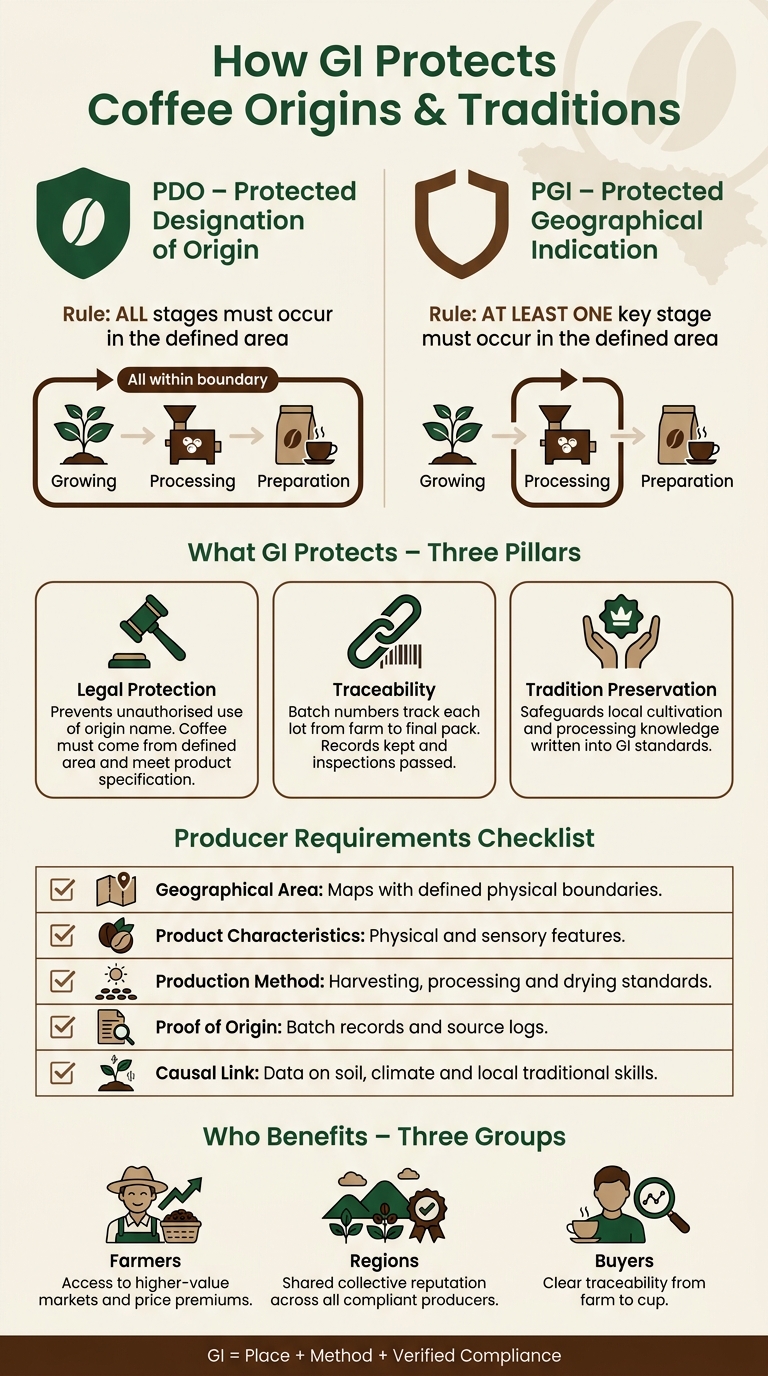
PDO vs PGI: How Coffee GI Protection Works
Legal protection against misuse of origin names
GI protects a coffee’s name, identity and market worth by linking it to a specific place. That link gives producers a legal way to stop others using a protected name when their coffee doesn’t make the grade.
If a coffee isn’t from the defined region, or it fails to meet the specification, that name can’t appear on the label. That changes the whole picture. Misuse stops being a matter of brand image and becomes a legal breach.
Of course, that legal right means little if nobody can prove where the coffee came from. That’s where traceability comes in.
Traceability and control from farm to label
For a GI label to carry weight, the coffee needs a clear paper trail from the farm to the final pack. Each certified batch receives a batch number, which follows it through the supply chain. Producers have to keep records, pass inspections and meet the published specification before they can use the protected name.
In Cerrado Mineiro, Expocacer uses digital batch tracking so buyers can see each lot’s producer, sensory profile and background. That matters more than it might seem at first glance. Once coffee is roasted or blended, its origin story can get blurry without tight lot tracking.
The table below sets out what GI protects and why that matters.
Comparison table: what GI protects and why it matters
| Area | What it covers | What producers must show | Buyer value |
|---|---|---|---|
| Legal protection | Prevents unauthorised use of the origin name by third parties | The coffee comes from the defined area and meets the product specification | Confidence that the name on the label is legally verified |
| Traceability | Documented journey from farm to final pack via batch numbers | Detailed records are kept and inspections are passed | Full transparency on the coffee's history and origin |
| Tradition preservation | Safeguards long-established cultivation and processing knowledge | Established farming and processing methods are followed | Access to heritage-rich products that cannot be copied elsewhere |
How GI preserves traditions and local knowledge
Growing and processing methods written into GI standards
GI does more than protect a name. It also protects the methods behind that name.
A GI specification sets out how coffee must be grown, harvested and processed. In plain terms, local practice becomes a protected standard.
These specifications often cover minimum altitude, approved coffee varieties, and the harvesting and processing methods producers have to follow. In Son La, Vietnam, the GI requires hand-picking on steep slopes so cherries are picked at an even stage of ripeness. That rule helps keep a manual harvesting practice that has shaped the region’s coffee for generations.
In Kintamani, Bali - Indonesia's first registered coffee GI, certified in 2007 - the specification protects the traditional Subak Abian farming system, including organic fertilisation techniques and other local farming practices that help preserve the region’s citrusy profile. Producers must follow these standards if they want to use the protected name.
With GI coffee, these local methods are part of the protected identity, not just nice extras. The same idea runs across GI coffees: local growing and processing methods become part of the product’s legal identity.
Why local knowledge is part of coffee heritage
Soil and climate explain some of a coffee’s taste. But that’s only part of the picture. The human side matters too - when farmers decide to pick, how long they ferment, and how they dry the coffee. GI systems formally recognise this producer know-how as part of a coffee’s identity, and as something that is hard to copy.
That matters because it gives local communities a formal role in keeping their own knowledge alive. In Indonesia, local groups called Masyarakat Perlindungan Indikasi Geografis (MPIG) oversee GI compliance in their regions, helping keep generational standards in place across all members.
That’s also why compliance matters. Producers must prove they follow the specification before they can use the protected name.
What producers must do to qualify and why it matters to coffee communities
Common GI requirements for coffee producers
Those standards only mean something if producers can prove they meet them. In practice, that means showing a clear link between place, method and cup quality. Producers need to define the geographical area with maps and show that the coffee’s qualities come from that area, using evidence such as soil type, altitude, rainfall, temperature data, and the local skills and methods that shape flavour.
It doesn’t stop with the first application. Producers also have to follow set production standards for harvesting, processing and drying. On top of that, they must keep records at each stage so every batch can be traced back to its source. Before the protected name can be used, an independent body checks that the rules have been met.
The main qualification points are fairly simple:
| Requirement Category | What Producers Must Show |
|---|---|
| Geographical area | Maps with defined physical boundaries |
| Product characteristics | Physical and sensory features |
| Production method | Harvesting, processing and drying standards |
| Proof of origin | Batch records and source logs |
| Causal link | Data on soil, climate and local traditional skills |
Because applications can be expensive, producers often apply as a group through a co-operative or regional association.
Benefits for farmers, regions and buyers
Once producers meet the standard, GI turns compliance into market value. For farmers, that can mean access to higher-value markets where origin-based labelling helps support price premiums. That discipline is what gives GI its commercial weight.
For regions, the gain is reputation. A GI works as a collective asset: any producer who meets the standard can use the protected name. So the region’s quality identity is shared across all compliant producers in that area.
For buyers, GI-backed traceability cuts uncertainty. It gives them a clear line of sight from farm to cup.
Conclusion: GI protects both place and practice
GI ties coffee to a place, protects the name, and preserves the methods behind it. Producers earn the right to use that name through verified compliance.
"This traceability is essential because it adds trust to the product, value to the brand, and security to the market, as well as allowing consumers to know and recognise the producer behind the cup." - Mariana Velloso Heitor, Chair of the Board of Directors, Expocacer
FAQs
How does GI affect coffee prices?
Geographical Indication (GI) certifications can lift coffee prices by signalling quality and a clear sense of place.
Buyers often connect GI-labelled coffee with the reputation of a specific region, so they may be willing to pay more. That price premium can help farmers earn better returns, even when production costs are higher or yields are lower, while also supporting rural livelihoods.
Can GI coffee still vary in flavour?
Yes. Coffee with a Geographical Indication (GI) can still vary in flavour.
A GI protects a coffee’s link to its region. But in most cases, it doesn’t lock that coffee into one fixed flavour profile. Many GIs are based on place of origin and reputation, not strict sensory rules.
So even coffees from the same GI region can taste different. They may still share a connection to the same area, while showing different flavour notes in the cup.
Who checks GI coffee rules are followed?
GI rules are usually checked by producer groups or designated oversight bodies. In the UK, producers must be verified against the product specification, with Defra acting as the competent authority.
In other places, local producer associations or community groups often keep an eye on compliance and product quality. Some regions also rely on accredited third-party control bodies.