


Coffee can move from $0.40 to $3.20 per pound, so every buying choice matters. My main takeaway is simple: faith-led coffee firms tend to show their beliefs in three places - how they buy beans, how they use profit, and how they track results.
If you want the short version, here it is:
- I see direct trade used to pay growers more than market-linked rates
- I see fixed giving models, such as 10% of profits or £5 per case
- I see clear social results, including schools, clinics, clean water, and support for children
- I see trade-offs, such as tighter margins, higher shipping costs, and slower growth
- I see simple checks that matter: packaging, energy per roast, price paid to growers, length of farm relationships, and named charity giving
Creation Coffee is the clearest UK example in the piece. It links bean buying, recyclable packaging, and a 10% profit donation to Compassion UK into one business model. Other cases show similar patterns: one roaster pays US$0.80 per pound above Fair Trade rates, another pays farmers 25% to 30% more than local buyers, and another used a US$1 per bag rebate to fund water filters for 342 households.
If I were a UK buyer or small roaster, I would read this article as a plain test: are faith claims visible in prices, giving, and public reporting - or not?
Quick comparison
| Business/model | What it does | Social result | Main pressure point |
|---|---|---|---|
| Creation Coffee | Direct trade, small-batch roasting, recyclable packaging, 10% of profits to Compassion UK | Support linked to children and communities in sourcing regions | Lower retained profit and slower expansion |
| Guadalupe Roastery | Pays US$0.80/lb above Fair Trade rates | Farm school and health clinic | High import and shipping costs |
| Endiro Coffee | Pays farmers 25%–30% more than local buyers | Clinic and school support | Tight margins |
| Delicious Peace model | US$1 per bag rebate | Water filters for 342 households and cleaner cookstoves | Stock risk |
What follows shows how those choices work in practice, and what UK coffee firms can measure if they want faith and business to line up.
sbb-itb-cca2aed
2. Christian values that shape sustainable coffee business
For Christian coffee owners, faith shapes sourcing, pricing and how profit is used. In practice, those values show up most clearly in two places: how coffee is bought and where surplus goes.
Stewardship, justice and transparency in sourcing
In business, stewardship means looking after land, people and resources instead of squeezing them for short-term gain. In coffee, you see that most clearly in the way a roaster buys beans.
Many Christian-led roasters lean towards direct trade. That usually means long-term ties with specific farms, paying above market rates and removing some of the middlemen. Guadalupe Roastery, founded by Brad Fassbender in 2016, pays farmers US$0.80 per pound above Fair Trade International set prices. That extra payment helped one partner farm in Nicaragua, run by Rolyn Garcia and Lorena Altamirano, open an on-site school and health clinic for its employees and their families. Across that partnership, Guadalupe has bought 54,000 pounds of coffee from that one farm.
Justice in sourcing also means being clear about what is paid. Level Ground Trading, co-founded by former pastor Stacey Toews, shows customers what it pays farmers alongside the market price. The point is simple: integrity should be visible, not just claimed.
But buying well is only part of the story. Faith-led roasters also make a clear choice about what surplus is meant to do.
Using profit for mission and long-term support
How profit is used sits at the heart of faith-based business models. Instead of treating surplus as only a financial reward, many Christian roasters see it as a resource that carries responsibility.
Some, such as Creation Coffee, build giving into the model from the start. Kingdom Coffee does something similar with a per-case setup: every case of its Tesfa filter coffee sold generates a £5 donation to Tearfund for community development in Ethiopia, and in 2015 it donated £10,000 to Toybox to support 100 children in Guatemala.
Across the sector, faith-led roasters often accept tighter margins so they can do things in a way that fits their beliefs. That trade-off is not always easy, but it is a deliberate one.
The next case study shows how those ideas play out in a UK roastery.
3. Case study: Creation Coffee's faith-led business model
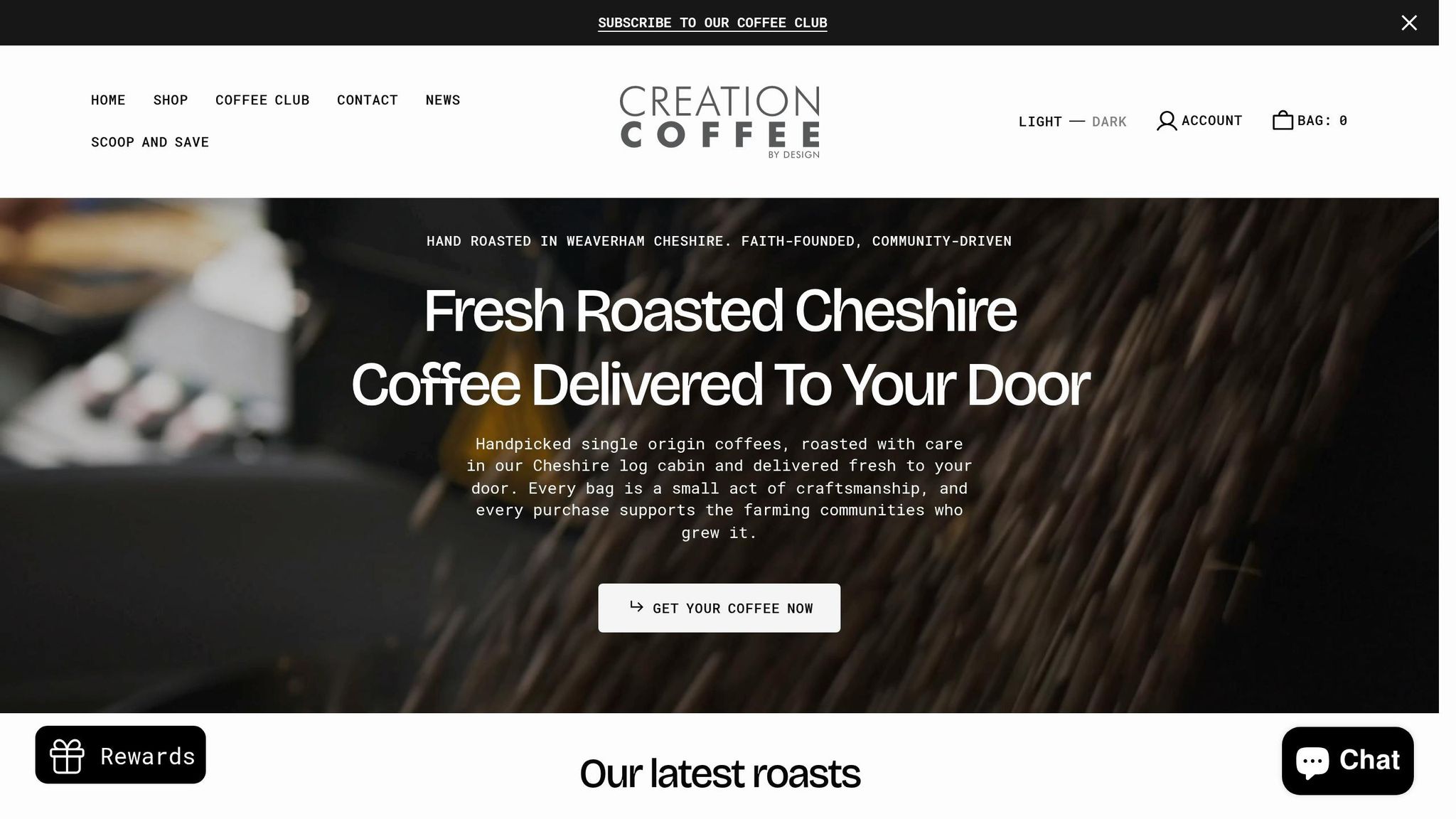
Creation Coffee is a small-batch speciality roastery in Weaverham, Cheshire, run by founder Jon Cook. The business puts its beliefs into day-to-day decisions, not just brand messaging. It offers a clear example of stewardship and profit-with-purpose in practice.
How small-batch roasting and direct trade support quality and ethics
Small-batch roasting gives Jon more control over each lot. He can adjust the roast to fit the bean, which helps with quality and cuts waste at the same time. Verified buyers often point to the freshness and quality of the coffee.
That same thinking carries through to sourcing. Creation Coffee buys through direct trade from Colombia, Guatemala and Brazil. A shorter supply chain helps the business pay fair prices and stay closer to where the coffee comes from. It also gives extra meaning to the sourcing model, because the company gives priority to regions where Compassion UK already works, tying each purchase to Compassion UK's activity on the ground.
That link between buying and giving isn't accidental. It's built into how the business works.
Giving 10% of profits to a children's charity
Creation Coffee gives 10% of all profits to Compassion UK, which works in poverty alleviation in places such as Colombia, Guatemala and Ethiopia - including some of the same countries where the roastery sources its beans. That overlap is deliberate.
"Every bag you buy is a small act of solidarity - with the farmer who grew the beans, and with the children in their communities." - Creation Coffee
This isn't a one-off campaign or a seasonal pledge. It's part of the model from the start. For a solo-run e-commerce roastery, setting aside a fixed share of profits for charity puts a clear cap on how much can be kept for growth. It also says a lot about the purpose of the business.
Trade-offs in running a UK faith-based roastery
Running a roastery this way comes with hard choices. Direct-trade sourcing, small-batch roasting and 100% recyclable packaging all affect costs and day-to-day operations. On top of that, giving away 10% of profits before reinvestment slows how fast the business can expand.
Even with those pressures, Creation Coffee keeps pricing competitive. The Genesis Espresso Blend starts at £9.00. Single-origin coffees such as Colombia Planadas are priced at £11.00, while Guatemala Hamacas comes in at £12.00. The Creation Coffee Club subscription helps steady cash flow through recurring revenue, and free local delivery in Cheshire helps strengthen loyalty in the local area. For customers farther away, free shipping on orders over £50.00 makes larger orders more appealing.
The business gives up some margin to stay in line with its beliefs. That trade-off shows up across many faith-based coffee businesses, and Creation Coffee is one clear example of it.
4. What other faith-based coffee case studies show
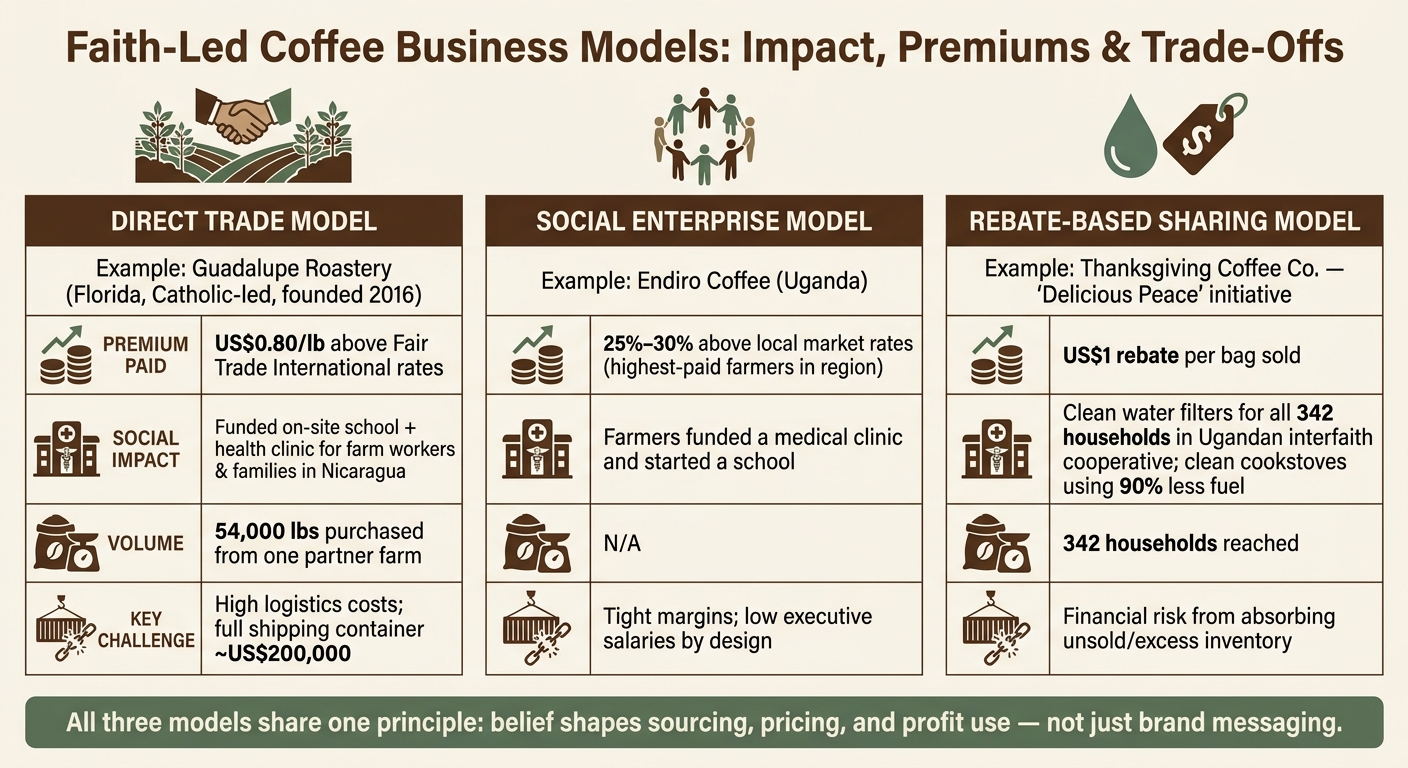
Faith-Led Coffee Business Models: Impact, Premiums & Trade-Offs
Other faith-led coffee businesses point to the same pattern: direct sourcing, better pay for farmers, and profits put back into local communities. In plain terms, belief shapes how the business runs day to day. What matters most is not the message on the packaging, but what changes for people on the ground.
Common models: profit-sharing, community investment and farmer support
One common route is direct trade with a fixed premium. Guadalupe Roastery, a Catholic-led business in Florida founded in 2016 by Brad Fassbender, sources directly from a single family farm in Nicaragua. It pays US$0.80 more per pound than the Fair Trade International minimum prices. That arrangement helped fund an on-site school and health clinic for the farm's employees and their families.
Another route is social enterprise and profit-sharing. Here, higher prices and surplus income are fed back into community life. Endiro Coffee in Uganda pays farmers 25% to 30% more than most local buyers, which makes them the highest-paid farmers there. That extra income has helped farmers build a medical clinic and start a school.
A third route is rebate-based sharing tied to specific outcomes. Thanksgiving Coffee Company's "Delicious Peace" initiative used a US$1 rebate per bag to fund clean water filters for all 342 households in a Ugandan interfaith cooperative. It also introduced clean cookstoves that use 90% less fuel.
Benefits and limits across these models
Each model leads to clear results, but each comes with trade-offs. Direct trade can lift producer income, yet it also needs serious capital. A single shipping container can cost a small roastery around US$200,000. Social enterprise models keep margins tight by design. Rebate models are simple for customers to grasp and easy to track, but taking on unsold stock can create a real financial strain.
These examples show three recurring ways faith-led coffee businesses turn belief into practice.
| Model Type | Sustainability Benefit | Social Impact | Key Challenge |
|---|---|---|---|
| Direct Trade (e.g., Guadalupe Roastery) | Higher income for producers by bypassing middlemen | Funds on-site schools and health clinics | High logistics costs and the need to buy full containers |
| Social Enterprise (e.g., Endiro Coffee) | Pays farmers 25% to 30% above market rates | Supports clinics, schools and vulnerable communities | Tighter margins and low executive salaries |
| Rebate-based sharing (e.g., Delicious Peace) | Funds clean cookstoves that reduce deforestation | Clean water filters for all 342 households in the cooperative | Financial risk from absorbing excess inventory |
The next issue is how to measure those environmental, social and community outcomes.
5. Measuring impact and key lessons for UK coffee businesses
Useful measures: environmental, social and community outcomes
The case studies above show what faith-led coffee can do. These measures help prove it. The next step is simple: check whether those values change results. If stewardship and justice matter, they should show up in figures, not slogans.
On the environmental side, packaging is one of the easiest things to check. Switching to LDPE4 recycling-ready bags means customers can recycle them through many UK local recycling programmes. Energy use per roast batch is also worth tracking. It gives you a clear view of whether production choices are cutting waste.
For sourcing, the main figure is straightforward: track the premium paid above the global Arabica price. Publishing that data openly - origin, price paid and comparison to global prices - turns transparency into something customers can actually see.
On the social and community side, businesses can track the share of women in supply-chain management and monitor community investment, such as schools or clinics. Charitable giving is measurable when it is fixed, published and tied to a named charity.
Use these measures as a reporting checklist:
| Measure | What to track | Why it matters |
|---|---|---|
| Packaging recyclability | % of materials using LDPE4 or equivalent | Cuts landfill; easy for UK consumers to act on |
| Roasting efficiency | Energy use per roast batch | Shows whether production choices are cutting waste |
| Producer premium | Price paid vs global Arabica price | Shows whether sourcing is genuinely fair |
| Supply chain stability | Length and continuity of direct trade relationships | Shows long-term commitment rather than spot buying |
| Community outcomes | Share of women in supply-chain management; schools or clinics supported | Links sourcing to measurable local benefits |
| Charitable giving | Fixed % of profits donated annually | Creates a clear, measurable social commitment |
Conclusion: what Creation Coffee's example makes clear
Creation Coffee's model shows that Christian values do not have to stay abstract. Sourcing through direct trade, roasting in small batches, donating 10% of profits to Compassion UK, and using recyclable packaging are all decisions that can be tracked and reported.
"Sustainability isn't just a policy for us - it's a promise." - Creation Coffee
That distinction matters. A promise implies accountability, and accountability is what helps a faith-led business stay steady when commercial pressure builds. This is how faith becomes accountability in coffee business.
FAQs
How does direct trade improve sustainability?
Direct trade can improve sustainability in a very practical way: it helps farmers earn 20 to 40% more than they would through standard pricing, often around £2.30 to £6.15 per pound for speciality lots.
That extra income matters. It gives farmers more financial stability, which can help them invest in their land, deal with market swings, and put money back into their communities. At the same time, these longer-term relationships tend to encourage transparency and stronger care for the environment.
How can buyers check if faith claims are genuine?
Look for clear proof of a company’s claims. That means giving proper detail about coffee origins, including farm names, altitude, and processing methods. When a brand shares that kind of information, it usually points to strong traceability.
Independent certifications like B Corp, Fairtrade, and Rainforest Alliance can also help back up ethical claims. Some companies go a step further with technical checks, such as isotope ratio analysis, to confirm bean authenticity.
Does giving 10% of profits limit business growth?
At Creation Coffee, giving 10% of profits to charity isn't seen as a drag on growth. It's part of the point of the business.
That choice reflects the company's values: generosity, honesty and care. And it doesn't sit off to the side as a nice extra. It can shape day-to-day decisions, including things like fair pay for farmers, because the team sees it as part of building long-term impact that lasts.