


A high coffee price does not tell you who got paid well. If I want to judge a bag of coffee properly, I need to look at four numbers in order: farmgate, FOB, landed cost, and retail price.
Here’s the short version:
- Farmgate shows what the farmer or co-op was paid
- FOB adds milling, local transport, and export costs
- Landed cost adds shipping, customs, storage, and importer costs
- Retail price adds roasting, packaging, labour, and margin
A few figures from the article make the point fast:
- In 2018, the C-market fell to $1.24/lb, below production cost for many farmers
- In 2022/23, coffees scoring 86–87.9 had a median FOB of $4.20/lb, vs $2.30/lb for 82–83.9
- Microlots under 1,000 lbs reached $4.90/lb, while lots over 40,000 lbs sat at $2.24/lb
- Roasting cuts weight by about 15%, which affects the final £ price
- Exchange-rate moves can change cost by about £0.15–£0.30 per lb for UK roasters
What I’d look for from a roaster:
- named farms, co-ops, or washing stations
- prices in $/lb or £/kg
- lot size, harvest year, process, and cup score
- a comparison with production cost, not just the C-market
- a plain breakdown from origin to shelf
If a brand only says “ethically sourced” or “we pay above market rate”, that tells me very little. I want the numbers, the context, and the route from farm to bag.
That’s the core idea of coffee pricing transparency: not just what coffee costs, but where the money went.
How to decode the Farm Gate Price (Coffee Economics with Karl)
sbb-itb-cca2aed
How coffee prices are built from farm to roaster
Coffee Pricing Transparency: From Farmgate to Retail
These labels only make sense when you look at how coffee pricing works on the ground.
The main factors that shape the price of green coffee
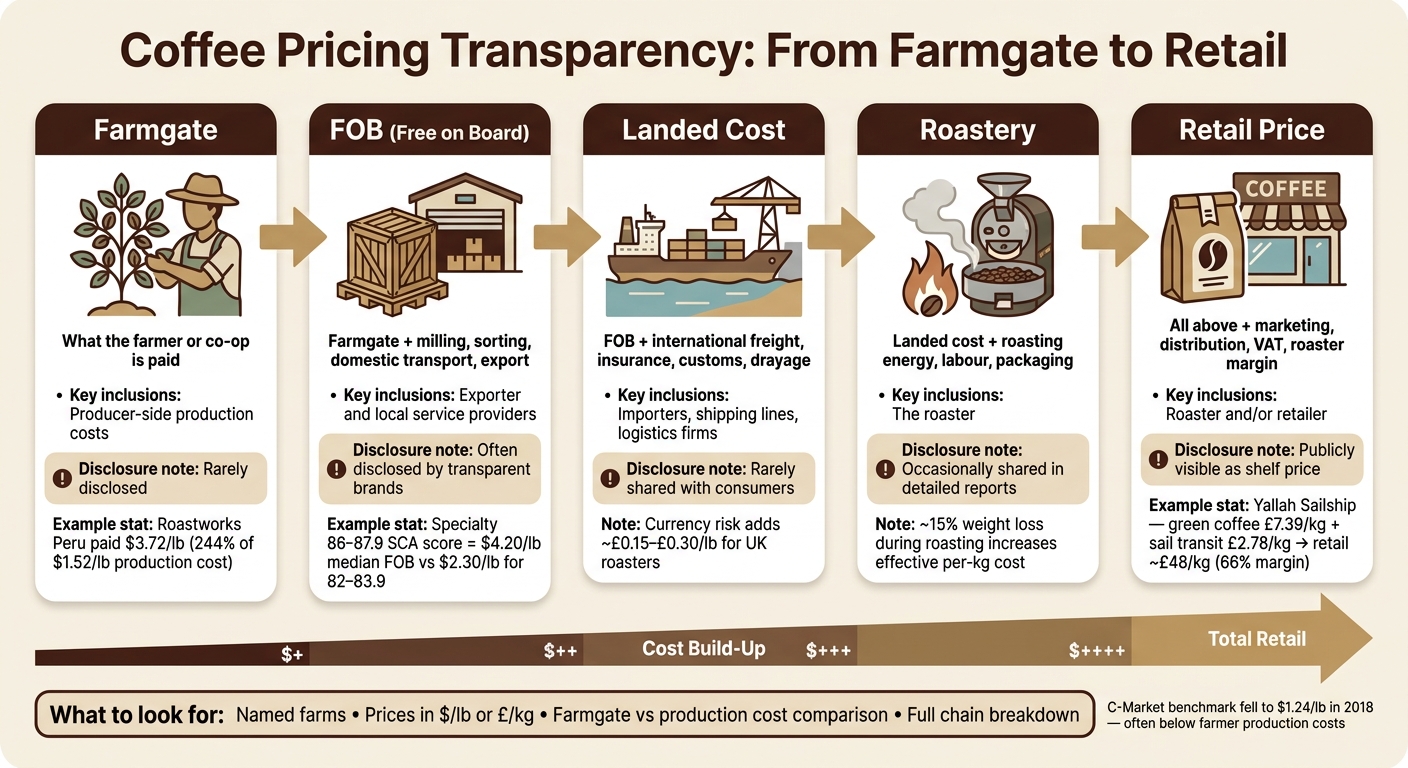
Each price label points to a different stage in the cost build. What a roaster pays for specialty coffee is made up of several layers, and each one pushes the total up before the beans ever reach the roasting drum. If you want transparency, you need to split out what went to the producer from what was spent on logistics, roasting and retail margin.
Cup score is one of the biggest drivers. In the 2022/23 specialty market, coffees scoring 86–87.9 on the SCA scale had a median FOB price of $4.20/lb - about 83% higher than coffees scoring 82–83.9 at $2.30/lb. That gap isn’t random. Higher scores often come from better farm work, more selective picking and tighter processing.
Lot size changes the maths too. Microlots under 1,000 lbs had a median FOB price of $4.90/lb in the same period, while large lots over 40,000 lbs came in at $2.24/lb. Smaller lots tend to carry higher per-kilogram handling and logistics costs.
Origin can add a premium of its own. Panama tends to command about +$1.38/lb above benchmark prices, while Brazil often sits around $0.45/lb below benchmark. Processing method matters as well. Anaerobic fermentation and other more labour-heavy techniques usually sell for more than standard washed or natural lots.
For UK roasters, currency also matters. Coffee is traded in USD but bought in GBP, so exchange-rate moves can change the effective cost by about £0.15–£0.30 per pound between contract booking and final settlement. Certifications add another layer. Organic is about +$0.30/lb, while Fairtrade sets a floor of $1.40/lb FOB.
Put simply, the main cost layers are quality, origin, logistics and roasting.
What each price layer covers across the supply chain
From farmgate to shelf, every stage adds cost. This is where things get a bit slippery for buyers, because some costs are easy to spot and others stay buried in the final price.
| Supply Chain Layer | What It Includes | Who Is Paid | Usually Disclosed? |
|---|---|---|---|
| Farmgate | Producer-side production costs | Farmer or producer group | Rarely; requires direct trade or transparency reports |
| FOB (Free on Board) | Farmgate plus milling, sorting, domestic transport and export costs | Exporter and local service providers | Standard benchmark; often disclosed by transparent brands |
| Landed / Ex-Warehouse | International freight, marine insurance, port fees, customs clearance and drayage | Importers, shipping lines and logistics firms | Rarely shared with consumers |
| Roastery | Landed cost plus roasting energy, labour, packaging and around 15% weight loss | The roaster | Internal data; occasionally shared in detailed reports |
| Retail | All of the above plus marketing, distribution, UK VAT where applicable and roaster margin | Roaster and/or retailer | Publicly visible as the shelf price |
Roasting brings its own cost as well: around 15% weight loss. As water vapour is driven out during roasting, coffee loses about 15% of its mass.
That’s why price on its own never gives you the whole picture.
Why pricing transparency matters for producers, roasters, and customers
Pricing transparency shows whether money is reaching producers and how the final retail price takes shape. That matters because every step in the chain changes who gets paid, how much they get, and what that payment is meant to cover.
How transparency supports fairer price discovery for producers
The main issue with coffee pricing is simple: the global commodity benchmark - the C-Market - often has very little to do with what it costs a farmer to produce coffee. In 2018, the C-Market fell to $1.24/lb, which sat well below the cost of production for most smallholder farmers. Even when it climbed back to around $4.00/lb in late 2025, that did not mean producers automatically saw better payments unless contracts made those numbers clear.
Publishing farmgate and FOB prices helps show how money is split before coffee even leaves origin. It also shows where value stays in the chain. Roastworks' Peru Velo De Novia lot is a good example. The cost of production was $1.52/lb, the poverty line income was $1.91/lb, and Roastworks paid $3.72/lb - 244% of production costs. On its own, a high price per pound can sound impressive. But without context, you can't tell whether that figure covers the cost of farming or supports a decent income.
That same level of openness gives customers a better way to judge whether a higher shelf price makes sense.
How transparency helps customers understand retail prices
For UK buyers, a higher shelf price is easier to understand when a roaster shows how that number was built. Transparent pricing can explain the effect of small-batch roasting, ethical sourcing, UK warehousing, fair wages, and logistics on the final price on the shelf.
Ultra-small lots and specialist logistics can push prices up, especially when a business doesn't have much scale. Yallah Coffee's Sailship breakdown shows this clearly: green coffee at £7.39/kg, sail transit adding £2.78/kg, and a retail price of about £48/kg reflecting a 66% margin.
"Simply saying what a producer is paid does nothing to qualify if there is profit distribution within their business." - Yallah Coffee
That quote gets to the heart of the issue. A single number can sound good in a product description, but it doesn't tell the whole story. Transparent reports do. They trace the path from farmgate price to landed cost, so customers can see where their money went instead of relying on broad marketing claims.
The next section looks at the signs of genuine transparency, and where numbers on their own start to fall short.
What full transparency looks like in practice
Even when roasters publish numbers, those numbers only help if readers can see what sits behind them.
Common obstacles and why numbers need context
Published prices only mean something when the source data is clear. And even roasters with good intentions can hit limits in what they’re able to share. Some producers would rather keep prices private, especially if that information could shape local negotiations. On top of that, data formats differ from one origin to another, and converting cherry prices into green coffee figures often involves assumptions that can skew the final number.
A price on its own can send people in the wrong direction. Without details like quality, lot size, harvest year, and processing method, it’s hard to tell whether a figure is strong, weak, or somewhere in between.
The same goes for claims about paying more. Saying a roaster paid a premium doesn’t tell you much without the number itself. If the C-market is low, even a 50% premium may still sit below a farmer’s cost of production. So the benchmark matters just as much as the premium.
That’s why a practical checklist helps. It makes it easier to tell the difference between plain disclosure and polished marketing copy.
A checklist for judging transparent coffee brands
When you look at a roaster’s sourcing claims, the gap between useful disclosure and vague ethical language usually comes down to one thing: specific detail. The table below shows what to look for and what should make you pause.
| Transparency Signal | Meaningful Disclosure | Vague Ethical Language |
|---|---|---|
| Price metric | Farmgate or FOB price in $/lb or local currency | "We pay fair prices" or "above the C-market" without figures |
| Producer detail | Named farm, co-operative, or washing station | "Smallholder farmers in Ethiopia" |
| Context | SCA scores, lot size, harvest year, processing method | Price figures with no quality or volume data |
| Benchmarks | Price compared to cost of production or independent pricing data | Direct Trade claims with no supporting figures |
| Relationship | Documented multi-year partnerships (e.g. buying since 2012) | "We visit our farmers" with no specific history |
| Third-party validation | Signatory of The Pledge or uses independent pricing data | No external reference point |
Tim Wendelboe's 2024 transparency report is a useful benchmark here. It disclosed an average FOB price of $6.37/lb and named specific long-term relationships, including buying from Elias Roa at Finca Tamana since 2012 and the Caballero family since 2009. That kind of detail separates a sourcing report from a marketing statement.
Creation Coffee as an example of transparent sourcing values
A values-led roaster can still be clear without spelling out every last operational detail. Creation Coffee is a Christian-based roaster that uses direct trade and donates 10% of profits to Compassion UK, linking sourcing values to social impact.
Conclusion: how to make better coffee buying decisions
Pricing transparency only helps if it lets you judge value. The useful kind of disclosure is specific: it names the farm or co-operative, states the farmgate price, and shows how that price compares with local production costs. By contrast, claims like "ethically sourced" don't say much on their own.
Key takeaways to remember
Read the figures in order: farmgate, FOB, landed price, then retail.
Use producer-cost comparisons to judge whether a price means anything in practice.
If you're buying UK home-delivery or subscription coffee, look for roasters that:
- name specific farms or co-operatives
- state prices in $/lb or £/kg
- explain what sits between the origin price and the retail bag
Use named farms, clear prices, and cost context to choose coffee with confidence.
FAQs
Why is a high bag price not enough?
A high bag price on its own doesn’t tell you much. It doesn’t show whether farmers are earning a living income or even covering rising costs like labour, fertiliser, and fuel.
It also leaves out the bigger picture of production, including yields, local currency conversion, and processing stages. So a single price can’t tell you if a producer is being paid fairly for their work.
What is the difference between farmgate and FOB?
Farmgate is the price paid straight to the coffee farmer or producer group before any export costs are added. Put simply, it’s the clearest way to see what the producer gets paid.
FOB (Free on Board) is the export price. It includes the farmgate price, plus local costs involved in getting the coffee loaded onto a ship. That can include transport, milling, warehousing, export paperwork, taxes, and service fees.
How can I spot real coffee price transparency?
Look for roasters that share specific details, not fuzzy marketing claims.
Good transparency means showing the price paid straight to the producer, often called the farm-gate price, along with producer names, harvest years, lot sizes, and cup quality.
It should also include reference points such as the cost of production. And, ideally, supply chain paperwork or direct trade details, so accountability is much clearer.