


Cupping and profiling are two critical tools for maintaining quality in coffee roasting. Here's how they differ and work together:
- Cupping: A sensory evaluation method to assess coffee's flavour, aroma, acidity, and body. It helps identify the final taste and ensures consistency in production batches. However, it requires extensive training and can be influenced by external factors like water quality or taster fatigue.
- Profiling: A data-driven approach that tracks temperature, time, and other roast metrics to replicate successful roasts or diagnose issues. While precise, it doesn't reveal the coffee's flavour and requires specialised equipment and software.
Key takeaway: Cupping reveals what the coffee tastes like, while profiling explains why it tastes that way. Together, they create a feedback loop for consistent, high-quality roasting.
Quick Comparison
| Factor | Cupping | Profiling |
|---|---|---|
| Focus | Flavour, aroma, and sensory attributes | Roast metrics (temperature, time, etc.) |
| Equipment | Minimal (bowls, spoons, timer) | Advanced (software, probes, analysers) |
| Training | Palate development | Understanding roasting data |
| Weakness | Subjective; influenced by external factors | Doesn't assess flavour |
| Best Use | Evaluating coffee taste and quality | Replicating and refining roast profiles |
Cupping: Sensory Evaluation for Quality Assurance
What is Cupping?
Cupping is the go-to method in the coffee industry for assessing the taste and aroma of coffee. It’s a structured process: start by grinding the coffee slightly coarser than you would for a drip filter. First, evaluate the dry fragrance. Then, pour hot water (between 92.2°C and 94.4°C) over the grounds and let it steep for four minutes, during which a crust forms on the surface. Breaking this crust releases the coffee’s aroma, which you inhale deeply. Finally, once the coffee cools to about 71°C, taste it, allowing the flavours and aromas to spread across your palate.
What Cupping Measures
Cupping focuses on nine sensory attributes: fragrance/aroma, flavour, aftertaste, acidity, body, balance, sweetness, cleanliness, and uniformity. Each of these is scored individually, with the combined total forming a score out of 100.
"Specialty coffee... [requires] a cupping score of 80 points or more and needed to be free of primary defects (sour beans, foreign matter, or insect/fungus damage)." - MDPI Foods Journal
These scores help quantify quality while also revealing the unique characteristics tied to the coffee’s origin and processing. For example, a washed Ethiopian coffee might feature bright acidity and floral notes, whereas a naturally processed coffee from the same region could have a fuller body and fruity sweetness. By understanding these sensory metrics, we can better appreciate the advantages and challenges that come with cupping.
Benefits and Limitations of Cupping
For small-batch roasters, cupping is a powerful tool. It allows them to evaluate green coffee before making a purchase and to approve production batches before they’re packaged. At Creation Coffee, cupping plays a key role in ensuring that every batch of hand-roasted coffee reflects its origins perfectly before it reaches customers.
That said, cupping isn’t without its challenges. It requires a lot of training - developing a finely tuned palate can take months or even years. The results can also be influenced by external factors like the taster’s physical condition, the water quality, or the environment. Using water that meets SCA standards (total hardness of 50–175 ppm CaCO₃) is crucial, as water that’s too hard or too soft can obscure the coffee’s true character. Additionally, a typical cupping session lasts one to two hours, which can be a significant time investment for small-batch roasters.
Despite these challenges, cupping remains a valuable part of a broader quality control process. When combined with tools like roast profiling, it provides a more complete approach to ensuring coffee quality from start to finish.
sbb-itb-cca2aed
Profiling: Data-Driven Roasting for Consistency
What is Roast Profiling?
Roast profiling brings precision into the art of coffee roasting by using data to complement sensory evaluation. It involves tracking and controlling the temperature curve of the roaster, starting from when the green beans are loaded until they are dropped into the cooling tray. The aim is simple: once you create a roast that tastes amazing, profiling helps you replicate it again and again.
Instead of relying on memory, profiling uses recorded data. Tools like Artisan (a free, open-source program) and Cropster (a subscription-based option) display this data as a live curve. These tools let you compare each new roast to a saved "background profile" in real time. This approach allows roasters to focus on specific metrics that guide the process to perfection.
Key Metrics in Profiling
Flavour differences in coffee often come down to roast colour and development time. Several key metrics influence the outcome:
| Metric | What It Measures | Why It Matters |
|---|---|---|
| Charge Temperature | The drum temperature when beans are loaded | Sets the starting point, ensuring consistency for repeatable results |
| Rate of Rise (RoR) | The speed at which the bean temperature increases | A steady, declining curve prevents flavour-damaging spikes or crashes |
| Development Time Ratio (DTR) | The time from the first crack as a percentage of total roasting time | Accounts for 60–70% of flavour variation; light roasts aim for 18–22% DTR |
| Drop Temperature | The bean temperature at the end of the roast | Defines the final roast level and colour |
| Weight Loss % | The moisture and organic matter lost during roasting | Influences solubility and correlates with roast degree |
Among these, the Rate of Rise (RoR) is especially crucial. A smooth, gradually declining RoR ensures even roast development. On the other hand, sudden spikes or crashes can lead to defects like baked or hollow-tasting coffee, which are often hard to identify without profiling data.
Benefits and Limitations of Profiling
The most obvious benefit of profiling is consistency. Roasters who rely on detailed profiles achieve 30–50% better batch-to-batch uniformity compared to those who work by intuition alone. This is especially handy for small-batch roasters dealing with beans from various origins, as it avoids applying a one-size-fits-all approach to coffees that react differently to heat.
Profiling also works as a diagnostic tool. At Bailies Coffee Roasters in Belfast, Head of Coffee Jan Komarek uses a ROEST L100 Plus sample roaster to test roast times ranging from 6 to 15 minutes before scaling up to a 120-kg Neptune production roaster. This method helps pinpoint whether a flavour issue is due to green coffee ageing or a flaw in the roast profile.
"Sometimes if a coffee tastes like it is aging, we can go back to the lab roaster and check if it's the green coffee, or if changes are needed to the profile - it's an easy way to check." - Jan Komarek, Head of Coffee, Bailies Coffee Roasters
Despite its advantages, profiling does have its challenges. The equipment and software needed can be a significant upfront cost, and commercial software subscriptions add ongoing expenses. Moreover, there’s a learning curve - understanding and interpreting the data effectively takes time and practice.
"A roast becomes data-driven only when measurements change how the roaster interprets bean behaviour and how the next decision is made." - LeBrew
It’s worth noting that profiling doesn’t replace sensory evaluation. While it provides a reliable, data-driven framework, the final flavour still needs to be assessed through cupping for the best results.
Cupping vs. Profiling: A Direct Comparison
Strengths and Weaknesses Compared
Cupping and profiling are both essential for quality control in coffee, but they serve different purposes. Cupping focuses on sensory evaluation - it reveals what the coffee tastes like. Profiling, on the other hand, is all about the technical side - it explains why the coffee tastes that way. Neither method is enough on its own; they work best when used together.
| Factor | Cupping | Profiling |
|---|---|---|
| Primary Focus | Flavour, aroma, acidity, body, and defects | Temperature curves, Rate of Rise, and Development Time Ratio |
| Equipment Needs | Minimal: bowls, spoons, scale, kettle, timer | Extensive: probes, tracking software (e.g., Artisan or Cropster), colour analyser |
| Training Required | Palate development and familiarity with the SCA 100-point scale | Understanding roasting phases and software analysis |
| Key Weakness | Subjective; results can vary due to taster fatigue | Objective but doesn’t reveal how the coffee tastes |
| Best For | Green coffee selection and final quality checks | Replicating successful roasts and diagnosing errors |
When to Use Cupping or Profiling
The timing of these tools is crucial. Cupping takes place after roasting - it’s the evaluation phase. Profiling happens during roasting - it’s about execution.
Cupping is ideal for assessing green coffee samples, comparing different roast approaches, or performing a final quality check before packaging. Profiling, on the other hand, is indispensable for recreating a successful roast, adapting to seasonal changes (like a colder roastery in winter), or troubleshooting inconsistencies in taste.
"Coffee cupping is a helpful tool to let us know how we're doing with our roasting. We cup several days a week to check for consistency before blending, bagging, and fulfilling orders." - Daniel Gunter, Director of Coffee Quality, Evans Brothers Coffee
By combining the strengths of both methods, you can create a thorough system for diagnosing issues and improving your roast.
How Cupping and Profiling Work Together
The true value of these tools lies in how they complement each other. For instance, if a cupping session reveals that a coffee expected to be bright and citrusy tastes dull and heavy, profiling data can help pinpoint the problem. Was the development phase too long? Did the final temperature go too high? Profiling provides the data to answer these questions.
"Using our roast tracking software, we can pull up our reference profile and compare the roasts. Maybe we need to use less heat at the beginning of the roast, or maybe we need to finish at a slightly lower temperature." - Daniel Gunter, Director of Coffee Quality, Evans Brothers Coffee
This creates a continuous cycle: roast, taste, adjust the profile, and taste again. Over time, linking cupping notes to specific profile metrics - such as observing that a shorter roast time enhances acidity - builds a dependable library of reference data. This iterative process makes future roasting decisions much simpler. Together, cupping and profiling form the backbone of an effective quality control workflow.
Production Cupping: The Process of Evaluating Coffee for Sale
A Practical Framework for Small-Batch Roasters
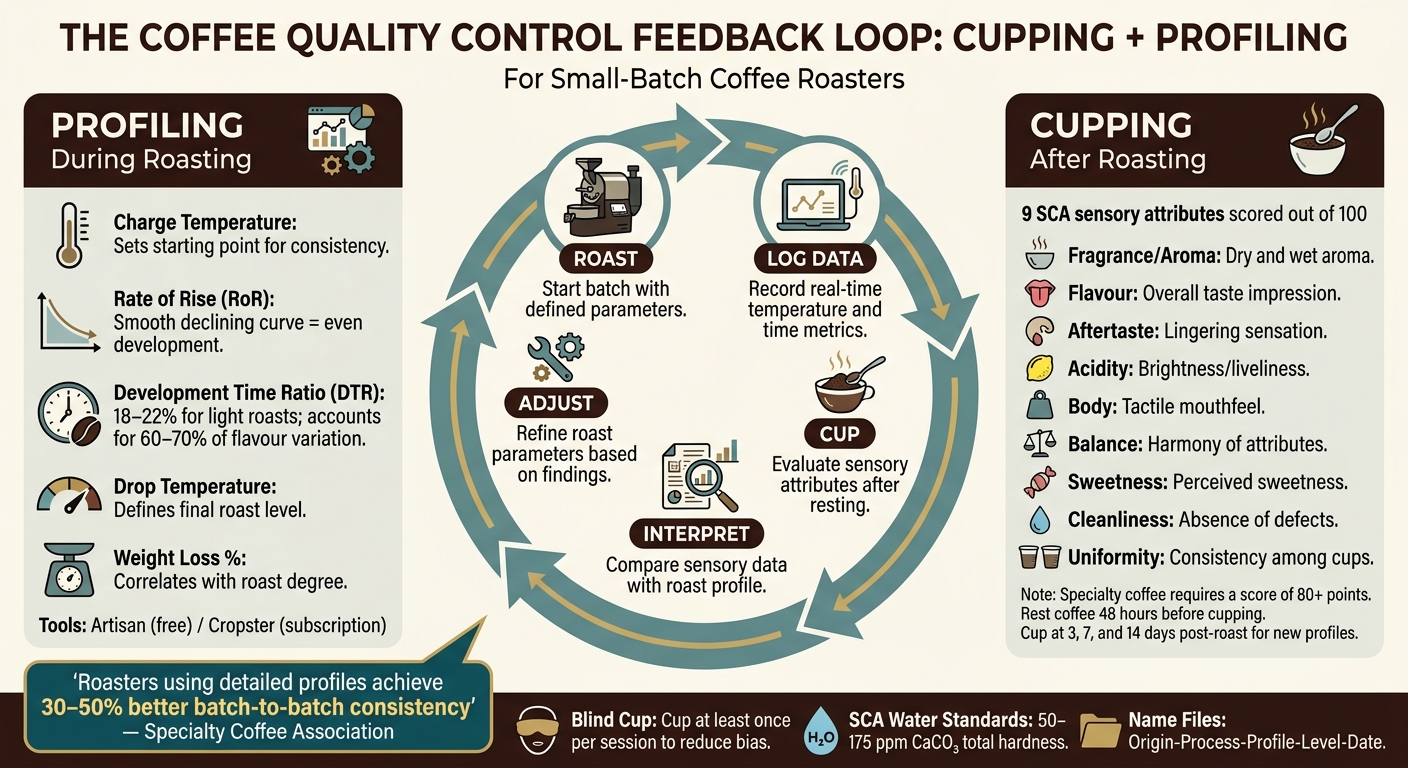
Cupping vs. Profiling: The Coffee Quality Control Feedback Loop
Setting Up a Cupping Routine
Regular cupping throughout the week is essential to catch potential issues before they reach your customers. Use standardised SCA scoring sheets to evaluate key attributes like acidity, sweetness, body, and aftertaste. For the most accurate flavour assessment, ensure the coffee rests for at least 48 hours after roasting before you begin cupping.
When working on new roast profiles, it’s helpful to roast at least three batches and cup them at 3, 7, and 14 days post-roast. This allows you to track how the flavour evolves over time. To minimise unconscious bias, include at least one blind cupping session where the taster doesn’t know details like the coffee’s origin, roast colour, or batch specifics. Keep detailed records, including sensory notes and measurable data like weight loss percentage and Agtron colour scores, to ensure your observations are backed by tangible metrics.
Once your cupping routine reliably captures flavour profiles, the next step is to establish a profiling system that builds on these evaluations.
Building a Profiling System
Create a reference profile for each coffee to help you identify any deviations in future batches. Free tools like Artisan make this process accessible, while subscription services like Cropster offer advanced features for those with higher production demands.
In the UK, seasonal changes in ambient conditions can pose challenges for consistency. Adjust your charge temperature accordingly: increase or decrease it by ±5°C for every 10°C change in ambient temperature. This helps maintain consistent heat transfer between batches. The table below outlines common seasonal adjustments:
| Condition | Adjustment | Rationale |
|---|---|---|
| High ambient temp (summer) | Reduce charge temp 5–10°C | Faster heat transfer |
| Low ambient temp (winter) | Increase charge temp 5–10°C | Slower heat transfer |
| High humidity (>70%) | Extend drying phase | More moisture to evaporate |
| Low humidity (<40%) | Reduce drying phase | Less moisture to evaporate |
To keep your records organised and easy to compare, adopt a consistent naming format, such as Origin-Process-Profile-Level-Date.
Once your profiling system is in place, it’s time to integrate these technical insights with your sensory evaluations.
Combining Both Tools in Your Workflow
Blending sensory data with technical measurements creates a reliable feedback loop. The most effective approach is to follow a repeatable cycle: roast, log data, cup, interpret, adjust. This combination of cupping and profiling is the foundation of quality control for small-batch roasting.
After each cupping session, link your sensory notes to the corresponding roast curve metrics. This creates a detailed reference library that you can use to refine future batches.
"We can connect the cupping notes to very specific landmarks or inputs on the roast profile and clearly identify where flavours (positive or negative) are being created during the roasting process." - Mill City Roasters
The Specialty Coffee Association highlights that roasters who maintain detailed profiles and records achieve 30–50% better batch-to-batch consistency compared to those relying solely on intuition. By letting data and tasting inform one another, you create a feedback loop that ensures consistent quality in every batch.
Conclusion: Maintaining Quality in Small-Batch Roasting
Cupping and profiling work hand in hand to create a strong quality control system. While profiling documents the roasting process, cupping verifies the final flavour. Both steps are crucial. For small-batch roasters, precision is everything; cupping identifies even the slightest flavour shifts, and profiling helps refine the process. This combination is the cornerstone of every carefully crafted batch.
These practices ensure that small-batch, ethically sourced coffee consistently delivers on quality.
At Creation Coffee, this level of precision and care turns each roast into an act of artistry rather than routine production.
"Every roast is crafted with care - from our traditional drum roaster in the log cabin at the bottom of the garden to your mug at home." - Creation Coffee
FAQs
How do I link cupping notes to roast data?
To connect cupping notes with roast data, use tools that help track and link roast parameters to sensory evaluations. By overlaying roast curves with cupping notes, you can pinpoint how specific variables impact flavour profiles.
Keep a consistent record of cupping sessions, compare the findings with roast data, and adjust profiles in a structured way. This method creates a stronger link between roast development and sensory results, enhancing quality control for small-batch coffee roasting.
What water should I use for consistent cupping?
For consistent cupping, it's important to use water that’s free from chlorine and any unpleasant odours. Aim for a pH level close to neutral, ideally between 6.5 and 7.5, and keep the Total Dissolved Solids (TDS) around 150 mg/L. Additionally, ensure minerals like calcium and sodium are within recommended levels to preserve the balance and clarity of your coffee's flavour.
Which roast metrics matter most for flavour?
Key factors that shape the flavour of a roast include development time, end temperature, and the rate of rise (RoR). A shorter roast tends to emphasise brightness and acidity, while a longer roast leans towards deeper, chocolate-like flavours. Keeping an eye on the development time ratio (DTR) is essential for achieving the right balance of acidity, sweetness, and bitterness. Additionally, closely tracking bean temperature and RoR allows roasters to adjust and refine the process to achieve the perfect flavour profile.