


When your coffee tastes the same every time, it’s no accident. Consistency in coffee blends comes from precise roasting, monitoring, and sourcing. This article explains how roasters maintain uniform flavour across batches by managing variables like bean weight, roast loss, and seasonal changes. Key techniques like pre-roast and post-roast blending, understanding roast levels, and ethical sourcing are covered to help ensure quality in every cup.
Key Points:
- Pre-roast blending is efficient but may compromise quality; post-roast blending offers more control over flavour.
- Roast levels - light, medium, and dark - affect flavour, acidity, and body differently.
- Monitoring factors like roast loss (12–20%) and bean moisture ensures consistency.
- Seasonal changes in temperature and humidity require adjustments in roasting profiles.
- Ethically sourced beans and small-batch roasting prioritise quality and flavour balance.
Precision and attention to detail at every stage ensure reliable, repeatable results. Whether you prefer filter coffee or espresso, these practices guarantee a satisfying brew every time.
Coffee Blends and Consistency Challenges
What Makes a Coffee Blend
A coffee blend is essentially a mix of beans from different regions, varietals, or processing methods, brought together to craft a balanced and layered flavour profile. For example, Ethiopian beans might add brightness and acidity, Sumatran beans contribute earthy depth, and Central American beans often provide chocolatey undertones.
Each type of bean carries unique qualities influenced by factors like altitude, soil, and climate. The roaster’s job is to carefully manage these elements, balancing sweetness, acidity, bitterness, and body. Even slight changes in the proportions can dramatically alter the final flavour.
While these diverse origins and methods make blends rich and interesting, they also introduce challenges in maintaining consistency. Understanding how blends are composed is key to addressing these potential hurdles.
Common Consistency Problems
The complexity of blending beans from different origins naturally leads to challenges in keeping the flavour consistent across batches. Coffee is, after all, an agricultural product, and beans from the same region can vary depending on the season. Roasters must rely on strict quality control and frequent cupping sessions to ensure uniformity. For instance, a blend that’s perfect in January might require tweaking by June, as new harvests bring subtle changes in flavour.
Processing methods add another layer of difficulty. Washed beans, known for their clean and crisp acidity, contrast with natural-processed beans, which are heavier and sweeter. Combining these styles in a single blend requires careful management to preserve the intended flavour.
Equipment can also play a role in consistency issues. Gas drum roasters, for instance, are sensitive to variations in gas pressure and airflow, which can disrupt the roast curve and lead to batch inconsistencies. Poor airflow might result in unpleasant "smokey" or "burnt" notes, whereas steady heat produces a cleaner, sweeter cup. Even minor shifts in gas pressure can completely alter the roast profile.
sbb-itb-cca2aed
Blending and Blend Theory for Coffee Roasters
Roasting Techniques for Uniform Blends
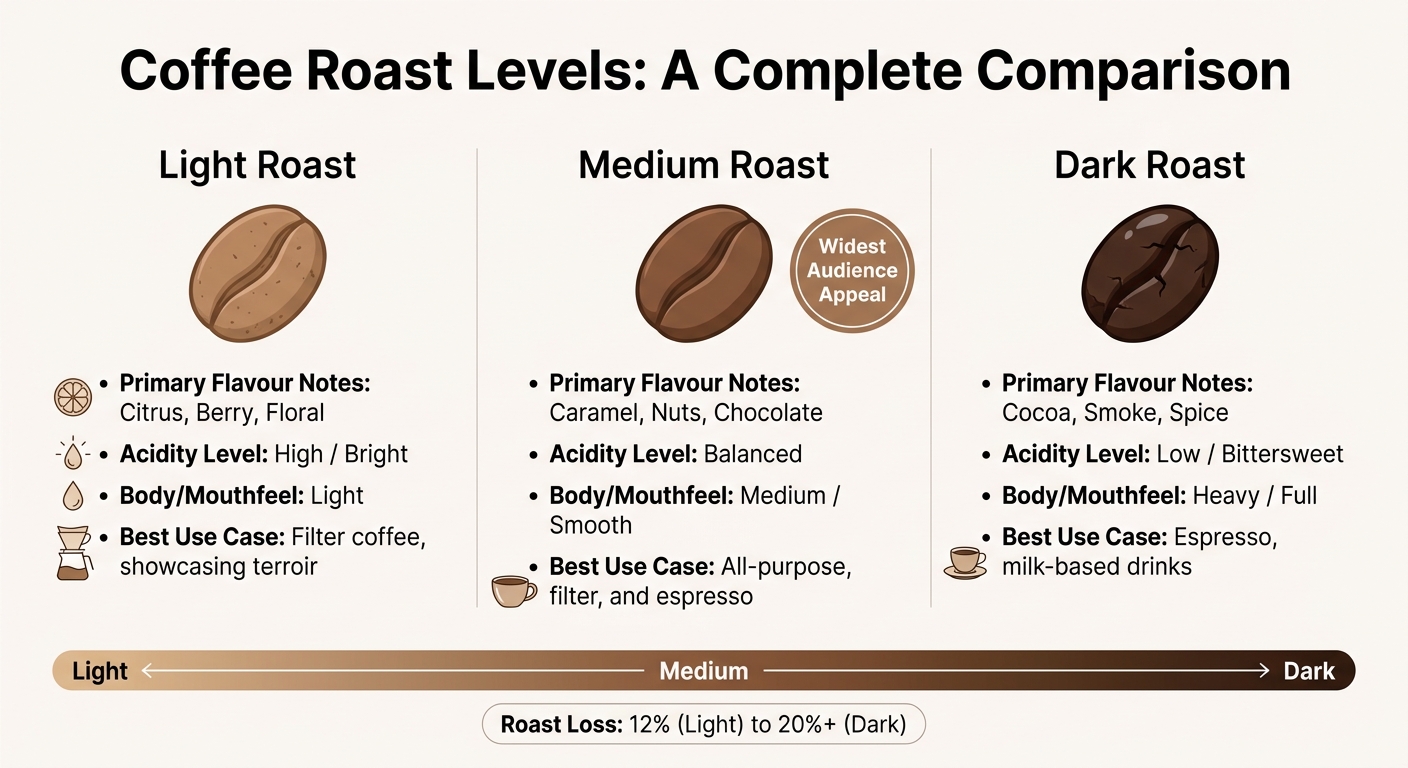
Coffee Roast Levels Comparison: Light, Medium, and Dark Roasts
Pre-Roast vs Post-Roast Blending
The timing of when you blend coffee beans - whether before or after roasting - has a major impact on the uniformity and quality of the final product.
Pre-roast blending involves mixing green coffee beans before roasting. This ensures that all the beans are roasted together for the same duration. It's about 15–20% more efficient in terms of production time and labour, making it a popular choice for large-scale operations. However, this approach can compromise quality.
"Many people feel that pre-blending sacrifices the quality of one or more components since you're not applying the 'ideal roast' to each individual bean." - Mill City Roasters
On the other hand, post-roast blending focuses on roasting each coffee separately to its ideal profile before combining them. This method allows for greater flavour precision, especially when dealing with beans that have differing densities or moisture levels. For instance, blending a delicate Ethiopian natural-processed bean with a dense Brazilian pulped natural pre-roast might lead to uneven roasting. Post-roast blending avoids this issue by treating each type of bean individually.
Some roasters opt for a hybrid method, pre-blending beans with similar roasting requirements while adding more delicate or distinctive beans post-roast. This approach balances efficiency with flavour control, particularly helpful for maintaining consistent blends when seasonal bean swaps are necessary.
One crucial factor to keep in mind: limit blends to a maximum of four components. Blends with five or more origins can lead to dosing inconsistencies. For example, in an 18–20g espresso shot, it's unlikely that the correct ratio of each component will be present, resulting in unpredictable extractions.
"If your espresso blend has five components, what's the likelihood that every 19 gram dose will have the correct amount of each of those components? Not likely. Who suffers in that situation? The barista... because every shot will pull differently!" - Mill City Roasters
Next, let’s delve into how roast levels influence blend consistency and flavour.
Roast Levels: Light, Medium, and Dark
After choosing a blending method, understanding how roast levels affect flavour and consistency is essential. Each roast level brings unique qualities that shape the final blend.
Light roasts highlight the bean's origin characteristics, such as citrus, berry, and floral notes. They tend to have bright acidity and a lighter body, making them ideal for filter coffee where the terroir can shine. However, they can be tricky to use in blends that require a more balanced profile.
Medium roasts are often the go-to for blending. They develop flavours like caramel, chocolate, and nuts while maintaining moderate acidity and a smooth body.
"We typically find medium roasted coffees have the widest audience appeal, offering a nice blend between traditional and interesting flavour profiles that work with all coffee drink types." - Jack Merriman, Bridge Coffee Roasters
Dark roasts lean towards bold, roast-driven flavours like cocoa, smoke, and toasted sugar. These roasts have low acidity and a full body, making them perfect for espresso or milk-based drinks where strong flavours are needed to stand out against dairy.
| Roast Level | Primary Flavour Notes | Acidity Level | Body/Mouthfeel | Best Use Case |
|---|---|---|---|---|
| Light | Citrus, Berry, Floral | High / Bright | Light | Filter coffee, showcasing terroir |
| Medium | Caramel, Nuts, Chocolate | Balanced | Medium / Smooth | All-purpose, filter, and espresso |
| Dark | Cocoa, Smoke, Spice | Low / Bittersweet | Heavy / Full | Espresso, milk-based drinks |
When crafting blends, roasters often mix high-acid beans with lower-acid ones to create a balanced espresso with pleasant acidity. For example, a medium-roasted Brazilian bean might bring chocolatey sweetness, while a lighter Kenyan coffee could add bright berry notes. Post-roast blending allows for precise control when combining beans roasted to different levels. These techniques are integral to maintaining the precision and care that define speciality coffee production, as exemplified by Creation Coffee.
Monitoring and Adjusting Roast Parameters
Measuring Key Flavour Attributes
Keeping an eye on both physical and sensory parameters is essential for maintaining blend consistency. Start by weighing your green coffee carefully - variations as small as 50 g can impact heat transfer rates, making consistent roasting more challenging. This step ensures a standardised approach to heat application.
One of the most reliable indicators of consistency is roast loss. By comparing the weight of green coffee to the roasted beans, you can track the percentage of weight lost, which typically ranges from around 12% for lighter roasts to over 20% for darker ones. If you notice significant deviations, it might point to changes in the moisture content of the green beans or inconsistencies in how the roast profile was executed.
Beyond weight, other metrics like moisture content, water activity, and bean density are worth monitoring. Using specialised meters for these measurements can help you predict how the beans will respond to heat during roasting and how stable they’ll be over time. For sensory evaluation, standard cupping forms are invaluable. Comparing attributes like acidity, body, and sweetness against a Reference Roast Profile helps you quickly identify any deviations. Together, these metrics provide a solid baseline that cupping further refines.
Using Cupping to Check Quality
Once you've measured the physical metrics, it's time to validate the sensory profile through cupping. This step ensures the roast delivers consistent flavours across the batch.
The standard practice is to cup five cups per lot to assess uniformity. Using the SCA cupping form, each cup can score up to 2 points (with a maximum of 10 for uniformity) if its flavour aligns with the others.
"Uniformity scores how consistent the five cups in a cupping session taste. If one cup is different from the others, it suggests the lot isn't consistent throughout." – Green Coffee Collective
If one cup stands out with an unusual flavour, like a ferment note, it could indicate issues like mixed lots or uneven drying. On the other hand, high uniformity scores confirm the roast profile is stable, and the cupping results accurately represent the entire batch. This multi-cup method is particularly effective at detecting off-notes, helping you pinpoint whether inconsistencies originate from the green coffee supply or the roasting process.
Adapting to Seasonal Bean Changes
Seasonal and environmental changes can have a noticeable impact on roasting, requiring you to adjust your approach in real time.
Factors like ambient temperature and humidity play a big role in how beans behave during roasting. For instance, colder winters can slow down how quickly your roaster heats up, while high humidity can cause beans to lose moisture faster, accelerating the roast.
"Ambient temperature and humidity significantly impact roast dynamics. During cold winters, our roaster takes longer to heat up... We adjust our gas application, airflow, and charge temperatures seasonally to compensate for these environmental factors." – Holistic Roasters
To counteract these challenges, make sure to bring green beans to room temperature at least 24 hours before roasting if they’ve been stored in a cold environment. Adjust the charge temperature as needed - increase it during colder weather to offset heat loss, and lower it in warm, humid conditions to avoid over-roasting.
Another key metric to monitor is the Development Time Ratio (DTR), which refers to the percentage of the roast time that occurs after the first crack. For espresso, a DTR of 20–26% typically strikes a good balance between acidity and body. Seasonal changes in bean moisture or density may also require tweaks to your roast profiles or bean ratios to maintain consistency.
Sourcing and Crafting Ethical Blends
Creating consistent coffee blends isn’t just about tweaking roast settings - it’s also about sourcing top-tier, ethically traded beans and maintaining tight control over production through small-batch roasting.
Selecting Ethically Sourced Beans
Direct trade is the backbone of dependable, high-quality blends. By sourcing beans directly from cooperatives like Honduras' La Central Cooperative or farms in Ethiopia’s Kochere district, roasters not only support fair practices but also secure the consistent quality needed for reliable flavour profiles. Blends also help smooth out annual variations by combining beans from different regions with similar flavour characteristics.
Ethical sourcing goes hand in hand with transparency. It’s about knowing where the beans come from and focusing on their complementary attributes - not using blends to mask lower-quality beans. For instance, Brazil’s nutty, chocolatey undertones pair beautifully with Ethiopia’s bright, floral notes, creating a balanced blend when both origins meet strict quality standards.
Small-Batch Roasting for Precision
Once ethically sourced beans are selected, small-batch roasting takes centre stage in refining the blend. This approach prioritises quality over quantity, focusing on developing each bean’s full flavour potential. It’s all about finding the perfect harmony of acidity, sweetness, and bitterness.
"Our aim when roasting isn't to produce the largest amount of coffee in the shortest time possible." – Danelaw Speciality Coffee
Small-batch roasting offers the precision needed to avoid defects. Roasting too quickly can lead to flat flavours, while slow roasting risks woody, overdeveloped notes. For blends, it’s critical to roast each origin separately to a consistent medium level. This ensures that the focus remains on the blend’s flavour profile rather than inconsistencies in the roast. Testing small 100-gram batches with different ratios - such as 70% Colombia and 30% Kenya - helps identify the ideal balance before scaling up.
Case Study: Creation Coffee
Creation Coffee perfectly illustrates the impact of ethical sourcing and small-batch roasting. By combining hand-roasting techniques with direct trade practices, they ensure every 250g, 500g, or 1kg bag delivers the consistent flavour profile their customers expect. Their attention to detail at every stage guarantees quality in every cup.
Conclusion
Creating consistent coffee blends demands a mix of precise roasting methods, careful monitoring, and responsible sourcing practices. Whether you opt for pre-roast blending for efficiency or post-roast blending to fine-tune complex flavour profiles, success lies in understanding your beans and maintaining control at every stage of the process. This attention to detail forms the backbone of a reliable and repeatable roasting routine.
Keeping track of key metrics - like bean temperature, ambient temperature, and rate of rise - helps you replicate successful roasting profiles. Additionally, logging environmental data alongside these profiles allows you to adjust for seasonal variations that can influence your roaster’s performance.
Small-batch roasting plays a vital role in achieving this precision. Testing with 100-gram batches helps fine-tune bean ratios and balance flavours. Pair this with direct trade sourcing, and you ensure that every element of your blend meets the highest standards of quality and flavour.
Creation Coffee exemplifies this dedication to consistency with their hand-roasting techniques and commitment to direct trade sourcing. Whether you’re buying a 250g, 500g, or 1kg bag, their small-batch approach ensures every cup delivers a well-crafted flavour profile. Check out their selection at creationcoffee.co.uk and experience how precision roasting and ethical sourcing elevate every sip.
FAQs
How do I decide between pre-roast and post-roast blending?
When deciding between pre-roast and post-roast blending, it all comes down to what you prioritise: consistency or flavour precision.
Pre-roast blending means mixing the green coffee beans before roasting. This method ensures the beans roast together evenly, resulting in a consistent flavour profile across the batch.
On the other hand, post-roast blending involves roasting each type of bean separately before combining them. This approach gives you more control over the roast level of each bean, helping to highlight their individual characteristics. However, it can introduce some variation in the final blend.
If you’re after uniformity, pre-roast blending is the way to go. But if you want to maximise the unique flavours of each bean, post-roast blending might be your best bet.
What’s the quickest way to spot roast inconsistency batch-to-batch?
The quickest way to spot inconsistencies between roast batches is to keep an eye on crucial metrics like bean temperature, rate of rise (RoR), and first crack timing. Leveraging data logging tools allows you to compare roasting profiles and identify any variations. Regularly monitoring these elements ensures consistency in both blend quality and uniformity.
How should roast profiles change with UK seasonal humidity and temperature?
Roast profiles in the UK need to account for seasonal shifts, especially during the summer when humidity levels rise, and temperatures climb. It's important to adjust drying times and heat application to keep moisture reduction consistent. This approach helps avoid over-roasting and ensures your blends remain consistent, no matter the time of year.