


Less than 10% of plastic waste in the UK gets recycled, and coffee packaging is a major contributor to landfill waste. Compostable coffee bags offer a plant-based alternative that breaks down into organic matter instead of polluting the environment.
Here’s what you need to know:
- Types of Compostable Bags: Some are designed for industrial composting (requiring facilities with high temperatures), while others are certified for home composting and can decompose in garden bins.
- Materials: Commonly made from cornstarch, sugarcane, or wood pulp, these bags meet strict standards like EN 13432 to ensure full decomposition.
- Disposal Challenges: UK councils often lack facilities to process industrially compostable bags, leaving home composting as the most practical option for many.
- Limitations: Compostable bags have a shorter shelf life, weaker seals, and higher costs compared to traditional packaging.
Tip: Always check the certification label (e.g., "OK Compost Home") and follow proper disposal methods to maximise their benefits.
How to make compostable & biodegradable (coffee) packaging
sbb-itb-cca2aed
What Are Compostable Coffee Bags?
Compostable coffee bags are made from plant-based materials like cornstarch, sugarcane, or wood pulp. These materials are designed to break down under specific conditions without leaving behind harmful residues or microplastics . Unlike items labelled as biodegradable - which simply degrade over time - compostable bags must meet strict certification standards, such as EN 13432. This ensures that every single component of the bag, from the outer wrap to the zippers, is fully compostable.
"There's no such thing as 80-percent compostable and 20-percent not. Either you're compostable or not."
Brenda Platt, Co-director of the Institute for Local Self-Reliance, highlights that this certification applies to all parts of the bag. Many compostable coffee bags include multiple layers, such as outer wraps, internal liners, degassing valves, and zippers. Each layer must pass certification to ensure the entire product is compostable. However, some products marketed as "made from compostable materials" can still include non-compostable elements like valves or closures.
For these bags to decompose, they need specific conditions - heat, moisture, and microbial activity. Without these, the materials won't break down. In the right environment, biopolymers like PLA degrade into smaller pieces that microorganisms consume, eventually turning into lactic acid. Paper and cellulose components, on the other hand, decompose more slowly, giving structure to the compost pile. These technical processes set compostable bags apart from traditional laminated coffee packaging.
Unlike conventional coffee bags - which are often laminated with plastic or aluminium and difficult to recycle - compostable bags provide an alternative that avoids landfill waste. However, their design does come with limitations. For instance, their shelf life is roughly 12 months, and they are not ideal for coffee weights exceeding 1 kg due to weaker seals. While compostable bags present a more eco-friendly option, these constraints should be carefully considered for practical use.
Materials Used in Compostable Coffee Bags
Compostable coffee bags are made using materials like plant-based biopolymers, cellulose films, and paper laminates. With the UK's Extended Producer Responsibility (EPR) regulations coming into force in 2026, simpler mono-material packaging designs are becoming more attractive due to lower fees. For example, plastic incurs £423 per tonne, while paper or cardboard costs only £196 per tonne. Knowing the properties of these materials is essential for assessing their performance, environmental impact, and cost-effectiveness.
Plant-Based Biopolymers
One of the most widely used biopolymers in compostable coffee bags is Polylactic Acid (PLA). Sourced from renewable materials like corn starch or sugarcane, PLA is biodegradable and has antibacterial properties. However, it doesn’t match aluminium foil or composite materials when it comes to protecting against oxygen and moisture. This creates a trade-off between a shorter shelf life and the potential cost savings under the EPR framework.
Cellulose Films
Cellulose films act as plant-based laminates, offering a compostable alternative to traditional plastics while maintaining similar barrier properties. They are often paired with other materials to enhance moisture resistance. A growing trend in the industry is replacing aluminium foil layers with these plant-based options, which help maintain product freshness while avoiding high EPR fees tied to multi-material laminates.
Paper Laminates
Kraft paper is a popular choice for the outer layer of compostable coffee bags. While it is a sustainable and cost-effective material under EPR regulations, its natural resistance to moisture is limited. To address this, kraft paper is often combined with additional laminates, creating a balance between eco-friendliness and effective coffee preservation. For instance, pairing a kraft paper exterior with a bioplastic inner layer provides both sustainability and functionality.
Mono-material designs, where the entire package consists of a single type of material, simplify waste management and help meet EPR compliance requirements. As Albiz Packaging highlights:
"Packaging that's harder to recycle attracts higher costs, whilst sustainable, easily recyclable materials benefit from lower fees".
This push for mono-material solutions aligns with industry trends, making waste processing and reporting more straightforward.
Certifications for Compostable Coffee Bags in the UK
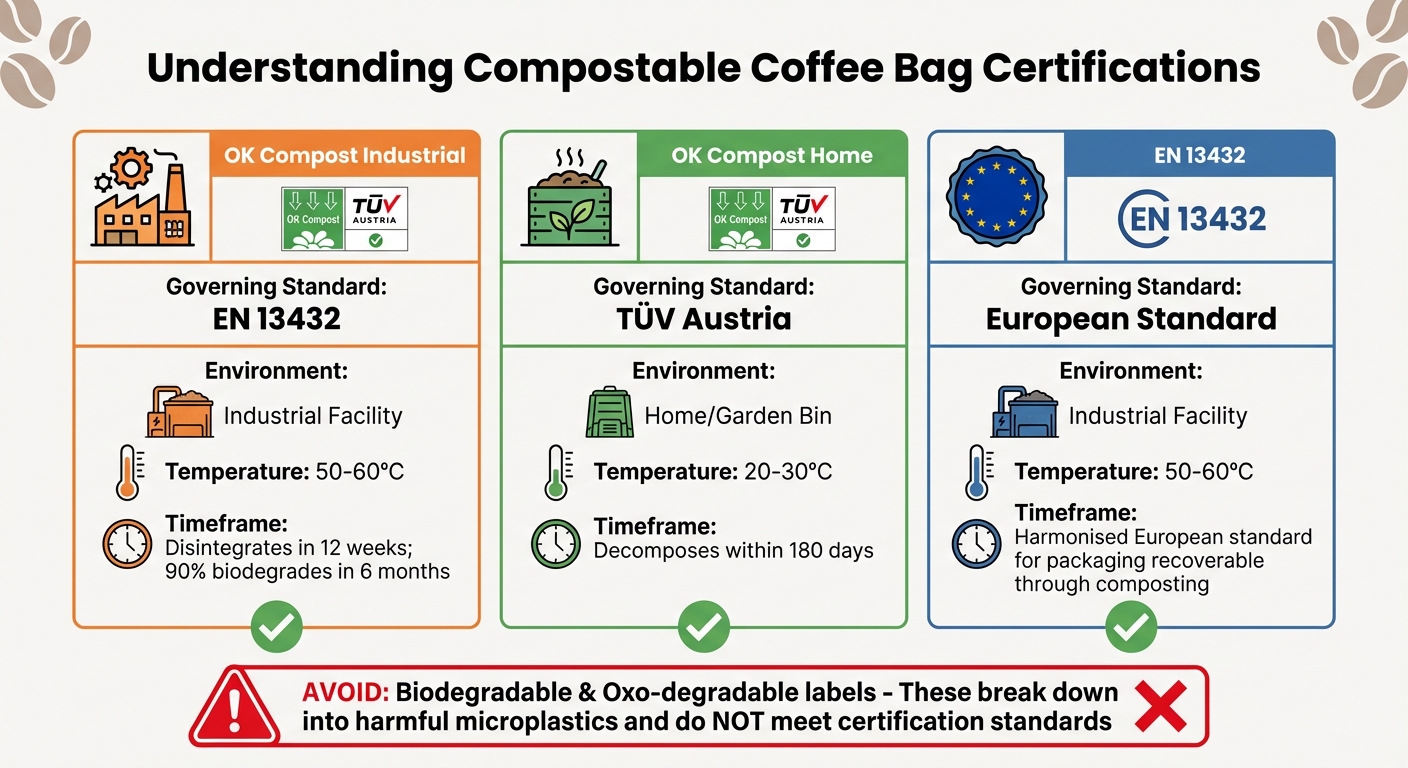
Compostable Coffee Bag Certifications and Disposal Methods Comparison
Certifications play a crucial role in ensuring compostable coffee bags live up to their promise of breaking down completely, which is essential for proper waste management. These certifications confirm that every part of a coffee bag degrades fully. In the UK and Europe, the EN 13432 standard is the benchmark for compostable packaging, with certification typically managed by organisations like TÜV Austria and DIN Certco.
Coffee bags often consist of 4–6 components, such as laminated layers, degassing valves, and zippers. For a coffee bag to achieve full certification, the entire assembled pouch must pass rigorous testing to confirm all components degrade together. This distinction is vital: a bag "made from compostable materials" does not automatically qualify as a "certified compostable pouch." Certification involves testing every element to ensure the whole product meets compostability standards.
Understanding EN 13432 Certification
The EN 13432 standard requires packaging to disintegrate within 12 weeks and achieve 90% biodegradation within six months under industrial composting conditions. Industrial facilities maintain temperatures between 50–60°C to speed up the decomposition process. Grounded Packaging explains:
"Commercial composting facilities generally run at a much higher temperature than home composts, generally 50-60C... and it is that additional temperature that helps process the organic matter with greater speed".
For consumers who rely on home composting, certifications like OK Compost Home from TÜV Austria ensure materials can break down at lower temperatures of 20–30°C. This is particularly relevant in the UK, where many households use garden bins, and local councils may not always accept compostable packaging in food waste collections.
Comparison of Certifications
| Certification | Governing Standard | Composting Environment | Temperature | Key Guarantee |
|---|---|---|---|---|
| OK Compost Industrial | EN 13432 | Industrial Facility | 50–60°C | Disintegrates in 12 weeks; 90% biodegrades in 6 months |
| OK Compost Home | TÜV Austria | Home/Garden Bin | 20–30°C | Decomposes at ambient garden temperatures |
| EN 13432 | European Standard | Industrial Facility | 50–60°C | Harmonised European standard for packaging recoverable through composting |
These certifications define how compostable bags should be processed in both industrial and home composting environments. Be wary of misleading terms like "biodegradable" or "oxo-degradable", which do not meet EN 13432 or TÜV Austria standards. Such materials often break down into harmful microplastics instead of fully decomposing.
These strict certification standards set the stage for discussing proper disposal methods in the following section.
How to Dispose of Compostable Coffee Bags in the UK
Disposing of compostable coffee bags in the UK can be tricky. It depends on factors like certifications, local council services, and whether you have access to home composting. Certifications such as EN 13432 or OK Compost Home determine how these bags should be handled, so understanding the right disposal method is essential to maximise their environmental benefits.
Industrial Composting
First, check your local council's food waste policy. Many councils now rely on Anaerobic Digestion (AD) systems, which aren't designed to handle compostable bags. As The Coffee Factory explains:
"Most UK food waste is processed using Anaerobic Digestion (AD). These systems... cannot process compostable packaging. When compostable bags end up in food waste bins, they are treated as contaminants".
In AD systems, these bags are often removed as contaminants and sent to landfill or incineration. Adding to the challenge, only 12% of UK councils collected food waste as of 2021, leaving many households without this option.
If your council doesn’t accept compostable packaging, consider brand-led take-back schemes. For example, Bella Barista's "Ground to Ground" Eco-Alliance lets you return four bags for recycling and rewards you with a 5% discount. These initiatives can fill the gap where local services fall short.
Home Composting
If your coffee bag is certified "OK Compost Home", you can compost it in your garden bin. These bags decompose at ambient temperatures of 20–30°C, usually within 180 days. To speed up the process, place the bag in the centre of your compost heap, where it’s warmest.
For effective composting, mix soft green materials (like grass clippings or vegetable waste) with woody brown materials (such as twigs, cardboard, or paper). Regularly turning the pile ensures oxygen circulates, which helps break everything down without producing methane.
However, bags labelled only as "industrially compostable" (EN 13432) won’t break down in home compost bins. These need the high temperatures found in commercial composting facilities.
Avoiding Recycling Contamination
Never toss compostable coffee bags into your plastic recycling bin. These bags are often made from bioplastics like cornstarch, which can disrupt the recycling process for traditional plastics. Always follow the correct disposal route to avoid contamination and ensure these bags are handled properly.
Benefits and Limitations of Compostable Coffee Bags
Having looked at disposal methods, it’s worth exploring the broader benefits and challenges of compostable coffee bags, especially in the UK.
Advantages
When disposed of properly, compostable coffee bags can have a positive impact on the environment. Unlike traditional plastics, which can linger in the environment indefinitely, these bags are made from plant-based materials like cornstarch, sugarcane, or wood pulp. They also generate fewer greenhouse gas emissions during production. Once they break down, they contribute organic matter to the soil, improving its fertility and structure while supporting healthier ecosystems.
Take Biotrē bags as an example: they are 60% biodegradable by weight, with the paper component decomposing in about 84 days under the right conditions. This approach not only reduces waste but also aligns with the goals of ethical coffee roasters aiming for sustainable solutions.
Limitations in the UK Context
However, the situation in the UK is more complicated. Many compostable bags, certified under EN 13432, require industrial composting facilities to break down properly. Unfortunately, these facilities are scarce and often not accessible to most people. Without suitable disposal options, these bags may end up in general waste, negating their environmental benefits.
Cost is another hurdle. Compostable bags tend to be pricier than traditional foil-lined alternatives. For example, RAVE Coffee sells a 10-pack of compostable bags for £4.95, while Lyons go-Joe offers a similar product at around £2.20 per box of 10. For smaller coffee roasters, this price difference can be a significant challenge.
Maintaining product freshness also poses a problem. As Jared Rennie, Founder and CEO of Noble Coffee, puts it:
"Choosing packaging is a constant balance between quality and sustainability".
Certain bags include non-compostable parts like tin ties and valves, which must be removed manually. Additionally, partially compostable bags with polyethylene liners can take 5 to 10 years to decompose if not processed under optimal conditions. While these challenges highlight the complexity of eco-friendly packaging, they also reflect an industry in transition.
Comparison Table
Here’s a summary of the key benefits and challenges:
| Aspect | Advantages | Limitations |
|---|---|---|
| Environmental Impact | Decomposes into soil-enriching organic matter; lower greenhouse gas emissions | Limited access to industrial composting facilities may lead to disposal in general waste |
| Cost | Supports eco-conscious practices | Higher costs, ranging from £2.20 to £4.95 per 10 bags |
| Disposal | Can return nutrients to soil when composted properly | Requires industrial composting, which is not widely available |
| Convenience | Fits with sustainable goals | Non-compostable components need manual removal, adding complexity |
| Product Protection | Protects coffee to a reasonable extent | May not preserve freshness as effectively as foil-lined options |
Conclusion
Compostable coffee bags can help reduce packaging waste, but only if they’re disposed of correctly. Most of these bags, while made from plant-based materials, require industrial composting facilities to break down properly. Unfortunately, such facilities remain out of reach for many households in the UK.
When these facilities aren’t available, compostable bags often end up in general waste bins or contaminate recycling streams. To address this issue, some UK coffee roasters have turned to using 70% post-consumer recycled (PCR) plastic instead. This material integrates more easily into the existing local recycling infrastructure.
At Creation Coffee, sustainability shapes everything we do. From ethically sourcing our beans through direct trade to donating 10% of our profits to a children's charity, we aim to make choices that benefit both people and the planet. As we explore new packaging options, we focus on solutions that are practical and effective within everyday settings. This approach highlights how important proper disposal methods are to achieving environmental goals.
What can you do? Always check the label. Determine whether a bag is home compostable, industrial compostable, or recyclable. Follow your local council’s guidelines for compostable waste. For recyclable LDPE 4 bags, take them to a supermarket collection point. Remember, proper disposal is just as critical as choosing eco-friendly packaging.
FAQs
How can I tell if my coffee bag is home compostable?
To determine if your coffee bag is suitable for home composting, check for labels indicating it is 100% biodegradable and plastic-free. Additionally, it should specify that it breaks down into water, CO₂, and biomass within roughly a year. Avoid bags with non-biodegradable components, as these won't decompose naturally in a home compost setup.
What should I do if my council won’t accept compostable packaging?
If your local council in the UK doesn't handle compostable packaging, you might want to explore sending it to an industrial composting facility. These facilities are specially designed to process items like compostable coffee bags and food packaging - materials that often don't decompose properly in home compost bins or kerbside recycling. Avoid throwing compostable packaging into regular waste or recycling bins, as it could end up in landfill, defeating its purpose of being composted.
Do compostable bags keep coffee fresh as long as foil bags?
Compostable coffee bags may not keep your coffee as fresh as foil bags with one-way valves. They provide less defence against light, oxygen, and moisture, which can cause coffee to age more quickly. On the other hand, foil bags with valves are specifically designed to block light and oxygen while letting CO₂ escape, preserving the coffee's freshness for a longer period. That said, compostable bags are a more environmentally friendly choice.