


Coffee farming depends heavily on water, but choosing between rainfall and irrigation can significantly impact yields, quality, and costs. Here's what you need to know:
- Rainfall: Free and natural, it shapes the flavour of coffee beans. However, unpredictable patterns can harm crops through drought or excessive rain, leading to lower yields and quality issues.
- Irrigation: Offers precise water control, doubling yields in some cases and improving bean quality. But it requires high upfront costs, ongoing maintenance, and can strain local water resources.
Quick Comparison
| Aspect | Rainfall | Irrigation |
|---|---|---|
| Cost | Minimal | High initial and operational costs |
| Yield Stability | Risky; droughts or storms reduce yields | Stable; consistent water boosts yields |
| Water Efficiency | Variable; prone to runoff and erosion | High; drip systems up to 95% efficient |
| Bean Quality | Variable; depends on weather | Consistent; controlled water improves size and density |
| Labour | Low | Requires maintenance and monitoring |
The best choice depends on your farm's conditions, budget, and climate challenges. Balancing water management with responsible practices is key to growing quality coffee.
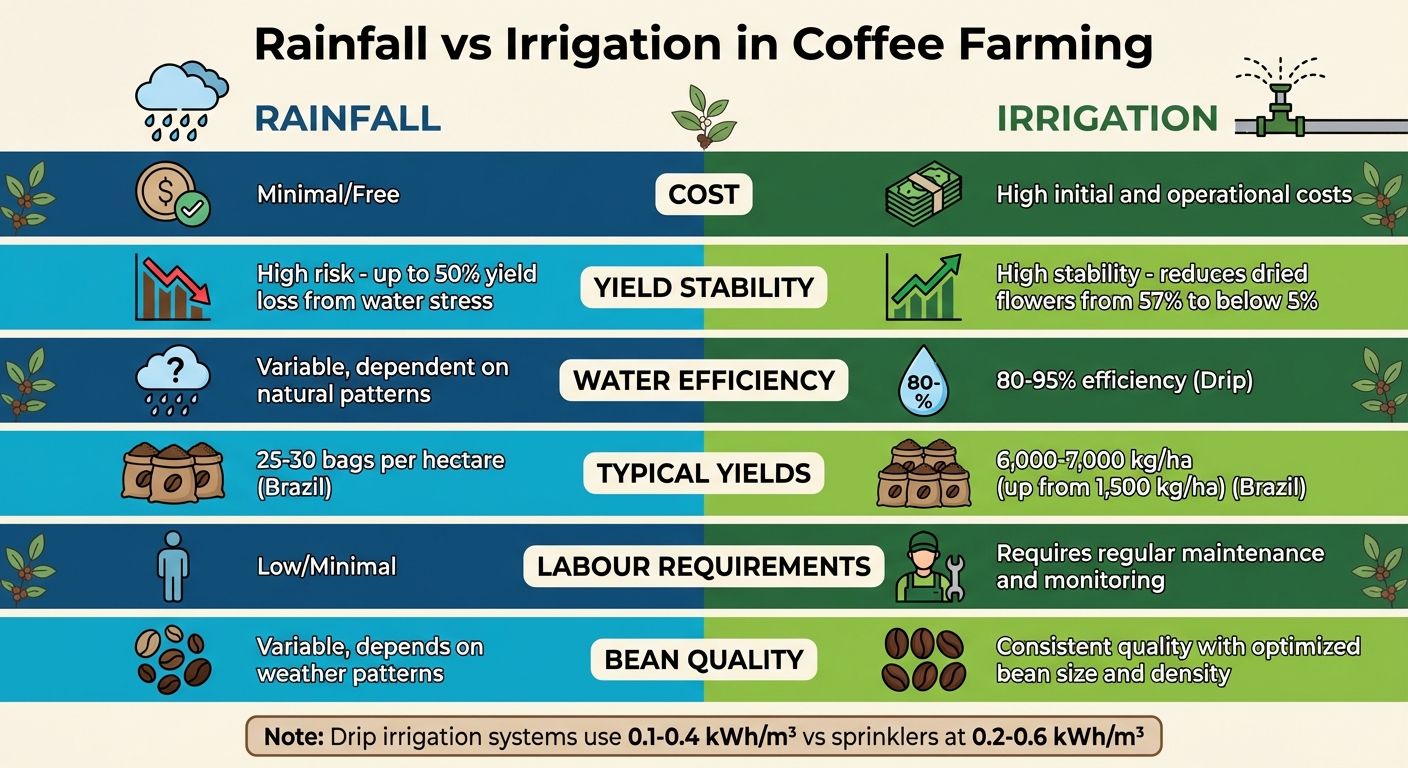
Rainfall vs Irrigation in Coffee Farming: Cost, Yield, and Efficiency Comparison
Rainfall-Dependent Coffee Farming: Pros and Cons
Benefits of Rainfall
Relying on natural rainfall can significantly reduce expenses for coffee farmers. Without the need for pumps, hoses, emitters, or the ongoing costs of electricity or fuel, growers can save a considerable amount of money. For small-scale farmers working within tight budgets, these savings can be the difference between staying afloat or facing financial hardship.
Rainfall also plays a crucial role in shaping the terroir - the environmental factors that give coffee its distinct flavour profile. The interplay of natural precipitation, soil composition, and altitude creates unique sensory characteristics in coffee beans. Evening rains, for instance, cool the air and slow the maturation of beans, allowing sugars and acidity to develop more fully. This natural process not only enhances flavour but also supports farming methods that align with ecological practices. However, while rainfall has its advantages, it also presents challenges that can impact crop reliability.
Drawbacks of Rainfall
The unpredictability of natural rainfall is a significant drawback for coffee farming. Coffee plants need precise amounts of water during critical stages, such as after flowering and during grain development. Irregular rainfall can lead to rapid flower drop or drought conditions, which may cause defoliation and halt photosynthesis. The result? Smaller beans of lower quality.
Excessive rainfall brings its own set of issues. Heavy storms can strip away topsoil rich in nutrients, while prolonged wet conditions create a breeding ground for pests and diseases like coffee leaf rust. Too much moisture can also lead to unintentional fermentation within the beans, resulting in undesirable flavours that lower the quality of the crop. As Ebru Coffee Co. explains:
"While navigating rainfall has always been a challenge, the effects of modern climate change are causing terroirs that were once havens for coffee plants to become unsuitable for growing".
The statistics highlight the challenges. In Brazil, rainfall-dependent farms typically yield 25–30 bags per hectare, with initial harvests sometimes producing as little as 15 bags. Seedling loss can climb as high as 20%, depending on weather conditions. In places like Puna, Hawaii, where rain falls year-round, coffee plants grow and develop at different stages simultaneously. This complicates the harvesting process, making it slower, more selective, and far more expensive.
sbb-itb-cca2aed
Irrigation in Coffee Farming: Pros and Cons
Benefits of Irrigation
Relying solely on unpredictable rainfall can be risky, but irrigation offers a way to manage water with precision. For coffee farming, this is especially important during the critical 10–17-week period after flowering, which plays a major role in determining the size and quality of coffee beans. Regular watering during this phase helps prevent the formation of small, poor-quality fruit and reduces the chance of "twisting" - a condition where buds fail to open or flowers dry out. Without irrigation, yield losses can reach up to 50%, but irrigation can reduce dried flower incidence from 57% to less than 5%.
A real-world example of irrigation's impact comes from Brazil, where NaanDanJain's drip-irrigation system, implemented across 10,000 hectares, boosted yields from 1,500 kg/ha to 6,000–7,000 kg/ha.
Irrigation also opens the door to fertigation, where fertilisers are delivered through the water system. This approach can increase productivity by as much as 123% compared to non-irrigated crops. Drip irrigation systems, in particular, are highly efficient, achieving water usage rates of 80–95%, compared to just 40–75% for surface irrigation. As Martín Ventura Viana, a third-generation coffee grower, points out:
"shown an improvement in the photosynthesis process and increased production quantity and bean quality".
Despite these benefits, irrigation does come with its own set of challenges, particularly in terms of cost and maintenance.
Drawbacks of Irrigation
One of the biggest hurdles for farmers is the financial cost. Setting up an irrigation system requires a significant investment in equipment like pumps, hoses, drip emitters, sprinklers, and filtration systems. If the water source is lower than the plantation, additional pumping equipment is needed, further increasing costs. Energy consumption is another factor, with sprinkler systems using 0.2–0.6 kWh per cubic metre of water, while drip systems consume slightly less at 0.1–0.4 kWh per cubic metre. For many farmers dealing with fluctuating coffee prices, these upfront and ongoing costs can be a major deterrent. As Martín Ventura Viana explains:
"The unsteady prices in the coffee industry have not made it viable for me to invest in one of these methods".
Maintenance is another challenge. Filters need regular cleaning to prevent clogging, and the entire system requires constant monitoring to ensure it runs efficiently. Farms located on steep slopes - particularly those with gradients over 45° - face additional difficulties, as specialised methods are needed to manage water runoff. Furthermore, heavy water use is a concern. In some Brazilian coffee farms, irrigation can consume around 94,000 litres of water per hectare per week, raising questions about the impact on local water supplies. Balancing these challenges is key to maintaining both quality and responsible water use.
Rainfall vs Irrigation: Comparison Table
Here's a side-by-side look at how rainfall and irrigation stack up:
| Aspect | Rainfall Pros/Cons | Irrigation Pros/Cons |
|---|---|---|
| Yield Stability | High risk; water stress can cause up to 50% yield loss | High stability; reduces dried flowers from 57% to below 5% |
| Cost | No installation or operational costs | High initial investment for infrastructure |
| Water Efficiency | Dependent on natural variability and prone to losses from runoff/erosion | High efficiency (80–95% for drip systems) |
| Quality Consistency | Variable; drought can lead to small or damaged beans | Consistent quality; optimises bean size and density |
| Labour | Minimal | Requires regular maintenance and monitoring |
| Environmental Impact | Follows natural cycles, though heavy rain can cause soil erosion | Potential risk of over-extraction from local water resources |
Next, we’ll dive into the specific irrigation methods that help coffee farmers fine-tune their water management.
Drip vs Sprinkler Irrigation for Coffee
Drip Irrigation
Drip irrigation systems stand out for their ability to deliver water directly to the root zone with precision. This method operates at an impressive efficiency of 80–95%, ensuring minimal water loss through evaporation or runoff. This level of precision is particularly advantageous in the hilly landscapes typical of coffee-growing regions, where emitters help equalise water flow across varying elevations.
Another key advantage is the system's lower energy requirements, consuming just 0.1–0.4 kWh per cubic metre of water, making it more energy-efficient than sprinklers. Additionally, drip systems keep the foliage dry, which helps reduce the risk of fungal and bacterial diseases. By leaving the spaces between rows dry, they also discourage weed growth. Drip irrigation is highly compatible with fertigation, enabling nutrients to be delivered directly to the roots through the water supply, ensuring efficient absorption. However, maintaining the system is crucial - filters must be cleaned regularly to prevent clogging.
Now, let’s look at how sprinkler systems approach water distribution differently.
Sprinkler Systems
Sprinkler systems distribute water across a larger area in a circular pattern, but they operate at a lower efficiency of 60–85%. They also require more energy, consuming 0.2–0.6 kWh per cubic metre. These systems are more prone to water loss through evaporation, runoff, and overspray, especially on steep slopes or during the hottest parts of the day. Martín Ventura Viana, a third-generation coffee grower, explains:
"In actual plantations with fully grown trees, [sprinkler irrigation] might not be as effective... as there could be water loss through evaporation, runoff, or overspray".
To reduce these losses, sprinklers need precise calibration, and irrigation should ideally be scheduled for early morning, late afternoon, or nighttime. This strategy avoids the "magnifying glass effect", where sunlight heats water droplets on leaves, potentially causing damage. Micro-sprinklers offer a practical compromise, particularly in rocky or organic coffee plantations, as they can also aid in distributing compost and manure effectively.
Here’s a quick comparison of the two methods:
| Feature | Drip Irrigation | Sprinkler Systems |
|---|---|---|
| Efficiency | 80–95% | 60–85% |
| Energy Use | 0.1–0.4 kWh/m³ | 0.2–0.6 kWh/m³ |
| Water Loss | Minimal | High (evaporation, wind drift) |
| Terrain Suitability | Excellent | Limited on steep slopes |
| Disease Risk | Lower | Higher (due to wet foliage) |
How Water Sources Affect Coffee Quality and Farming Practices
Water Management and Environmental Impact
How farmers manage water - whether they depend on natural rainfall or use controlled irrigation - has a big impact on the environment. For example, in Vietnam, water management initiatives have reduced water usage per tree from 1,000 litres to just 400 litres per irrigation cycle. Additionally, agroforestry methods, such as maintaining forest canopies, terracing, and using cover crops, play a key role in protecting coffee plants. These techniques act like natural shields, reducing storm damage, stabilising soil, and limiting nutrient loss, as well as preventing pesticide and fungicide runoff.
By carefully managing water, farmers not only protect the environment but also create ideal conditions for producing higher-quality coffee beans.
Water Sources and Coffee Quality
Water availability and consistency are crucial for coffee quality. Controlled irrigation helps maintain steady moisture levels, which is essential for proper bean development. This consistent moisture ensures beans grow with the right density, leading to even roasting and balanced flavours. On the other hand, unpredictable rainfall can cause uneven ripening, resulting in beans with inconsistent quality. With controlled irrigation, farmers can achieve uniform bean maturation, making it easier to produce coffee with consistent flavour and roasting characteristics.
Creation Coffee partners with farmers who prioritise sustainable water practices, delivering hand-roasted, small-batch specialty coffee that respects both the environment and the communities that grow it.
Conclusion
The choice between irrigation and relying on rainfall isn’t about picking one over the other - it’s about finding the right balance for each farm’s unique needs. Rainfall-based farming can be a cost-effective and traditional approach where precipitation is dependable. On the other hand, irrigation offers consistency and supports higher yields, particularly during the crucial 10 to 17 weeks after flowering, when coffee beans develop most rapidly. Striking this balance is key, as effective water management and care for the environment are fundamental to producing high-quality coffee.
Sustainable water practices, such as agroforestry, rainwater harvesting, and precision drip systems, help maximise water efficiency while minimising environmental impact. These methods create resilient farming systems that safeguard both the land and the quality of the coffee produced.
Ethical sourcing, particularly through direct trade, also plays a vital role in promoting sustainable water use. Fair direct trade relationships enable farmers to invest in water-saving technologies and adapt to changing climate conditions, ensuring long-term resilience.
Creation Coffee works closely with farmers who prioritise responsible water management through direct trade and ethical sourcing. By choosing their hand-roasted, small-batch speciality coffee, you actively support a supply chain committed to protecting the environment and uplifting farming communities. Plus, with 10% of profits donated to a children’s charity, every purchase contributes to strengthening a more sustainable and fair coffee industry.
FAQs
When is irrigation most critical for coffee plants?
Irrigation becomes crucial during droughts or periods of inadequate rainfall, as coffee plants rely on consistent moisture for healthy growth and optimal yield. Providing supplemental water during these times helps ensure the plants stay hydrated, supporting their health and preserving the quality of the crop, even in challenging dry conditions.
How can farmers irrigate coffee without harming local water supplies?
Efficient irrigation methods, such as drip irrigation, allow farmers to protect local water supplies while enhancing their practices. By delivering water straight to the plant roots, this method significantly reduces waste. To ensure water is used accurately, maintaining a high level of distribution uniformity and making regular system adjustments is key. Simple tools like catch cans can also help monitor and prevent over-irrigation, safeguarding water resources while supporting optimal coffee production.
Which irrigation method suits coffee farms best: drip or sprinklers?
Drip irrigation works particularly well for coffee farms because it delivers water straight to the root zone. This method cuts down on waste and ensures water is used efficiently. By reducing runoff and evaporation, it also helps maintain coffee quality while supporting better water management. On the other hand, sprinkler systems are less precise, leading to greater water loss. This makes them less suitable, especially in regions where conserving water is a priority.