


Ethical coffee sourcing is about ensuring farmers are paid fairly, protecting the planet, and maintaining a transparent supply chain. Here's how you can do it in five steps:
- Understand Harvest Seasons: Learn when coffee is harvested in different regions to buy beans at their peak quality. For example, Ethiopia's harvest is from November to February, while Brazil's is from June to September.
- Build Direct Relationships: Work directly with farmers to set fair prices and create long-term partnerships. Avoid over-reliance on one buyer to ensure stability for producers.
- Check Certifications and Traceability: Look for certifications like Rainforest Alliance or Smithsonian Bird Friendly, but also verify the supply chain to ensure ethical practices.
- Evaluate Coffee Quality: Request samples, cup the coffee, and assess it using the Specialty Coffee Association’s scoring system to ensure it meets high standards.
- Pay Fair Prices and Support Farming Practices: Offer prices above market rates and encourage eco-friendly methods like shade-grown cultivation and agroforestry.
1. Sourcing and Selling the Worlds Best Coffee with Cole Torode
sbb-itb-cca2aed
Step 1: Research Harvest Seasons and Partner with Farms
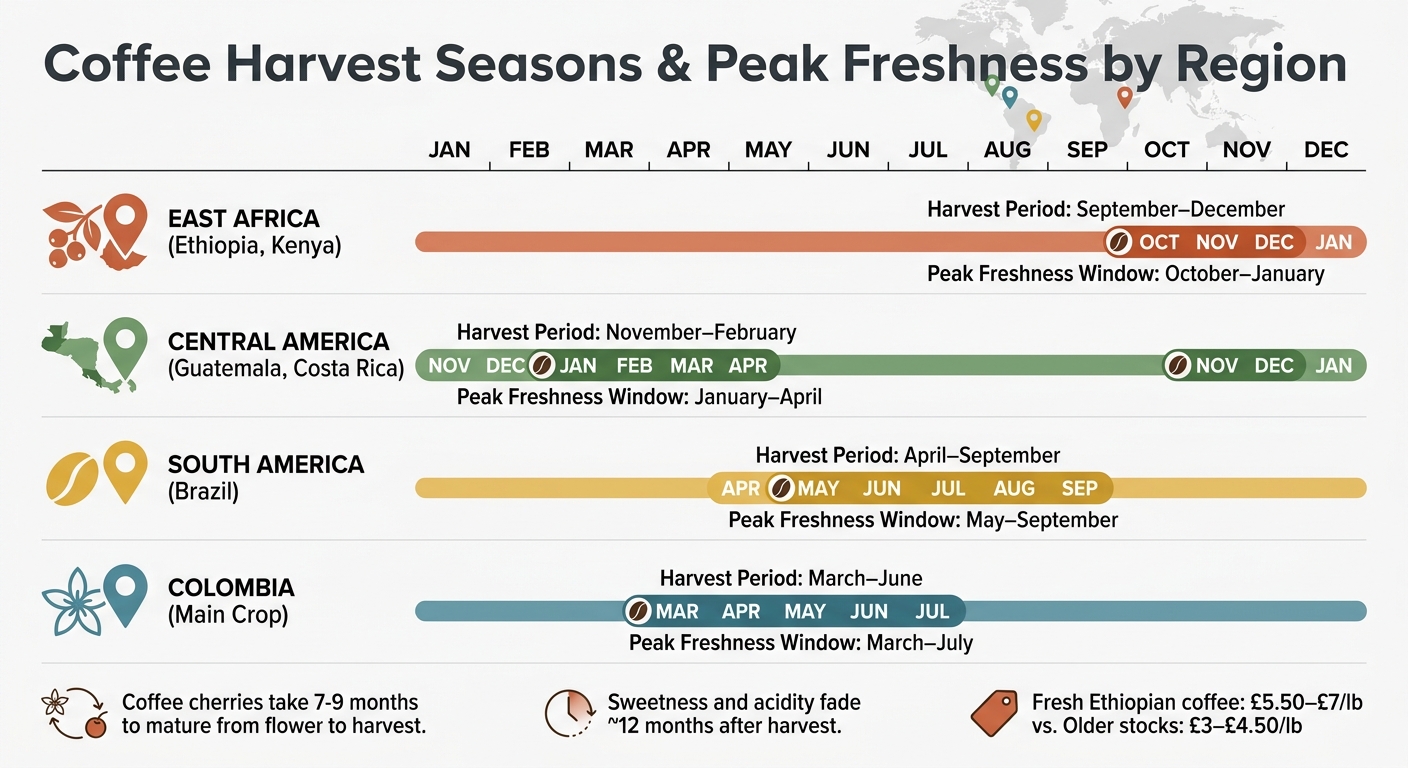
Coffee Harvest Seasons and Peak Freshness by Region
Find Coffee Regions by Harvest Season
Did you know coffee cherries take 7 to 9 months to mature from flower to harvest? That’s why understanding regional harvest calendars is so important for sourcing coffee at its peak. Broadly speaking, northern regions harvest later, while southern regions harvest earlier. For instance, Ethiopia’s harvest runs from November to February, Guatemala from December to March, and Brazil from June to September.
Why does this matter? Freshness directly affects coffee quality. Sweetness and acidity, two key flavour elements, begin to fade about 12 months after harvest. Victoria Santos, a Coffee Data Analyst at My Coffee Explorer, puts it this way:
Concentrating demand on new crops creates stronger prices for farmers at harvest time, benefiting their livelihoods more directly than off-season purchases of old stocks.
There’s also a financial incentive. Fresh Ethiopian coffee can sell for £5.50–£7 per pound, while older stocks fetch just £3–£4.50 per pound.
Here’s a quick snapshot of harvest periods and when the coffee is at its freshest:
| Region | Harvest Period | Peak Freshness Window |
|---|---|---|
| East Africa (Ethiopia, Kenya) | September–December | October–January |
| Central America (Guatemala, Costa Rica) | November–February | January–April |
| South America (Brazil) | April–September | May–September |
| Colombia (Main Crop) | March–June | March–July |
Once you’ve got the timing down, the next step is building relationships with the farmers who grow these exceptional crops.
Build Direct Relationships with Farmers
Sourcing ethically means going beyond transactions - it’s about creating long-term, stable partnerships. Pascale Schuit, Sustainable Sourcing Manager at Union Hand-Roasted Coffee, suggests:
Union does not purchase more than 50% of a specific producer's harvest. It creates a healthier business relationship if farmers have other buyers and avoid dependency on Union.
Visiting farms during peak harvest is a great way to establish these connections. It allows you to cup early lots, evaluate processing methods, and ensure quality standards are met. For added assurance, request exportable samples at least a month before shipment. Jamie Isetts, Green Coffee Buyer at Merit Coffee, highlights the importance of timing:
If we as roasters are aware of the seasonality of their farm, we can plan to buy more when the farmers have the most to offer. This awareness builds a sustainable relationship.
Step 2: Check Certifications and Traceability
Certifications That Matter
Once you've established partnerships with farms, the next step is making sure their ethical practices are certified and traceable. But not all certifications carry the same weight. For instance, the Rainforest Alliance certification focuses on protecting biodiversity, promoting worker welfare, and supporting environmentally sustainable farming - especially relevant for shade-grown coffee, which helps preserve fragile ecosystems. Meanwhile, Organic certification ensures coffee is grown without synthetic pesticides or fertilisers, protecting both the environment and the health of farmworkers.
If you're looking for the highest environmental standards, the Smithsonian Bird Friendly certification stands out. This combines organic farming with agroforestry practices, creating a gold standard for environmental responsibility. Shade-grown coffee certified under this label can support up to 19 times more biodiversity and store twice as much carbon compared to conventional coffee farms. Another emerging trend is combi-certification, which blends certifications like Smithsonian Bird Friendly with commitments to fair wages, addressing multiple ethical concerns in one go.
Here's a reality check: over 70% of the world's coffee comes from smallholder farmers, many of whom are underpaid. In Ethiopia, while around 90% of coffee is organically farmed by tradition, only 20% carries formal certification due to the high costs involved. This underscores the importance of not relying solely on labels.
Once you've identified certifications that align with your values, the next step is to ensure the entire supply chain upholds these ethical standards.
Verify the Supply Chain
Certifications are a great starting point, but they need to be backed by a traceable and transparent supply chain. Traceability means being able to track coffee back to its exact source, while transparency provides insight into key details like how much farmers are paid. As Farm & Forest Organic Coffee Roasters explains:
"Ethical sourcing is about traceability, knowing where your coffee comes from and how it got to your cup".
When working with roasters, ask the right questions: How often do they visit the farms? What farming practices do they support? Can they trace their coffee to a specific farm or even a particular plot? Some roasters are even using isotope ratio analysis, a scientific method that verifies the regional origin of coffee beans and helps prevent fraud.
It's also worth prioritising brands that pay farmers a "living income price" rather than just meeting minimum market rates. Since many smallholders already practise ethical farming but can't afford official certifications, having open conversations with your roaster can reveal the true story behind the beans.
Step 3: Sample and Cup the Green Coffee
Request Samples from Farm Partners
Once certifications are in order and traceability is confirmed, the next step is to evaluate the raw coffee beans through sampling. This involves requesting samples from your farm partners in alignment with harvest schedules. Typically, roasters taste "pre-ship samples" (PSS) to make their selections before the coffee leaves its origin country. Maxwell Colonna-Dashwood, Founder of Colonna Coffee, describes the process:
We will secure our favourites and then wait patiently for them to ship across the high seas to the roastery.
Sampling takes place at different stages: from the drying beds (the earliest point), after dry milling (pre-shipment samples to confirm quality and logistics), and when the coffee arrives at the warehouse. However, it’s important to note that providing samples and hosting visits from roasters can be a significant financial burden for small-scale farmers. Bellwether Coffee highlights this challenge:
Providing samples and hosting roasters can be a costly endeavour for small farms. But this face-to-face opportunity can be an invaluable part of the roaster-farmer relationship.
To ensure the process is cost-effective for both parties, it’s a good idea to discuss lot quantities upfront. Once the samples are received, they can then be evaluated for quality using the cupping method.
Use Cupping to Assess Quality
Cupping is the standard method used in the coffee industry to objectively assess the quality of coffee. Before cupping, the green coffee is lightly roasted the day before using a standardised profile (Agtron Gourmet 62-64) to ensure the roast doesn’t overshadow the bean’s natural characteristics. During the process, 8.25 g of coffee is brewed with 150 ml of water heated to 93°C. Key attributes such as fragrance, aroma, acidity, body, and flavour are evaluated within four minutes of steeping.
Coffee is scored on a 100-point scale following the Specialty Coffee Association (SCA) protocol. Coffees that score 80 points or higher are classified as Specialty Coffee. Seven Sisters Coffee Co describes cupping as:
At its heart, coffee cupping is a form of mindful tasting. It's about slowing down, paying close attention, and developing a deeper appreciation for the complex journey a coffee bean takes from the farm to your cup.
The process is straightforward but requires careful attention. Start by evaluating the fragrance - the smell of the dry grounds - before moving on to the aroma, which is the scent of the wet grounds after water is added. After four minutes, break the crust of coffee grounds on the surface with a spoon and inhale deeply to capture the aromatic release. When tasting, slurp the coffee sharply to aerate it, which helps distribute the liquid across your palate, engaging all taste buds to detect acidity, body, and flavour simultaneously. To maintain accuracy, always rinse your cupping spoons in hot water between samples to avoid cross-contamination.
This thorough evaluation process ensures that the coffee meets the highest quality standards while also respecting the hard work and dedication of the farmers who produced it.
Step 4: Negotiate Fair Terms and Support Sustainability
Pay Above Market Rates
When setting prices, it’s essential to prioritise farmers' livelihoods. Direct trade agreements should commit to paying more than both the C-market price and the Fairtrade minimum rates. These agreements go beyond just pricing - they establish a direct relationship between roasters and producers, creating a foundation for long-term business partnerships built on trust and stability.
To ensure fairness, adopt producer-led pricing. This approach guarantees that the price covers actual production costs and provides farmers with a liveable income. Additionally, offering contractual proof of purchase allows farmers to access pre-financing, which is crucial for covering harvest expenses and making investments in their farms. For roasters, subscription models can help stabilise revenue, making it easier to honour long-term commitments with producers.
By implementing these pricing strategies, you not only support farmers but also lay the groundwork for sustainable agricultural practices.
Support Eco-Friendly Farming Methods
Sourcing agreements should actively promote environmentally friendly farming. For instance, shade-grown coffee benefits biodiversity, supporting around 19 times more species and storing twice as much carbon compared to sun-grown varieties. Regenerative farming practices can significantly improve outcomes, increasing smallholder incomes by 62% and cutting CO₂e emissions by 3.5 million tonnes annually.
Include clear environmental commitments in contracts. Prohibit the use of harmful pesticides, prevent deforestation, and encourage agroforestry to enhance soil health and food security. Agroforestry, in particular, can reduce yield losses by 31% and minimise quality degradation by 19%, helping farmers manage climate-related risks. If direct trade isn’t feasible, look for certifications like Smithsonian Bird Friendly, which combines organic farming with strict shade-cover standards, or Fairtrade, which guarantees a price floor.
Finally, ensure that agreements include support for training, pre-harvest financing, and technical assistance. These measures empower farmers to adopt sustainable methods effectively, ensuring a better future for both the environment and the coffee industry.
Step 5: Inspect Quality and Share Your Story
Check and Roast the Seasonal Beans
Before diving into production, request a sample of 300g–350g of green beans. This lets you carry out both physical and sensory checks. Look for uniformity in bean size and ensure there are no primary defects (you can allow up to five full defects per 350g).
Moisture levels are critical too. Green beans should ideally have a moisture content between 9% and 13% - this helps prevent mould and keeps the beans stable during roasting. During your visual inspection, watch out for uneven colours, cracked beans, or a dusty appearance, as these could signal poor handling or ageing issues. Once the beans pass the physical checks, roast small test batches to get a feel for their density and moisture levels before scaling up your production.
To ensure quality, evaluate the samples using the Specialty Coffee Association (SCA) 100-point scale. Coffees that score 80 points or more are considered specialty grade, making up the top 5% to 10% of global coffee output. Coffees scoring 86+ are often celebrated for their exceptional complexity. This thorough testing ensures you’re delivering a product that meets high-quality standards while staying true to your ethical values.
Once you’ve confirmed the quality, it’s time to share the story behind your beans.
Share the Story Behind Your Sourcing
Transparency transforms a simple purchase into a meaningful connection. Instead of vague descriptions like "South America", provide specific details about the regions, farms, or cooperatives where your coffee is sourced. When customers know who grew their coffee, how it was processed, and the positive impact of their purchase, it adds depth to every cup.
Use various platforms to tell this story. Include sourcing details on your packaging, create dedicated pages on your website, and publish annual reports that highlight your impact. For example, sourcing reports have showcased partnerships with over 27 producers, some lasting more than 20 years, in regions like Ethiopia and Bolivia. At Creation Coffee, we share our journey from farm to cup on our website, focusing on how direct trade relationships ensure farmers are paid fairly while delivering small-batch, hand-roasted coffee to our customers.
Be ready to answer detailed questions about your green beans, quality standards, and how you ensure fair compensation for farmers. Explaining how subscription models and consistent purchasing provide financial stability for smallholders can further underline your commitment to ethical sourcing. Considering that over 70% of global coffee production comes from smallholder farmers who often face unfair wages, your transparency can help drive meaningful change.
Conclusion
Ethically sourcing seasonal coffee is about building connections that benefit everyone in the chain. By understanding harvest seasons, checking certifications, sampling beans through cupping, negotiating fair terms, and ensuring quality, you create a system that supports farmers while delivering exceptional coffee. With over 70% of coffee produced by smallholders who often face unfair pay, ethical sourcing not only values quality but also sparks meaningful change.
These steps do more than improve the coffee in your cup - they help drive progress for both people and the planet. Farms prioritising fair wages and sustainable methods tend to produce better-quality beans. Plus, shade-grown coffee farming enhances biodiversity and increases carbon storage. Choosing seasonally fresh, traceable coffee means you’re supporting responsible farming practices and helping secure financial stability for farming communities.
Creation Coffee is a shining example of these principles in action. Through direct trade partnerships, small-batch roasting with energy-efficient technology, and fully recyclable packaging, they bring ethical sourcing to life. Their commitment goes beyond coffee - they donate 10% of their profits to a children's charity, ensuring every purchase has a positive impact.
"We believe that exceptional coffee should never come at the expense of our planet or the people who grow it. Sustainability isn't just a policy for us - it's a promise." - Creation Coffee
FAQs
How do I find the right harvest season for a coffee origin?
To figure out the best time to harvest coffee from a specific region, refer to a coffee harvest calendar. These calendars detail harvest periods for different areas, considering how local climates and rainfall impact the timing. For instance, in Central America, the harvest usually runs from November to February. Knowing these cycles helps you source coffee when it's at its peak freshness and flavour.
What should I ask a roaster to prove traceability and fair pay?
To promote traceability and ensure fair pay, request detailed information about the coffee's origin, including specifics like the region, farm, and processing methods. Ask for supply chain documents, such as an ICO Certificate of Origin, and check for certifications like Fairtrade. It's also important to ask how fair compensation for farmers is guaranteed - whether through direct trade practices, transparent pricing, or certification programmes. These steps help verify ethical sourcing and maintain transparency.
How can I check green coffee quality without expensive equipment?
Evaluating green coffee quality doesn’t have to involve expensive equipment. You can rely on visual and sensory methods to get the job done. Start by inspecting the beans closely - look out for defects, uneven drying, or signs of microbial activity. Next, feel the texture of the beans. They shouldn’t be brittle or excessively dry. Also, check for consistency in size and colour, as uniformity is a good indicator of quality.
For a deeper analysis, roast small test batches and conduct a cupping session to explore the coffee’s flavour potential. These straightforward techniques can give you a solid understanding of coffee quality without the need for advanced tools.