


Humidity can change how your coffee tastes, smells, and brews. Coffee beans absorb moisture from the air, which impacts their aroma, sweetness, and acidity. High humidity speeds up staling, dulls flavours, and makes grinding uneven. Low humidity preserves aroma and improves grind consistency but slows brewing slightly.
Key Takeaways:
- High Humidity: Speeds up flavour loss, causes uneven grinding, and shortens shelf life.
- Low Humidity: Retains aroma, ensures consistent grinding, and extends freshness.
- Storage Tips: Use airtight, opaque containers in a cool, dry place (15°C–25°C, 30–50% relative humidity). Avoid heat, light, and moisture to keep coffee fresh longer.
Proper storage and monitoring humidity levels are essential for maintaining coffee quality.
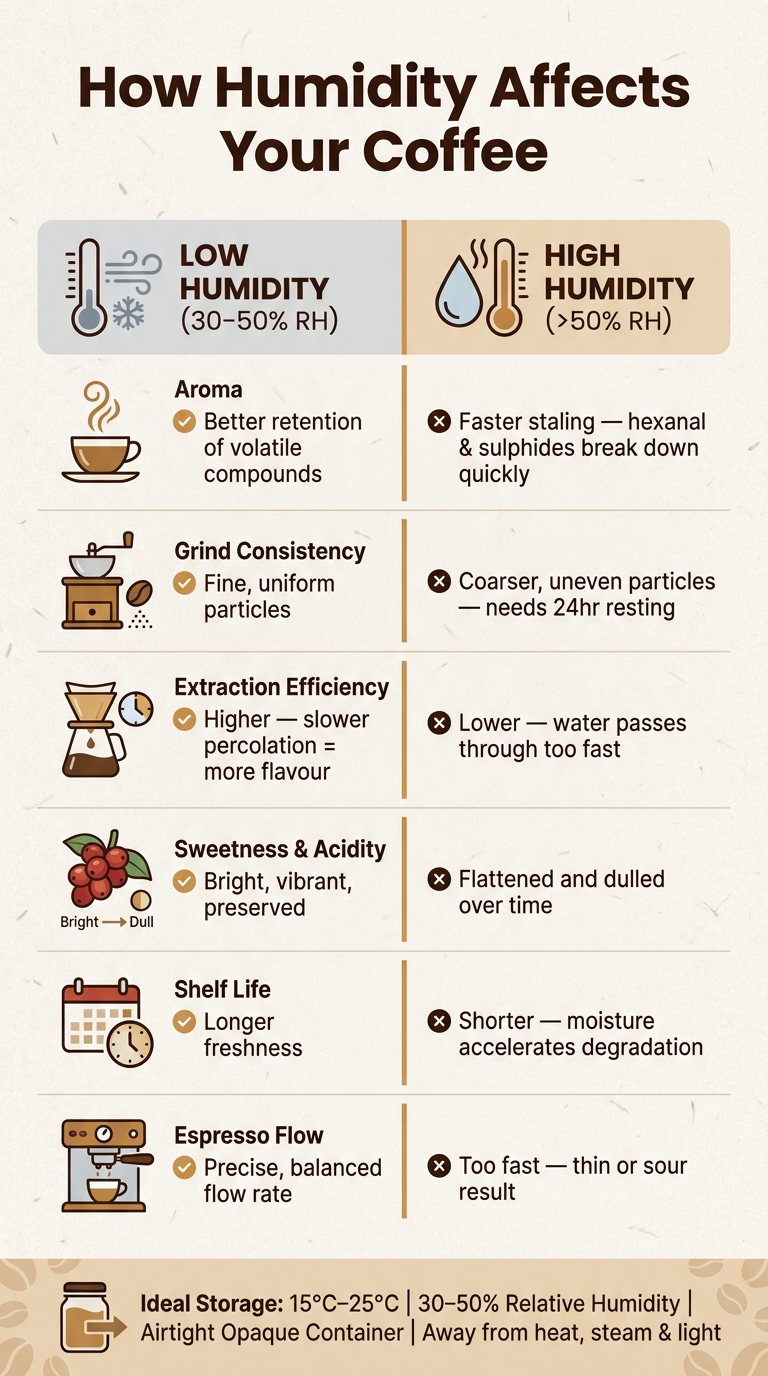
How Humidity Affects Coffee: Low vs High Moisture at a Glance
Weird Coffee Science - High Humidity Coffee Storage
sbb-itb-cca2aed
How Humidity Affects Coffee Bean Moisture
Coffee beans are highly responsive to the moisture levels in their environment. They either absorb or release water to reach what's known as equilibrium moisture content (EMC). This process can significantly impact the beans' structure and performance during roasting and brewing. Below, we'll explore how this applies to green and roasted coffee beans.
How Green Coffee Beans Absorb Moisture
Green coffee beans are naturally porous, which makes them particularly good at absorbing moisture from the surrounding air. However, when these beans take on too much moisture, it can complicate the roasting process. The excess water can lead to unpredictable roasting behaviour, making it harder to achieve consistent results.
How Roasted Beans Lose Moisture
During roasting, coffee beans undergo significant changes as they lose much of their moisture content. Studies show that roasted coffee typically contains between 2.3–8.8 g of water per 100 g of beans (measured on a wet basis). These moisture levels directly influence how the beans perform in grinding and brewing.
For example, roasted beans with higher moisture content often produce coarser, uneven grind particles and may need up to 24 hours to stabilise. On the other hand, beans with lower moisture content tend to grind more uniformly and extract more efficiently, although the brewing process might take slightly longer due to slower percolation.
| Feature | Low-Moisture Roasted Coffee | High-Moisture Roasted Coffee |
|---|---|---|
| Grind consistency | Fine and uniform | Coarser, uneven – benefits from resting |
| Extraction | More efficient | Less efficient |
| Aroma stability | Better retention of volatile compounds | Faster staling due to rapid evolution of hexanal and sulphides |
| Shelf life | Longer freshness | Shorter due to moisture instability |
These differences underline how crucial it is to manage moisture levels at every stage, from storage to brewing, to ensure the best coffee experience.
How Humidity Changes Coffee Flavour and Aroma
Humidity doesn’t just affect coffee’s aroma - it also impacts its sweetness and acidity. When roasted coffee absorbs moisture, its flavour starts to degrade quickly. As the internal water content rises, the volatile compounds that give coffee its rich and complex aroma begin to break apart.
Loss of Aromatics in High Humidity
One of the clearest signs of humidity damage is a dull, lifeless aroma. Compounds like hexanal and sulphides, which are crucial for coffee’s scent, break down faster in high-moisture environments, leading to quicker staling. Increased water activity speeds up this breakdown, particularly during storage when the coffee is sealed.
This isn’t just about aroma - humidity also disrupts other important flavour elements.
Flattened Sweetness and Acidity Under Fluctuating Humidity
Inconsistent humidity does more than dull the aroma. It also reduces coffee’s natural sweetness and bright acidity. When humidity levels fluctuate (with water activity between 0.1 and 0.9), coffee’s chemical balance becomes unstable. Over time, this strips away the vibrant acidity and sweetness that are hallmarks of a freshly roasted specialty coffee. A key factor here is the breakdown of polyphenols like chlorogenic acids, which are responsible for both aroma and bitterness. These compounds degrade more quickly in moist conditions.
How to Store Coffee: Temperature and Humidity Guidelines
Humidity can wreak havoc on coffee's aroma, sweetness, and acidity, so getting the storage conditions right is absolutely crucial.
Recommended Temperature and Humidity Ranges
When it comes to coffee storage, temperature and relative humidity (RH) are the two key factors to control. For everyday use, aim for a storage environment between 15°C and 25°C and a relative humidity of 30–50%. These conditions help reduce moisture absorption and slow down the chemical reactions that lead to staling.
"Temperature, rather than humidity, is the most important factor affecting the rate at which coffee loses its freshness." - Difference Coffee
Temperature fluctuations are a big no-no. When temperatures swing, condensation can form inside containers, speeding up spoilage. A consistently cool spot is far better than one that alternates between warm and cold.
| Condition | Recommended Range | Why It Matters |
|---|---|---|
| Temperature | 15°C – 25°C | Slows degassing and oxidation |
| Relative Humidity | 30% – 50% | Prevents beans from absorbing moisture |
By sticking to these ranges, you'll help preserve the coffee's intended flavour and aroma.
Protecting Coffee from Moisture, Heat, and Light
Apart from temperature and humidity, oxygen, light, heat, and moisture are the biggest threats to coffee freshness. In typical UK kitchens, steam, rising heat, and sunlight can quickly degrade your coffee.
The solution? Store your coffee in the right spot. A dark cupboard or pantry, far from the hob, kettle, and dishwasher, works best. Avoid leaving coffee on the counter, especially near appliances that emit heat or steam. As Podium Coffee Club explains:
"Coffee stored in clear glass on a sunlit counter ages faster than coffee stored in an opaque container in a cupboard - measurably, not theoretically." - Podium Coffee Club
For added protection, consider a hygrometer (available for under £15) to monitor humidity levels. If your kitchen tends to be humid - a common issue in older UK homes - silica gel packets can be a lifesaver. Toss a few into your storage tin to absorb excess moisture and keep your coffee in peak condition.
How Humidity Affects Grinding and Brewing
Humidity doesn't just impact coffee bean storage; it continues to play a role in how beans perform during grinding and brewing. Once opened, beans are exposed to the surrounding air, and changes in humidity can influence everything from grind consistency to flavour extraction.
How Moisture Affects Grind Consistency
Moisture levels in coffee beans can change their structure, which directly affects how they break apart during grinding. A study by Juerg Baggenstoss, Rainer Perren, and Felix Escher revealed:
"Coffees with high moisture content exhibited coarser particles upon grinding, and equilibration time prior to grinding was needed for coffees with high water content to improve grinding results."
Allowing beans with higher moisture content to rest for 24 hours helps redistribute the moisture, leading to more consistent grinding. Additionally, keeping beans whole for as long as possible is key. Once ground, coffee's larger surface area makes it much more prone to absorbing moisture from the air.
How Moisture Affects Extraction and Brew Balance
Beyond grinding, moisture levels also influence how coffee extracts during brewing. Coarser particles from high-moisture beans can change the brewing dynamics. Water passes through coarser grounds more quickly, reducing the contact time and, in turn, the amount of flavour extracted.
"Coffees with low water content were extracted more effectively than high moisture coffees, and percolation was slower."
This is particularly noticeable with espresso, where a precise flow rate is essential. High-moisture beans can cause the espresso to flow too quickly, resulting in a thin or sour taste. To counteract this, adjusting your grinder to a finer setting can help offset the coarser grind caused by humidity.
| Coffee Condition | Grinding Result | Percolation Speed | Extraction Effectiveness |
|---|---|---|---|
| Low moisture content | Finer particles | Slower | Higher |
| High moisture content | Coarser particles | Faster | Lower |
Humidity levels can fluctuate significantly, especially in older UK homes or during wetter months. If your espresso's extraction time suddenly shortens, checking the ambient humidity could save you from unnecessary troubleshooting.
Storage Methods That Help Preserve Coffee Flavour
Storing coffee correctly can make all the difference in keeping its flavour and aroma intact. The right methods help combat the effects of humidity, which can quickly compromise the quality of your beans or grounds.
Airtight and Opaque Containers
Did you know that roasted coffee is hygroscopic? This means it soaks up moisture from the air like a sponge. An airtight container acts as a protective shield, helping to keep moisture at bay and slowing the staling process. On top of that, using an opaque container guards against light exposure, another culprit in degrading coffee over time.
Pre-ground coffee is even more vulnerable. Research shows that finer grinds - around 600 μm - absorb moisture differently than whole beans, making them more prone to damage from humidity. If you buy pre-ground coffee, transferring it into a sealed, opaque container right away is a smart move.
"These tools offer valuable insights for researchers, coffee producers, and decision-makers in computing critical parameters related to roasted specialty coffee's shelf life, determining optimal packaging materials, and understanding the hygroscopic properties of coffee." - Collazos-Escobar et al.
For best results, choose a container size that matches the amount of coffee you have. This minimises the exposure to oxygen and moisture. If you're serious about keeping your coffee fresh, you might also want to explore moisture-control options.
Desiccants and Vacuum Sealing
Adding a small silica gel desiccant packet to your storage container can work wonders in absorbing any lingering moisture before it affects your coffee. For an even more controlled environment, vacuum-sealed containers eliminate oxygen entirely, offering a level of protection that regular airtight jars can’t always achieve. While premium vacuum canisters are available, combining a good airtight container with a desiccant packet is an easy and effective solution for most home brewers.
To keep an eye on humidity levels, a simple hygrometer can be a handy tool. It ensures you’re maintaining the right conditions for preserving flavour.
Where you store your coffee is just as important as how you store it. Avoiding heat sources is key.
Keeping Coffee Away from Kitchen Heat Sources
The kitchen can be a hostile environment for coffee, with heat and steam from appliances like ovens, hobs, and kettles creating bursts of moisture and temperature changes that can wreak havoc on your beans.
"Fluctuating temperatures can be detrimental to the quality of coffee. Variations can cause condensation inside the storage container, leading to moisture exposure that accelerates the degradation of the coffee." - Crockett Coffee
Instead, store your coffee in a cool, dark spot - a bottom pantry shelf or a cupboard away from heat sources is ideal. And while it might seem convenient, avoid keeping coffee in the fridge or freezer for daily use. The constant temperature changes can create condensation, which is just as harmful as ambient humidity.
If you’ve bought a larger supply, such as freshly roasted coffee from Creation Coffee, try portioning out what you’ll use in a couple of weeks into a separate sealed container. This approach prevents repeated exposure to air and moisture every time you open the main bag, helping to keep the rest of your coffee fresh.
Conclusion: Keeping Coffee Fresh in Humid Conditions
Humidity poses a serious challenge to coffee quality, yet it’s often underestimated. Roasted coffee beans are like sponges, quickly soaking up moisture that strips away their distinctive aromas, sweetness, and acidity. To keep your coffee in top condition, aim for a relative humidity of 30% to 50% and store it at temperatures between 15°C and 25°C.
The good news? You don’t need fancy gadgets to protect your coffee. An airtight, opaque container stored in a cool, stable spot will do the trick for most situations. For those looking to extend freshness further, research shows vacuum sealing can preserve beans for months. However, ground coffee is much more vulnerable to moisture and should ideally be used within a few days.
It’s worth noting that storage can only preserve the quality of the beans you start with. That’s why using freshly roasted beans is key to getting the most out of your storage efforts. Creation Coffee ensures you start on the right foot by hand-roasting their single-origin and blend coffees in small batches, delivering them fresh to your doorstep.
"Starting with the freshest beans possible makes proper storage even more effective." - BrewedLate Coffee
FAQs
How can I tell if humidity has made my coffee go stale?
When humidity takes a toll on your coffee, there are a few tell-tale signs to watch for. These include a noticeable loss of aroma, a flavour that feels dull or flat, or an increase in sour or bitter notes. You might also notice clumping in the coffee grounds or, in extreme cases, even mould growth. These changes happen because coffee absorbs moisture from the air, particularly in environments where humidity exceeds 60% relative humidity (RH). This extra moisture triggers chemical changes that can compromise the quality of your coffee.
Should I change my grind size when the weather turns humid?
When the weather turns humid, tweaking your grind size becomes essential. Higher humidity affects coffee beans by increasing their density and static, which can result in clumping. This, in turn, may cause over-extraction, leaving your brew tasting off-balance.
To counteract this, opt for a coarser grind. It helps maintain the right balance in your brew, ensuring those pesky humidity-related issues don't get in the way of your perfect cup.
Is it worth using silica gel or a vacuum canister for home storage?
Using silica gel or a vacuum canister is a smart choice for storing coffee at home. These methods help control humidity and keep moisture at bay, which protects the coffee's flavour and aroma. This way, your coffee stays fresher for a longer period.