


If I want to judge flavour, I look at the SCA score first. If I want to judge roast consistency, I check the origin grade too. That is the short answer.
In this comparison, I’d sum it up like this:
- SCA tells me more about cup quality
- Kenya AA / AB / PB mostly tell me bean size
- Colombia Supremo / Excelso / EP / UGQ mostly tell me size and export prep
- Brazil COB mixes defects and cup class, so it sits closer to SCA than Kenya or Colombia
- A coffee can have a strong physical grade and still score lower in the cup
- Under SCA rules, 80+ points is specialty coffee
- SCA physical checks also matter: 0 primary defects, up to 5 secondary defects in 350 g, and 10%–12% moisture
So if I’m buying coffee in the UK, I would not treat origin grades and SCA scores as the same thing. They answer different questions. One helps me predict sorting and roast behaviour. The other helps me judge what I am likely to taste.
Quick comparison
| System | Main focus | What it tells me best | What it does not tell me well |
|---|---|---|---|
| SCA | Sensory score + defects | Flavour, balance, cup quality | Bean-size grade names by origin |
| Kenya | Screen size | Bean size and sorting | Cup score |
| Colombia | Screen size + export prep | Size, prep level, defect control | Cup score |
| Brazil (COB) | Defects + cup class | Physical faults plus broad cup class | A direct SCA-style score |
My takeaway is simple: SCA is better for flavour; origin grades are better for physical sorting; using both gives the clearest view.
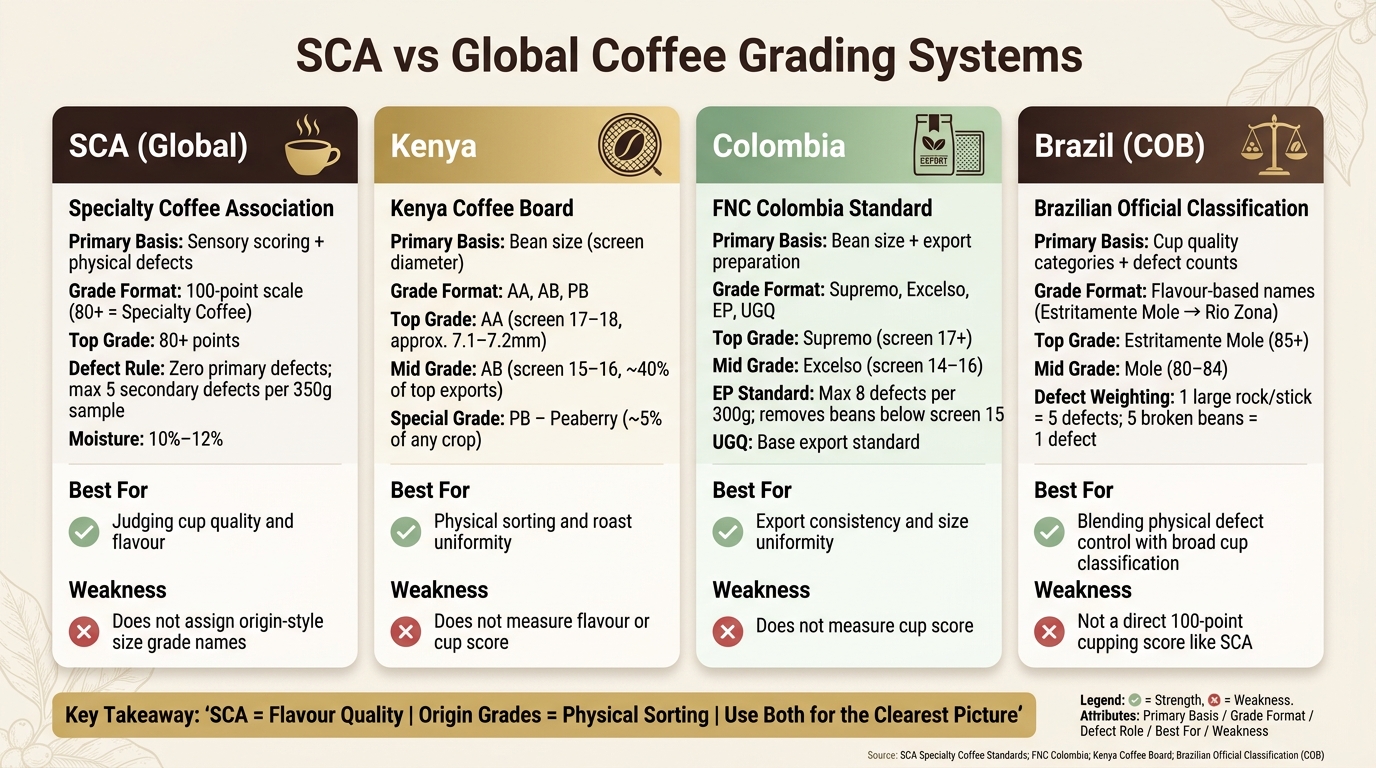
SCA vs Global Coffee Grading Systems: What Each Score Really Tells You
SCA Green Coffee Sizing and Grading Standards

sbb-itb-cca2aed
The SCA grading system: scores, cupping and specialty classification
The SCA system is the coffee trade’s main benchmark for cup quality. It pairs sensory scoring with physical defect checks, which helps buyers and sellers compare coffees across origins instead of only sorting them by size or defect count.
How the SCA 100-point cupping score works
The score matters because it turns flavour into a repeatable benchmark. Cupping is a structured, blind tasting process. Coffee is roasted to a precise profile, ground evenly, and brewed at 93°C using a ratio of 8.25 g of coffee per 150 ml of water.
Certified Q Graders then assess five separate cups from the same lot. They score:
- aroma
- flavour
- aftertaste
- acidity
- body
- balance
- sweetness
- clean cup
- uniformity
- overall impression
Each attribute receives its own score, and those scores are added together to produce a final result on a 100-point scale.
What counts as specialty coffee under SCA standards
To qualify as specialty coffee, a lot must score 80 points or more and also meet the physical defect limits set by the SCA.
Physical grading under SCA standards
The physical check uses a 350 g sample. Inspectors review defects, screen size, and moisture content. One primary defect disqualifies the lot. Up to five secondary defects are allowed. Moisture must fall between 10% and 12%. Roasted samples must also show no quakers, the pale underdeveloped beans linked to poor development.
That’s what makes SCA a quality standard; the next section looks at how origin systems grade beans in different ways.
Global coffee grading systems: Kenya, Colombia, Brazil and export grades
These grading systems were built for trade. The goal is simple: sort beans by size, remove defects, and get steady export shipments out the door. They help buyers and exporters speak the same language.
But there’s a catch. They sort coffee for export; they do not score flavour. That makes them handy for trade, but less useful than SCA when the job is to judge what’s in the cup.
Kenya grades: AA, AB and PB
Kenya’s grading system is based on screen size, which means the physical diameter of the bean. Beans pass through perforated metal screens measured in 1/64-inch steps. AA is the largest grade, covering screen sizes 17–18, or about 7.1–7.2 mm. AB combines screens 15 and 16, and AB makes up about 40% of Kenya’s top-quality export coffee.
PB means peaberry. This is a natural mutation where only one rounded bean forms inside the coffee cherry instead of the usual two flat-sided beans. Peaberries account for around 5% of any coffee crop. They are graded on their own because their shape changes how they sort and roast.
The main point is easy to miss: size affects sorting, not flavour. An AB lot can - and often does - outscore an AA lot on the cupping table. So Kenya’s grades work well for sorting, but they are weak if used alone as a measure of quality. The same thing shows up in Colombia.
Colombia grades: Supremo, Excelso, EP and UGQ
Colombia’s grading system, overseen by the Federación Nacional de Cafeteros (FNC), also leans on size grading. Supremo covers the largest beans, screen 17+, while Excelso covers medium-sized beans at screen 14–16. Excelso is often a mix of Supremo and smaller "Extra" grade beans, and it is the high-volume grade often used in blends.
Two other terms focus on export sorting rather than bean size. EP (European Preparation) means a lot has been hand-sorted to tighter tolerances. That usually means no more than 8 defects per 300 g sample, with all beans below screen 15 removed. Like Kenya’s system, it puts uniformity first. UGQ (Usual Good Quality) is the base export standard for Colombian coffee.
Brazil pushes this a step further by combining defect counts with cup categories.
Brazil and other export-focused defect systems
Brazil uses a different model. Instead of putting most of the weight on screen size, the COB (Brazilian Official Classification) system combines defect counts with cup categories. Cup quality ranges from Estritamente Mole down to Rio Zona, which is the lowest category.
On the physical side, the defect weighting is exact. One large rock or stick counts as 5 full defects, while 5 broken beans equal only 1 full defect.
Here’s the quick comparison:
| Feature | Kenya | Colombia | Brazil (COB) |
|---|---|---|---|
| Main basis | Bean size (screen) | Bean size (screen) | Cup quality + defects |
| Top grade | AA (screen 17–18) | Supremo (screen 17+) | Estritamente Mole (85+) |
| Mid grade | AB (screen 15–16) | Excelso (screen 14–16) | Mole (80–84) |
| Defect role | Secondary to size | Secondary to size | Primary driver |
Brazil comes closer to SCA than Kenya or Colombia because it brings cup categories into the system. Even so, it still classifies coffee in a different way from a 100-point cupping score. That’s the main contrast with SCA.
SCA vs global grading systems: key differences in practice
Sensory scoring versus physical sorting
Building on the earlier physical and sensory definitions, the main difference in practice comes at the buying stage. SCA scores cup quality, while origin grading systems mostly sort beans by size and defects. Kenya AA and Colombia Supremo are size-based grades. They tell you about bean dimensions and sorting, not flavour.
Physical grading still matters. More even bean size helps roasting stay even.
That’s why roast consistency and flavour prediction are not the same thing.
Grade names, defect rules and trade impact
Grade names can be misleading. The same label can point to very different defect limits depending on the origin. For example, an Ethiopian Grade 1 requires just 0–3 defects per 300 g, while an Indonesian Grade 1 can allow up to 11 defect points per 300 g. By contrast, SCA specialty grade requires zero primary defects and no more than five secondary defects in a 350 g sample. European Preparation (EP), a tighter export standard well known to UK buyers, usually allows no more than eight defects per 300 g and removes beans below screen 15.
| System | Primary Basis | Grade Format | Defect Treatment |
|---|---|---|---|
| SCA (Global) | Sensory + defects | 100-point score (80+ = specialty) | Zero primary, ≤5 secondary per 350 g |
| Kenya | Bean size | AA, AB, PB | Size sorting |
| Colombia | Bean size | Supremo, Excelso, EP, UGQ | Size-based; EP adds tighter preparation |
| Brazil (COB) | Cup quality + defects | Flavour-based grade names | Cup categories plus defect counts |
What the differences mean for UK specialty roasters
For UK buyers, this changes how a lot should be judged before purchase. A lower physical grade can still be the better buy if the cup score is stronger. In plain terms, UK roasters need to read both: SCA for flavour, origin grades for consistency.
Conclusion: which grading system tells you the most about quality
The comparison points to one simple takeaway: no single grading system gives you the full picture. SCA scores are the clearest way to judge cup quality, with 80+ marking specialty coffee. By contrast, origin grading systems such as Kenya AA, Colombia Supremo, and Brazil’s defect-based export grades describe physical sorting and export prep, not flavour.
Put simply, origin grades can hint at how a coffee may roast. SCA scores tell you more about what ends up in the cup.
For a direct-trade roaster like Creation Coffee, that mix matters day to day. Looking at both size and score helps with roast consistency, traceability, and confidence in the cup.
Grading is a tool, not a promise. The best coffee choices come from reading physical grades and cupping scores side by side.
FAQs
Can a Kenya AA coffee taste worse than an AB?
Yes. In Kenya, AA and AB refer only to bean screen size. AA means larger beans. It does not mean better flavour.
That matters because size alone tells you very little about what ends up in the cup. An AB lot can easily score higher in cupping than an AA lot. The bigger drivers of taste are things like altitude, processing, and variety.
Why doesn’t bean size guarantee better flavour?
Bean size mainly tells you about physical size and how even the beans are. It does not tell you, on its own, how good the coffee will taste.
Labels like AA or Supremo can sound fancy. But here’s the thing: a bigger bean doesn’t automatically mean a better cup.
A smaller bean that’s been processed well can taste much better than a larger bean that’s been handled badly. Where size sorting helps most is consistency. When beans are closer in size, they tend to roast more evenly, which makes the roast easier to control.
Should I check both SCA score and origin grade before buying?
Yes. Checking both gives a fuller picture of quality.
The SCA score shows cup quality, while the origin-specific grade can reflect physical factors such as bean size, moisture content, and defect counts. Together, they help you assess both flavour and consistency.