


Carbon credits provide coffee farmers with a way to earn extra income by adopting tree-friendly farming practices. These credits are tied to reducing or preventing CO₂ emissions and are bought by businesses or individuals to offset their carbon footprint. Farmers who grow coffee under shade trees or preserve existing forests can sell these credits, helping them financially while protecting their land.
Key takeaways:
- What are carbon credits? Each represents 1 tonne of CO₂ reduced or removed. Farmers generate them by planting trees or preserving forests.
- Why does it matter? Climate change threatens coffee farming, with suitable land expected to shrink by 50%. Shade-grown coffee offers a solution, storing carbon and improving resilience.
- How do farmers benefit? Programmes like Rabobank’s ACORN ensure farmers receive at least 80% of carbon credit sales, offering an additional revenue stream.
- Challenges: Farmers face delays in payments (2–4 years) and complex verification processes. Preserving mature trees is undervalued, despite its higher carbon storage potential.
Carbon credits are a practical way to support coffee farmers while addressing climate challenges, though improvements are needed to make the system more accessible and fair.
What Are Carbon Credits and How Do They Relate to Coffee Farming?
Understanding Carbon Credits
A carbon credit represents the removal or reduction of one tonne of CO₂ (or its equivalent) from the atmosphere. These credits can be purchased by businesses or individuals to offset their emissions, creating a financial incentive for environmental action.
One crucial concept behind carbon credits is additionality. This ensures that the carbon removal stems from new projects or practices - actions that wouldn’t have occurred otherwise. Without this, credits would merely account for existing activities, offering no real benefit for the climate.
In 2023, the voluntary carbon market saw prices ranging from £5 per tonne to over £50 per tonne, depending on the quality of the credits. Higher-priced credits often come with extra benefits, such as protecting biodiversity or improving livelihoods for farmers.
Coffee farming plays a significant role in this system, particularly through agroforestry practices.
How Forest-Friendly Farming Connects to Carbon Credits
Coffee farming has unique potential for generating carbon credits through agroforestry, where shade trees are planted alongside coffee crops. These trees absorb CO₂ as they grow, storing it in their trunks, roots, and soil - a process known as carbon sequestration.
There are two main approaches to leveraging agroforestry for carbon credits:
- Carbon creation: Planting new trees on monoculture farms to build fresh carbon stocks.
- Carbon protection: Preserving mature agroforests to prevent the release of carbon that has taken years to accumulate.
While both are valuable, protecting mature shade trees is particularly critical. Removing these trees can release far more carbon than new plantings are likely to absorb.
Here’s a quick comparison of these strategies:
| Carbon Strategy | Primary Action | Main Benefit |
|---|---|---|
| Creation | Planting new trees in monocultures | Rapid, measurable carbon sequestration |
| Protection | Conserving existing agroforests | Prevents release of large, existing carbon stocks |
| Agroforestry | Integrating trees with crops | Diversifies income and improves climate resilience |
As of August 2023, the NGO Solidaridad, in collaboration with the ACORN platform and Rabobank, connected around 50,000 smallholder coffee and cocoa farmers across Colombia, Nicaragua, Uganda, and Kenya to the carbon market. These farmers collectively sold 70,000 tonnes of carbon credits, earning at least 80% of the sale value.
"We use the carbon market as an incentive mechanism to encourage farmers to embark on this journey. In the end, we want farmers to have a better agricultural commodity production system and a higher income through carbon as an add-on revenue system." - Eduard Merger, Climate Innovation Lead, Solidaridad Deutschland
This approach highlights how agroforestry and carbon credits can work together to promote sustainable farming while supporting farmers economically. In the next section, we’ll look at how coffee farmers implement these methods to produce verifiable credits.
sbb-itb-cca2aed
Peru coffee producers generate income by combating climate change
How Coffee Farmers Generate Carbon Credits
To support sustainable coffee farming, producers can adopt specific methods that help them earn carbon credits. These practices reward farmers for their environmental efforts while promoting ecological balance.
Farming Practices That Generate Credits
Farmers can move from unshaded monocultures to shaded, mixed-tree systems to increase carbon absorption. This shift, called carbon stock creation, contrasts with carbon stock protection, which focuses on preserving mature trees and existing agroforests to prevent carbon release.
These strategies fall within a spectrum of agroforestry systems. These range from simple shaded monocultures with one or two tree species to more intricate systems incorporating native forest trees alongside commercial crops. Generally, more complex systems offer greater carbon storage and biodiversity benefits:
| System Type | Carbon Potential | Biodiversity Value |
|---|---|---|
| Unshaded Monoculture | Lowest | Minimal |
| Shaded Monoculture | Moderate | Low to Moderate |
| Simple Agroforestry | High | Moderate |
| Complex Agroforestry | Highest | Highest |
Tree density plays a key role in predicting carbon storage. Shade-grown coffee farms, for instance, can store 70–80 tonnes of carbon per hectare, rivaling tropical forests. However, translating these practices into carbon credits requires careful monitoring and verification.
How Carbon Credits Are Verified and Issued
To generate carbon credits, farmers need to prove their carbon gains through a detailed verification process. This involves more than just planting trees. First, a baseline assessment measures the existing carbon stocks. Then, tools like satellite monitoring track changes over time. Rabobank’s ACORN platform is an example of how technology can lower costs and ensure more revenue reaches farmers.
As Emlyn Whittick from DeepRoots highlights:
"A clear and accurate baseline is crucial because future carbon gains will be measured against it."
Third-party organisations, such as Plan Vivo, Verra (VCS), or the Gold Standard, verify that the carbon sequestration is real, additional, and permanent before issuing credits. Farmers typically commit to maintaining their agroforestry systems for 20 to 50 years, which includes replacing trees lost to disease or extreme weather.
Eduard Merger, Climate Innovation Lead at Solidaridad Deutschland, emphasises:
"Reselling of carbon credits is not allowed to ensure that the actual value goes to farmers and not to the intermediary industry."
This thorough process, from baseline assessment to verification, ensures the credibility of carbon credits while supporting farmers in their sustainable practices.
How Carbon Credit Payments Reach Coffee Farmers
Once carbon sequestration is verified, payments are distributed based on the amount of carbon captured. Most programmes prioritise returning the bulk of the revenue directly to farmers. For example, Rabobank's ACORN platform ensures farmers receive at least 80% of the total value from each carbon sale. The remaining portion covers operational expenses and verification processes. Payments are typically processed through three main channels:
- Digital platforms: These connect farmers directly with buyers.
- Farmer cooperatives: These pool resources, distribute funds collectively, and sometimes allocate a portion to community projects such as water tanks or local finance initiatives.
- Partnerships with agribusinesses or local authorities: These entities manage the process on behalf of smaller producers.
Farmer cooperatives, in particular, play a crucial role for smallholders by reducing administrative burdens and offering additional benefits through shared community investments.
However, farmers should be prepared for a two-to-four-year delay in receiving payments. This waiting period allows time for sequestration to be measured and verified before payments are triggered. Additionally, some schemes set aside up to 20% of credits as a buffer against potential losses, such as those caused by disease or fire.
These payment structures underscore the importance of meeting specific requirements to participate in and benefit from these programmes.
What Farmers Need to Participate
The requirements for joining carbon credit programmes vary depending on the scheme. Farmers must typically provide clear land tenure documents to ensure long-term participation. Additionally, they need to supply three to five years of farm data to establish a baseline.
Eligibility criteria can differ across programmes. For instance, the ACORN-linked Climate Heroes project focuses on coffee and cocoa farms ranging from 0.1 to 10 hectares. These farms must either have recently established agroforestry systems or offer opportunities for planting new shade trees. Farmers whose land doesn’t meet these criteria may need to explore other schemes or wait until they qualify.
For smallholders who find the process overwhelming, joining a cooperative or carbon collective can be a practical solution. These organisations manage much of the monitoring, reporting, and verification work, making it feasible for farmers to participate. They also provide the scale needed for credit issuance, which is often challenging to achieve individually.
Benefits for Farmers and the Land
How Forest-Friendly Practices Benefit the Land
Shade trees play a crucial role in improving conditions for coffee cultivation. By regulating temperature and retaining soil moisture, they protect coffee plants from the increasing stress caused by rising temperatures. Farmers who incorporate native trees, such as nitrogen-fixing species like Gasparito (Erythrina americana), directly enrich the soil. This reduces reliance on synthetic fertilisers and promotes healthier plant growth. Beyond this, complex agroforestry systems featuring a variety of native species foster greater biodiversity compared to simpler shaded monocultures. This diversity not only supports wildlife but also enhances the resilience of ecosystems, building on the benefits already observed with high tree density.
"No money could ever convince me to fell a tree, because I recognise the value of that single tree, not only for its benefits, but also for its intrinsic value: this is our identity, our wisdom, our legacy." - Don Ramón Suárez Itza, Coffee Plantation Owner
Preserving mature agroforests is equally impactful. It prevents the release of decades' worth of stored carbon and safeguards intricate wildlife habitats. These ecological benefits also pave the way for long-term economic advantages for coffee farmers.
Economic and Long-Term Farming Benefits
The financial stability of farmers is strengthened by adopting forest-friendly practices, making them a cornerstone of sustainable coffee production. One key benefit is the opportunity to earn additional income through carbon payments, supplementing coffee sales and helping farmers manage the unpredictability of commodity prices. Eduard Merger, Climate Innovation Lead at Solidaridad Deutschland, explains:
"In the end, we want farmers to have a better agricultural commodity production system and a higher income through carbon as an add-on revenue system."
Additionally, shade-grown coffee plants tend to have longer lifespans and show greater resistance to pests and diseases compared to sun-grown varieties. While these plants may yield slightly fewer beans per harvest, their resilience is invaluable, especially with climate change expected to reduce suitable coffee-growing areas by 50%. Agroforestry systems also help farms withstand rising temperatures and erratic rainfall - two major challenges for Arabica coffee growers. Together, these ecological and financial benefits encourage sustainable farming practices, ensuring environmental care and long-term viability for coffee producers.
Challenges and Limitations of Carbon Credit Programmes
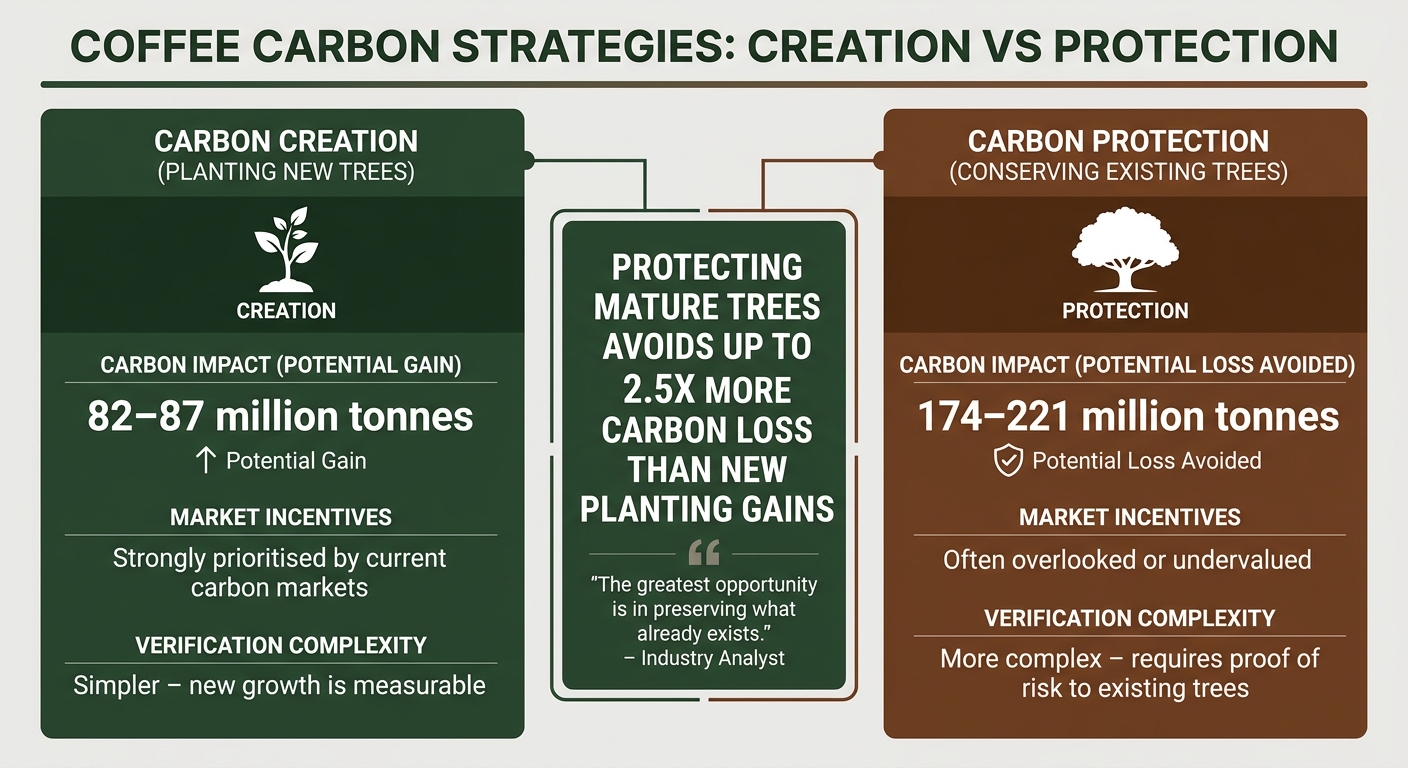
Carbon Creation vs. Carbon Protection: Coffee Farming & Carbon Credits
Financial and Logistical Barriers
Even with the environmental and economic potential of forest-friendly farming, many farmers struggle with significant financial and logistical hurdles. For smallholder farmers, carbon credit programmes often require high upfront costs, with the financial benefits arriving much later. As Eduard Merger points out, payments from carbon credits typically take two to four years to materialise, leaving farmers in a tough spot if they depend on steady income for daily living expenses. Additionally, there's the issue of opportunity cost: studies in Central America show that carbon-positive farms often generate less net income compared to intensified monocultures, at least in the short term.
The process itself is demanding. Farmers must map field boundaries, compile detailed historical land-use records, and meet various documentation requirements. On top of that, shifting regulations and new carbon trade taxes might further cut into the revenue farmers receive. While these barriers are daunting, overcoming them could lead to long-term financial stability and environmental benefits through sustainable farming practices.
Why Verification and Credibility Matter
Beyond financial and logistical obstacles, verifying carbon credits in diverse farming systems presents another layer of difficulty. Shade-grown systems, with their mix of species and tree ages, are far more complex to measure than standard monocultures. This complexity can lead to undervaluation or outright rejection of credits.
There’s also a troubling flaw in how carbon markets are structured. These markets tend to favour planting new trees over preserving existing ones, as new growth is easier to quantify. This creates an unintended incentive for farmers to clear mature agroforests - which store significantly more carbon - in order to replant and qualify for payments. Ruth Bennett, an ecologist and leader of the Smithsonian Bird Friendly programme, highlights this issue:
"There is a lot of money behind planting trees on degraded coffee farms, yet there are basically no financial incentives... to protect standing shade trees."
The table below summarises the disparity:
| Carbon Creation (Planting) | Carbon Protection (Conserving) | |
|---|---|---|
| Carbon impact | 82–87 million tonnes potential gain | 174–221 million tonnes potential loss avoided |
| Market incentives | Strongly prioritised | Often overlooked or undervalued |
| Verification | Simpler to measure (new growth) | More complex – requires proof of risk to existing trees |
To address these challenges, robust verification processes are critical. For instance, platforms like ACORN employ satellite monitoring to streamline the verification process, reducing the reliance on expensive manual audits. This approach helps ensure farmers keep a larger share of the profits - at least 80% of each carbon sale. ACORN also promotes transparency by prohibiting the reselling of credits, ensuring that the value remains with the farmers rather than intermediaries. Strengthening these verification methods is essential for creating a fair carbon market that genuinely supports sustainable farming while protecting both the environment and the livelihoods of farmers.
Conclusion: Backing Coffee Farmers Through Sustainable Practices
Carbon credit programmes offer coffee farmers rewards for adopting methods that protect the environment. By planting shade trees, maintaining mature agroforests, and using forest-friendly farming techniques, farmers not only store carbon but also safeguard biodiversity and strengthen the resilience of their farms.
These aren't just ideas on paper - they're already making a difference. Coffee farms worldwide hold significant carbon reserves, and embracing agroforestry could sequester an additional 81.53 to 86.50 TgC. Programmes like ACORN have shown this can work on a large scale, linking about 50,000 smallholder farmers in countries like Colombia, Nicaragua, Uganda, and Kenya to carbon markets. Their goal? To connect 100,000 farmers by the end of 2026.
As Annette Clubley from Source Climate Change explains:
"When managed like this, carbon credits, together with sustainable land management and conservation education can change lives and communities."
Of course, challenges remain. Farmers face delayed payments, complicated verification processes, and a market that undervalues the preservation of existing trees. But progress is happening. Improvements in technology, fairer payment systems, and a stronger emphasis on conservation are gradually transforming carbon markets to better serve smallholder farmers.
Creation Coffee is an example of this commitment, sourcing beans through direct trade and focusing on sustainability and community impact - principles that align with the goals of carbon credit programmes to support farmers globally.
FAQs
How much extra can a coffee farmer actually earn from carbon credits?
Coffee farmers stand to earn at least 80% of the total value from each carbon credit sale. How much they make depends on factors such as the size of their farm and the number of trees they plant. However, payments typically take between 2 and 4 years to come through. These programmes are designed to reward farming methods that are both sustainable and forest-friendly, offering farmers an additional income stream while also contributing to environmental conservation.
What happens if trees die or are lost to fire after credits are sold?
If trees are destroyed or lost to fires after carbon credits have been sold, those credits could become invalid or require re-verification. Ensuring that carbon sequestration remains intact is essential for the validity of these credits. To address this, protection measures are implemented to reduce such risks and maintain the intended climate benefits.
How can carbon credits reward protecting mature shade trees, not just planting new ones?
Carbon credits play a key role in encouraging the preservation of mature shade trees, acknowledging their importance in preventing carbon emissions that would result from their removal. These programmes reward conservation efforts alongside new tree planting, recognising that protecting existing trees not only safeguards large carbon reserves but also promotes biodiversity within coffee farming ecosystems.