


Coffee farms with trees, fewer chemicals, and protected streams tend to support more wildlife and steadier farm health. In the article, I found eight main farming methods behind that: shade canopies, Bird Friendly® systems, multi-species agroforestry, organic production, riparian buffers, pollinator habitat, forest corridors, and Ethiopian semi-wild forest coffee.
Here’s the short version:
- Shade matters: shade-grown coffee can lift bird numbers by 30% compared with sun-grown systems.
- Wild coffee is under pressure: over 60% of wild coffee species are threatened by habitat loss and climate change.
- Mixed farms do more: trees, flowering plants, and ground cover help with pests, pollination, soil moisture, and erosion control.
- Waterways need cover too: buffer strips along streams help limit runoff and keep banks in place.
- Labels can help: UK buyers should look for terms like shade-grown, organic, agroforestry, and Smithsonian Bird Friendly®.
- Place matters: these methods show up in Latin America, Ethiopia, Sumatra, and Mozambique in different ways, but the idea stays the same: keep coffee inside a living habitat, not a bare monoculture.
Bird Friendly Coffee - Smithsonian Certified
sbb-itb-cca2aed
Quick Comparison
| Practice | Main idea | What it helps |
|---|---|---|
| Shade-grown canopies | Coffee under native trees | Birds, soil moisture, erosion control |
| Bird Friendly® | Strict shade and no synthetic chemicals | Habitat quality, soil and water health |
| Multi-species agroforestry | Coffee mixed with trees and other crops | Wildlife movement, water infiltration, farm diversity |
| Organic coffee | No synthetic fertilisers or pesticides | Soil life, water quality, lower chemical pressure |
| Riparian buffers | Vegetation along streams and rivers | Runoff filtering, bank protection, wildlife movement |
| Pollinator habitat | Flowering trees and field margins | Pollination, helpful insects, ground cover |
| Forest corridors | Native vegetation between plots | Wildlife movement between habitats |
| Semi-wild forest coffee | Coffee managed inside existing forest | Forest cover, wild coffee habitat, woody plant diversity |
If you want to buy coffee that does less harm, I’d start with the pack: check for shade, habitat, low-chemical farming, and named farms or co-operatives rather than vague green claims.
Why Biodiversity Matters on Coffee Farms
Coffee farms do better when they work like living systems. Birds, insects, soil life and trees each do part of the job. Once you see what they add - and what disappears when habitat is stripped away - the farming methods in this article make a lot more sense.
How Birds, Insects and Soil Organisms Support Coffee Production
Birds, bats, bees and soil organisms all help keep a coffee farm productive. Insect-eating birds cut pest pressure, and bats carry on that work after dark. Bees and other pollinators matter too. Pollination tends to work better in shaded, mixed farm landscapes than in open monocultures.
Under the ground, soil organisms recycle nutrients and help coffee plants take up water and minerals. Integrated livestock can help here as well, returning nutrients to the soil and cutting reliance on synthetic inputs.
When these links start to break down, farms lean more heavily on outside inputs.
What Happens When Diverse Habitats Are Removed
When farmers clear shade trees and turn mixed farms into monocultures, those natural support systems fall away. Pest control drops off. Soils sit exposed. Erosion gets worse, especially on steep slopes. In many cases, farmers then have to spend more on chemical fertilisers and pesticides to replace what the ecosystem was doing before.
You can see the effect in Ethiopia's Southern Regional State, where forest area fell from 281,000 hectares in 1973 to 191,000 hectares by 2005 as land was converted and depleted. Those forests hold the unique wild Coffea arabica gene pool. Once that habitat is gone, the biodiversity linked to it is hard to rebuild.
That is why the next sections focus on farming systems that keep habitat in place.
How Habitat Diversity Improves Long-Term Farm Resilience
Diverse agroforestry systems help farms cope with heat, drought and erratic rain. Shade canopies hold more moisture in the soil and soften the stress caused by heavy or uneven rainfall. They also store carbon in the biomass of native trees, which helps cut the farm’s overall environmental footprint.
In 2024, Nitidæ set up 20 pilot coffee fields on Mount Namuli, pairing coffee with native shade trees. The project gives farmers an alternative to potato farming while helping conserve biodiversity in a Key Biodiversity Area. In this case, mixed habitat supports both income and biodiversity - exactly what wildlife-friendly farming is trying to achieve at scale.
These are the same ideas behind shade-grown coffee, agroforestry and riparian protection.
1. Shade-Grown Coffee Canopies
One of the clearest examples is the shade-grown coffee canopy.
When native trees are planted above coffee bushes, they create cooler microclimates. They also add habitat cover and leaf litter, which feeds the soil and helps lock in moisture. That can cut the need for synthetic fertilisers and irrigation.
There’s a strong wildlife upside too. Shade-grown farms boost bird abundance by 30% compared with sun-grown monocultures, and for some species they can come close to native-forest biodiversity. That same canopy structure helps the land hold water and slows erosion.
At Mount Gorongosa in Mozambique, this canopy system also helps protect local water supplies. It lowers runoff and helps farms get through dry spells with less stress.
Mix shade trees with other crops, and the setup becomes more resilient.
2. Bird Friendly® Certified Coffee Systems
Building on shade-grown systems, Bird Friendly® adds formal biodiversity standards. Smithsonian Bird Friendly® sets strict rules, including at least 40% shade cover and a mix of native trees. In plain terms, it turns coffee farms into working habitat, not just cropland.
That tree canopy does more than make the farm look greener. It gives birds and other wildlife space to live, feed and move through the landscape. It can also help link broken patches of habitat. In Sumatra’s Batutegi forest landscape, farmer Sri Atmiatun and the YIARI conservation group manage more than 3 hectares where coffee grows under candlenut, nutmeg and avocado trees. After moving away from monoculture, tigers and slow lorises have been sighted there.
Bird Friendly® also bans synthetic pesticides and fertilisers. That cuts chemical pressure on nearby streams and supports healthier soil organisms. So this is not only about birds in the canopy. It also affects what happens in the soil and water below.
There’s another reason this matters. More than 60% of wild coffee species are now at risk of extinction because of habitat destruction. Bird Friendly® can help protect coffee’s own genetic diversity as well. And its strict standards push farms towards the next step: mixed, multi-species farming.
3. Multi-Species Coffee Agroforestry
Shade on its own helps. But farms become richer in wildlife when they add more plant layers.
Multi-species agroforestry goes further than standard shade-grown coffee. Coffee plants grow under a mix of native trees, fruit trees and legumes. That mix within the farm - not just tree cover overhead - is what makes this system different.
Migratory birds such as Cerulean Warblers and Wood Thrushes use the mixed canopy. Pollinators work through the understory. Larger wildlife can move across linked plots.
In Mozambique’s Gorongosa restoration project, farmers plant 90 hardwood trees per hectare of coffee, with bananas and pineapples grown between them. That setup doesn’t just support wildlife. It also helps the land hold onto rain. Extra trees and ground crops improve soil structure and help water soak into the ground.
A similar low-input model is taking shape in Sumatra’s Batutegi Forest. There, under Indonesia’s social forestry programme, farmers have integrated goats into their multi-species plots since 2024, using manure and cutting chemical inputs.
That reduced-input approach leads naturally into organic management.
4. Organic Coffee Farming Without Synthetic Chemicals
Where agroforestry helps protect habitat, organic management helps protect the soil and water underneath it. By cutting out synthetic pesticides and fertilisers, farms can reduce runoff into waterways and support natural pest control and pollination.
Organic farms often rely on composted coffee pulp, manure, and nitrogen-fixing legumes such as pigeon peas to build soil and cut runoff.
In Peru, Valle Verde in Amazonas has 465 certified organic producers working on 1–2-hectare plots and distributes more than 500,000 seedlings each year. That’s the plain, on-the-ground value of ethically sourced organic coffee: less chemical pressure, stronger soils, and better habitat quality.
Organic systems often work best alongside agroforestry. Layered shade, paired with no synthetic chemicals, can deliver the strongest gains for biodiversity.
5. Riparian Buffer Zones Along Streams and Rivers
Where coffee plots meet streams, the banks need protection too. Riparian buffer zones are strips of native trees, shrubs and grasses left along waterways. They help filter runoff, keep soil in place and support wildlife moving through the farm. They also act as wildlife corridors between forest patches.
These buffer strips matter most on slopes and in watersheds where runoff can reach drinking water fast. In El Salvador, farmers installed grass barriers and infiltration ditches across upper-watershed coffee land to cut sediment and agrochemical runoff flowing into Lake Coatepeque. In Mozambique, Nitidæ's Mount Namuli coffee plots use native shade trees to protect the headwaters of the Licungo and Malema rivers. On steep catchments, keeping riverbanks vegetated helps cut erosion before it reaches the river.
6. Pollinator Habitat with Flowering Trees and Field Margins
Even on shaded farms, pollinators need a steady food supply when coffee isn’t in bloom. That matters because coffee depends on pollinators to set fruit. Flowering trees and field margins help fill the gap by keeping nectar and pollen available between coffee flowering periods.
The payoff can be big. In Brazil, a 2026 EMBRAPA study found that managed stingless bees increased branch-level yield by 67% near hives. Honeybee colonies increased yield per hectare by 16.5%, and pollination also improved cup scores by 2.43 points.
There’s more going on here than pollination alone. Field margins and understory plants can also give shelter to helpful insects, along with the birds that feed on them. That supports natural pest control across the farm.
Flower-rich margins do another useful job at ground level too. They help protect ground cover, slow runoff, and keep soils active between coffee rows.
And when these flowering strips link up across a farm, they can start to work like movement routes for wildlife.
7. Forest Corridor Protection Between Coffee Plots
Wildlife needs more than one good coffee plot. It also needs a way to move between them.
That’s where forest corridors come in. These are strips of native vegetation left between or around coffee plots. They reconnect broken habitat and give birds, insects and small mammals a safer route through the farm. This link across the landscape matters even more when coffee farms sit next to what’s left of nearby forest.
In Sumatra’s Batutegi landscape, 1,400 hectares of the Sumber Makmur social forestry area connect fragmented forest patches. Farmers keep shade trees in place and avoid pushing into protected forest. And that approach seems to be working: slow lorises, sambar deer and Sumatran tigers have all been recorded using the plots.
Corridor planting helps wildlife, but that’s only part of the picture. It also supports water flow. At Mount Gorongosa in Mozambique, where about 40% of original forest has been lost since 1970, restoration work encourages farmers to plant 90 hardwood trees per hectare of coffee. Those extra trees help keep rainfall in the soil and cut runoff and chemical pressure.
8. Ethiopian Semi-Wild Coffee Forest Management
Ethiopia offers a clear example of wildlife-friendly coffee when farming stays within existing forest. Its montane forests still contain wild Coffea arabica, and 60% to 70% of the country’s coffee comes from forest and semi-forest systems.
Semi-wild management sits in the middle ground between wild forest coffee and plantation coffee. Farmers work inside a natural forest rather than replacing it. They thin the canopy and clear some undergrowth so coffee plants get more light and space. Even so, native trees and a layered canopy stay in place, which helps forest wildlife.
There’s another point worth noting. Most smallholder farmers in these systems can’t afford synthetic chemicals, so the coffee is often organic by default.
At the landscape level, semi-wild management helps keep woody plant diversity in better shape. Models from Jimma Zone show that semi-wild systems retain about 19 woody plant species, while intensive plantations drop to 4. In those same models, a biosphere-reserve approach is the only one projected to produce net biodiversity gains.
The pressure point is easy to see: better returns can encourage farmers to intensify too far. Certification can add to that pressure if it leads farmers to clear more undergrowth to increase yields. When that happens, forest structure starts to weaken and degradation can speed up.
What These Practices Look Like Across Coffee Regions
The same ideas show up in different ways from one coffee region to another. But the aim stays the same: keep trees, habitat and natural pest control inside the farm system.
Latin America: Shade Coffee, Agroforestry and Bird Habitat
Across Latin America, shaded coffee farms and agroforestry systems do this work across whole landscapes. That matters for wildlife, not just crops. Migratory birds such as Cerulean Warblers and Wood Thrushes spend six to seven months of the year on shaded coffee farms and mixed-use farms, which means farm management can shape whether those birds make it through the season.
In Colombia's Sierra Nevada de Santa Marta, the indigenous-led ANEI Cooperative works with more than 500 families. It uses regenerative agriculture and biological corridors to protect threatened species in the Sierra Nevada de Santa Marta UNESCO Biosphere Reserve.
In Mexico, the Bats'il Maya project brings together 36 Mayan Ts'eltal communities in Chiapas. There, coffee agroforestry is used to restore forest canopies, alongside vermicomposting and natural pest control.
In Peru, the Cordillera Azul Restoration Project has set up a restoration area linked to a broader landscape. It is helping around 200 families move away from timber extraction and into agroforestry coffee and cacao systems through land-use agreements with local villages.
Ethiopia: Forest Coffee and Semi-Wild Management
In the Jimma region, the Mustefa family manages the Koye farm under a canopy of indigenous trees, including Albizia gummifera. They avoid artificial fertilisers to help protect the surrounding Illubabor forest ecosystem.
Other Coffee Regions Using Mixed Habitat Systems
In other coffee regions, the same mix of trees, mixed crops and lower-input farming is linked with clear habitat gains. In Sumatra, that includes habitat for wildlife such as Sumatran tigers and slow lorises. In Mozambique, the gains include better soil hydrology and more biodiversity in Key Biodiversity Areas.
For UK buyers, the next step is learning how these systems are described on packs and roaster websites.
How UK Coffee Drinkers Can Spot Wildlife-Friendly Coffee
The farming methods above only help if the pack or website spells them out clearly. In plain terms, the label should link back to shade, habitat, and low-chemical farming.
Labels and Certifications Worth Checking
Start with the Smithsonian Bird Friendly® seal. It’s one of the clearest signs that the coffee comes from habitat-friendly farming.
Organic certification also matters. It means no synthetic pesticides or fertilisers.
Useful Wording on Roaster Websites and Coffee Packs
Some terms are worth keeping an eye out for:
- agroforestry
- native canopy
- forest corridor
- pollinator habitat
These phrases point to active habitat management, not just a stripped-back monoculture plantation.
Direct trade can also mean more when the roaster names the farm or co-operative. That kind of detail gives you traceability you can actually follow.
Why Sourcing Claims Should Be Specific
Vague phrases like "sustainably sourced" or "eco-friendly" don’t say much on their own, so it’s wise to treat them with caution. Stronger sourcing claims name the farm, co-operative, or region. They may also mention conservation partnerships or land protection projects.
If a roaster’s website refers to in-situ conservation, named reserves, or technical support for farmers, that’s a good sign the claim goes beyond marketing.
Next, compare shade-grown and sun-grown coffee to see why those details matter.
Shade-Grown vs Sun-Grown Coffee: A Quick Comparison
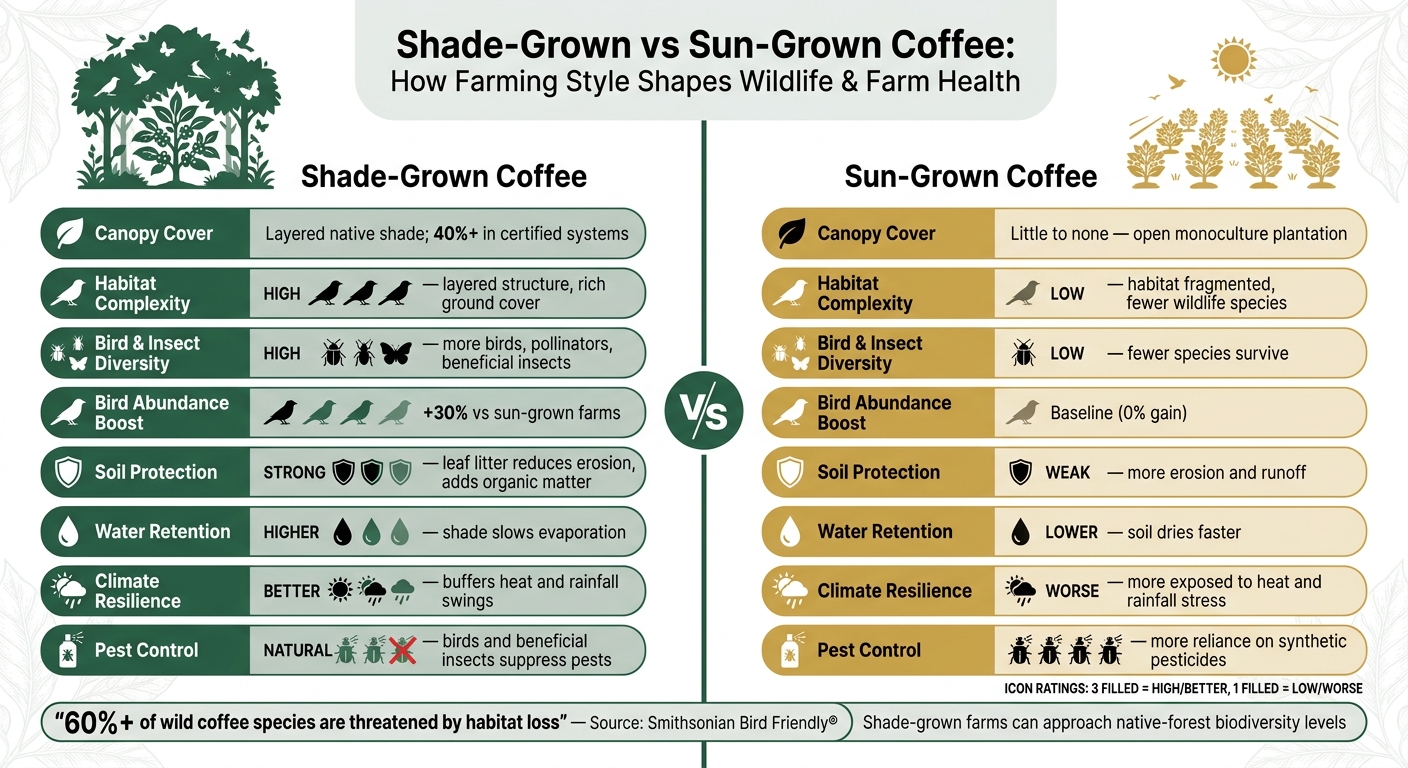
Shade-Grown vs Sun-Grown Coffee: Wildlife & Farm Impact Compared
The biggest difference is pretty simple: shade-grown coffee keeps habitat in place, while sun-grown systems usually remove it. The methods covered above - from Bird Friendly® canopies to riparian buffer zones - do this in different ways. But they all point to the same basic split.
| Feature | Shade-Grown Coffee | Sun-Grown Coffee |
|---|---|---|
| Canopy Cover | Layered native shade; often 40%+ in certified systems | Little to no canopy; open plantation with little shade |
| Habitat Complexity | High; layered structure and ground cover | Low; habitat breaks apart and supports fewer wildlife species |
| Bird & Insect Diversity | High; more birds, pollinators and beneficial insects | Low; fewer species survive |
| Soil Protection | Strong; leaf litter reduces erosion and adds organic matter | Weak; more erosion and runoff |
| Water Retention | Higher; shade slows evaporation | Lower; soil dries faster |
| Climate Resilience | Better; buffers heat and rainfall swings | Worse; more exposed to stress |
| Pest Control | Natural; birds and beneficial insects suppress pests | Higher reliance on synthetic pesticides |
This isn’t just about how a farm looks from a distance. It changes how the whole place works. Shade-grown systems can increase bird abundance by 30% compared with sun-grown farms, which shows that canopy cover affects farm ecology in a direct way, not just its appearance.
So when canopy is removed, the result isn’t only more sun on the coffee plants. You also get less shelter, less ground cover, drier soil, and fewer birds and insects doing the day-to-day work that keeps a farm in balance.
That trade-off leads to the final takeaway for UK buyers.
Conclusion
Across the systems above, wildlife-friendly coffee farming brings together shade, lower chemical use, protected waterways and connected habitat. The result is simple: farms stay productive, and wildlife has more room to live and move.
These practices support biodiversity while helping with resilience, soil health and input efficiency. For UK coffee drinkers, those choices can help keep coffee farms productive while also protecting wildlife.
FAQs
Which wildlife-friendly coffee label should I trust most?
Look for independent certifications such as Smithsonian Bird Friendly®. This label checks strict habitat standards, including mixed tree canopies that help migratory birds and native wildlife.
Other recognised third-party schemes, including Fairtrade and Rainforest Alliance, also review land use and ethical practices. Creation Coffee puts a strong focus on transparency and long-term relationships with farmers to support responsible care for the land.
Does shade-grown coffee affect flavour or yield?
Shade-grown coffee mainly helps with soil health, biodiversity and land care. It doesn’t directly change flavour or yield on its own.
What it does do is help create steadier conditions for the coffee plants. Shade trees can regulate the microclimate, protect crops from harsh weather and help keep the land in better shape over time.
Flavour, though, is shaped more by things like pollinator activity and day-to-day farm management. Those same factors can also support better yields. So while shade plays a big part in the bigger picture, its strongest role is in supporting long-term land health and, by extension, coffee quality.
How can I spot genuine habitat-friendly coffee on a pack?
Look for third-party certifications such as Smithsonian Bird Friendly, which independently verify strict ecological standards. These labels show that farms protect native tree canopies and ecological corridors that support wildlife.
You can also check for shade-grown labels and roasters using direct trade, as these often reflect regular farm visits and environmental practices such as agroforestry.