


If I want coffee that supports farms for the long term, shade-grown is the stronger choice. It can support more wildlife, protect soil and water, help farms handle heat, improve flavour, and give growers more than one way to earn.
Here’s the short version:
- More wildlife on farms: bird numbers can be 30% higher than on sun-grown monocultures.
- Cooler farm conditions: tree cover can lower temperatures by 4–6°C.
- Stronger yields in some cases: shade has been linked with 28% better yield in early fruiting, while added stingless bees lifted branch-level yield by 67%.
- Better cup scores: managed pollinators were linked with an average 2.43-point gain in SCA score.
- More income support: farmers may cut spending on water and inputs, while fruit or timber trees add extra income.
So when I look at shade-grown coffee, I’m not just looking at farming style. I’m looking at a system that can help the land, the crop, and the people behind it.
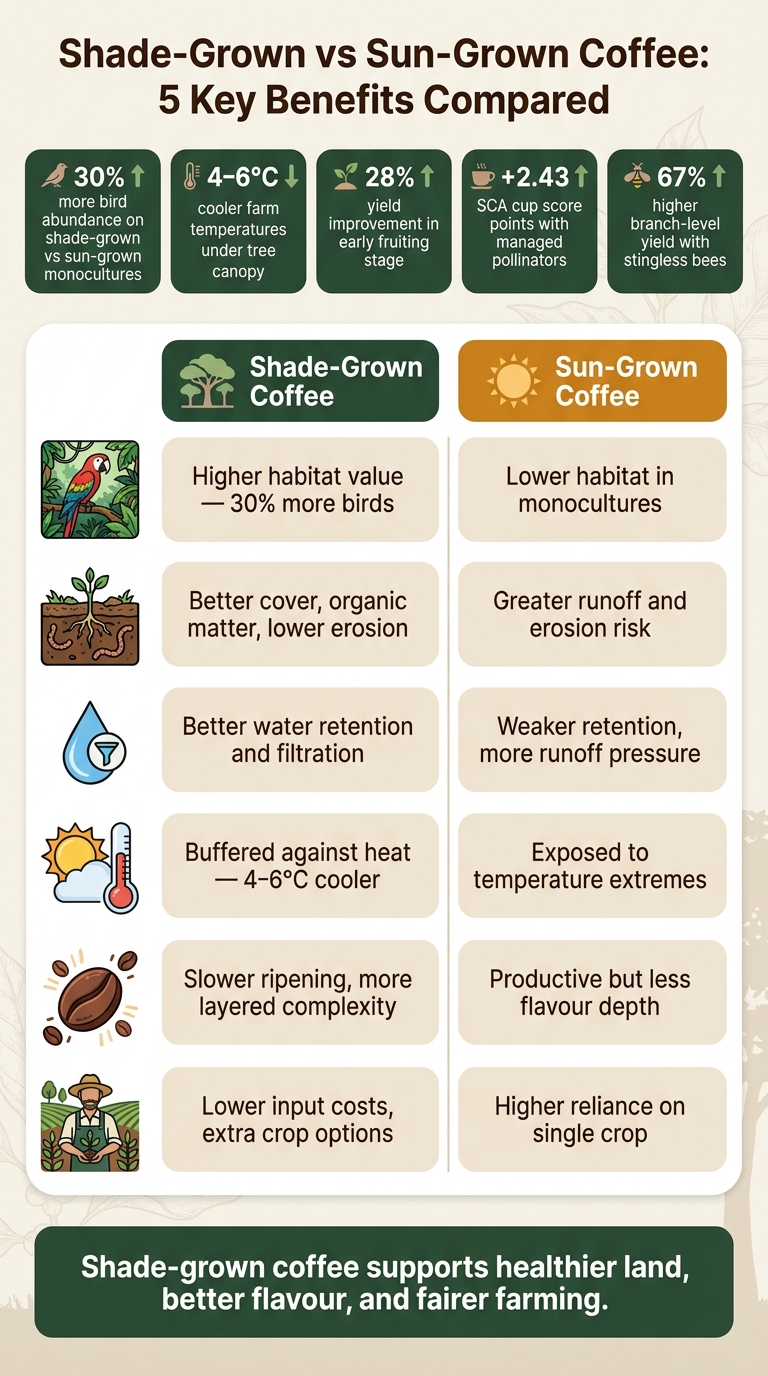
Shade-Grown vs Sun-Grown Coffee: Key Benefits Compared
how shade grown coffee farms protect migratory bird routes while boosting crop flavor naturally
sbb-itb-cca2aed
Quick Comparison
| Point | Shade-grown coffee | Sun-grown coffee |
|---|---|---|
| Wildlife | More habitat for birds, bats and pollinators | Less habitat in monocultures |
| Soil and water | Better cover, less erosion, steadier moisture | More exposure and runoff |
| Heat and weather | Cooler, more buffered farm conditions | More exposed to heat and shocks |
| Taste | Often linked with slower ripening and more layered flavour | Often less tied to flavour depth |
| Farmer income | Lower input pressure and extra crop options | More reliance on one crop |
Below, I’ll break down the five main reasons shade-grown coffee stands out.
1. Richer Biodiversity and Wildlife Habitat
Environmental Impact
Shade-grown coffee farms keep a forest-like shape. Native trees create a layered canopy that gives birds, bats and pollinators food, shelter and places to breed, while the understorey gives other animals room to live too.
That matters on a landscape level as well. These farms can connect broken-up habitats, helping wildlife such as birds, monkeys and jaguars move through an area with less risk. One stat says a lot here: shade-grown coffee farms can increase bird abundance by 30% compared with sun-grown monocultures.
This mix of wildlife doesn't just help nature. It helps the farm work better too.
Farm Resilience
Birds and bats can keep pest numbers down, which cuts the need for chemical pesticides. And pollinators play a part as well. A 2026 study found that adding stingless bees increased branch-level yield by 67% and improved cup scores.
In other words, the canopy isn't just there for looks. It supports a small living system that can make the farm more stable.
Cup Quality
Shade can shape flavour too. The cooler canopy often slows cherry ripening, and that slower pace can improve flavour complexity in the cup.
Community Benefit
Certification can help show buyers that the coffee was grown in a way that's friendlier to wildlife.
Beyond wildlife, shade also helps protect the soil and water the farm relies on. That living canopy supports far more than what's happening above ground.
2. Healthier Soils and Protected Watersheds
Environmental Impact
The same canopy that gives wildlife a place to live also shields the soil below. It breaks the force of heavy rain before it hits the ground, while tree roots help keep slopes in place. On steep coffee hillsides, that makes a big difference.
Under that canopy, fallen leaves and prunings break down into organic matter. That helps improve soil structure and fertility. The shade layer also shapes soil fungal and bacterial communities, which play a key part in nutrient cycling. On top of that, it cools the farm by 4–6°C, which helps the soil hold onto moisture instead of baking in direct sun.
Farm Resilience
Using fewer pesticides means less runoff into nearby streams and springs. That matters beyond the farm gate. Cleaner water supports neighbouring households and other plots that rely on the same sources.
Cup Quality
A cooler canopy with steadier moisture can also help cherries ripen more slowly, which may lead to a cleaner flavour in the cup.
Community Benefit
Mature shade farms already provide water and soil gains that young tree planting can't deliver in the short term. Keeping those systems in place supports steadier watersheds and more reliable water flow for farms and nearby communities. Those steadier soils and watersheds also give farms more support during hot weather and dry spells.
3. Climate Resilience and Carbon Storage
Shade does more than protect soil and hold water in place. It also helps coffee farms deal with heat and erratic weather.
Environmental Impact
Shade trees create a cooler, more stable microclimate that shields coffee plants from heat spikes, hail and wind. They also store carbon in wood, roots and soil, which turns the farm into a carbon sink.
That kind of stability can make harvests less erratic from one season to the next.
Farm Resilience
One of the biggest upsides of shade-grown systems is lower year-to-year yield swings. Research shows that shade can improve coffee yield by 28% during the early fruiting stage.
There’s another plus too. Farmers can grow intercrops such as banana plants beneath the canopy, which gives them an extra income stream when climate conditions hit the coffee harvest.
Community Benefit
Steadier harvests and extra crops can strengthen farm income and cut reliance on a single coffee crop.
A steadier growing environment can also support cleaner flavour in the cup.
4. Better Flavour and Cup Quality
The same shade that protects the farm can also make the coffee taste better. Shade-grown coffee ripens more slowly, which gives the beans more time to build sugars and flavour compounds.
Cup Quality
Shade-grown Arabica from Nicaragua's Segovia region is known for notes of chocolate, apricot, fig and spice. That slower ripening helps shape a more layered cup.
Pollinators can help here too. In coffee landscapes with managed pollinators, beverage quality improved by an average of 2.43 SCA cup score points. And when cup quality goes up, farmers may be able to earn better prices.
Community Benefit
Higher cup scores can lift farm prices. Certification programmes such as Smithsonian Bird Friendly also set clear shade standards, requiring at least 40% shade cover and a mix of native trees.
5. Better Social and Ethical Outcomes for Farmers
Beyond ecology and flavour, shade-grown coffee can also help the people growing it.
Farm Resilience
Shade-grown systems can help soften big harvest swings, which gives farming families a more steady income. That matters. Coffee income can be patchy from one season to the next, and a steadier harvest can make day-to-day planning far less stressful.
There’s also the cost side. Shade trees hold moisture in the soil and cycle nutrients back into the farm, which can cut irrigation and fertiliser costs.
And coffee doesn’t have to do all the heavy lifting on its own. Fruit or timber trees can give farmers extra food and another source of income beyond coffee.
Community Benefit
Coffee prices can move up and down sharply, so access to premium markets can make a big difference. These markets may pay more for higher quality coffee and for verified social standards.
Certifications linked to shade-grown farming can also help at community level. Fair Trade's Social Premium - a cooperative fund used for community projects - has funded schools, healthcare and shared equipment.
There’s also a generational issue here. The average age of coffee farmers globally is now in the 50s or 60s. If shade-grown farming pays well, younger people have a stronger reason to stay on the land instead of walking away from it.
That mix of steadier income, lower input costs and community support is one reason shade-grown coffee differs from sun-grown systems.
Shade-Grown vs Sun-Grown Coffee: A Quick Comparison
Here’s the contrast at a glance.
| Factor | Shade-grown coffee | Sun-grown coffee |
|---|---|---|
| Biodiversity support | Higher habitat value from tree cover | Lower habitat value in monocultures |
| Soil health and erosion risk | Better soil cover, more organic matter and lower erosion risk | Greater exposure, more runoff and erosion risk |
| Watershed protection | Better water retention and filtration from canopy cover and leaf litter | Weaker water retention and greater runoff pressure |
| Climate resilience | More buffering against heat and weather stress | More exposed to temperature extremes and weather stress |
| Reliance on synthetic inputs | Often lower synthetic input use | Often higher use of synthetic fertilisers and pesticides |
| Flavour complexity | Often linked to slower ripening and more nuanced flavour | Can be productive but often less associated with complexity |
Put simply, shade-grown coffee tends to support healthier farm ecosystems, while sun-grown coffee often puts more pressure on soil, water, and local wildlife.
That doesn’t mean sun-grown coffee can’t produce strong yields. It can. But the trade-off is hard to miss: less tree cover usually means less shelter for birds and insects, more strain on the land, and a farm that’s more exposed when heat or heavy rain hits.
On the cup side, shade-grown coffee is often tied to slower cherry ripening, which can help develop more layered flavour. Sun-grown coffee may still be productive, but it’s less often linked with that kind of depth.
These trade-offs lead into the article's final takeaway.
Conclusion
These five benefits make one thing clear: shade-grown coffee matters. It helps the farm, the cup and the community. From biodiversity and soil health to climate resilience, flavour and farmer incomes, the pattern is simple: the way coffee is grown shapes the land, the people and the wildlife linked to it.
Sustainability in coffee rests on three parts: care for nature, social justice and economic viability. That’s the standard Creation Coffee aims to reflect through ethical sourcing, direct trade and support for community projects.
Shade-grown coffee is a practical choice for healthier land, better flavour and fairer farming.
FAQs
How can I tell if coffee is truly shade-grown?
Look for trusted third-party certifications such as Bird Friendly, Rainforest Alliance, or Fairtrade. These labels give you an independent check that shade-grown farming methods are being used.
It also helps to buy from transparent roasters that share details about the farm, altitude, and cultivation methods. Those details make it much easier to see whether the coffee comes from farms that protect native tree canopies, instead of sun-grown monocultures.
Does shade-grown coffee always taste better?
Not always. Shade-grown coffee often gets praise for flavour because the tree canopy creates a cooler microclimate. That slower pace can help coffee cherries ripen more gradually, which may lead to more layered, complex flavours in the cup.
That said, taste doesn’t come down to shade alone. Soil properties, plant reproductive stages, and farming methods all play a part in how a coffee ends up tasting. At Creation Coffee, we roast specialty-grade beans in a way that respects their natural flavour and origin.
Is shade-grown coffee usually more expensive?
Often, yes. Shade-grown coffee can cost more because farms that use this approach may produce less coffee than intensive sun-grown monocultures.
Part of the price can also come from certification fees, careful land management, and fair pay for farmers. When you choose shade-grown coffee, you’re backing biodiversity, better soil health, and the long-term livelihoods of coffee-growing communities.