


I judge direct-trade coffee by what growers are paid - not the label. Before buying, I check who grew it, when they were paid and whether the roaster commits to buying across harvests.
For me, Christian values mean justice, honesty, stewardship and love of neighbour in each purchase. My checks cover:
- Grower relationships: named farms, purchase records and agreed buying terms.
- Prices and roasting: clear producer payments, lot-to-bag records and roast dates.
- Land and livelihoods: grower-led work with records of what changed.
- My own habits: bag sizes and delivery dates that help me avoid waste.
Creation Coffee states that it gives 10% of profits to Compassion UK and offers a 10% subscription saving. I treat those as separate from sourcing: charitable giving does not prove fair producer pay. <u>Both need checking.</u>
Farmer Partnerships and Long-Term Support
How to Check Farmer Relationships
Record the first purchase year, harvest years, volumes bought and the farm or co-operative’s name to show how the partnership has developed. Records matter more than labels. Check purchase records, speak with producers and review technical support. Site visits help, but they’re not required.
Communication needs to work both ways. Growers explain rainfall, yields, processing choices and priorities. Roasters provide timely feedback on cup quality, drying and packaging. Ask how both sides agreed quality standards and whether growers can respond to feedback. Farmers are skilled business partners, not recipients of help. This sets the basis for pricing and buying commitments.
Buying Commitments Across Harvests
Repeat orders help growers plan labour, equipment and investment. That’s stewardship in practice. Written agreements should specify volumes, delivery windows, payment terms and quality premiums. An intention to buy again is not a commitment. Ask what happens if weather reduces yields or changes quality, and whether the buyer can still keep its promises.
Buying more of the crop - not just one standout small lot - gives growers more security. Each lot needs clear pricing. Buyers should pay for extra labour, equipment and risk rather than leave growers to carry those costs.
Supporting Growers’ Land and Livelihoods
Christian integrity means keeping purchasing promises. Stewardship means listening to growers’ priorities for soil, shade, water and resilience. Ask what changed, who gained, over what period, and how it was measured. Producer-led projects and follow-up records provide stronger evidence than good intentions. A single purchase or donation is a contribution, not proof of lasting gains. Those commitments should also show up in the price paid and the freshly roasted coffee sold.
sbb-itb-cca2aed
Greenwashing vs. Direct Trade vs.Fair Trade
Clear Pricing and Responsible Roasting
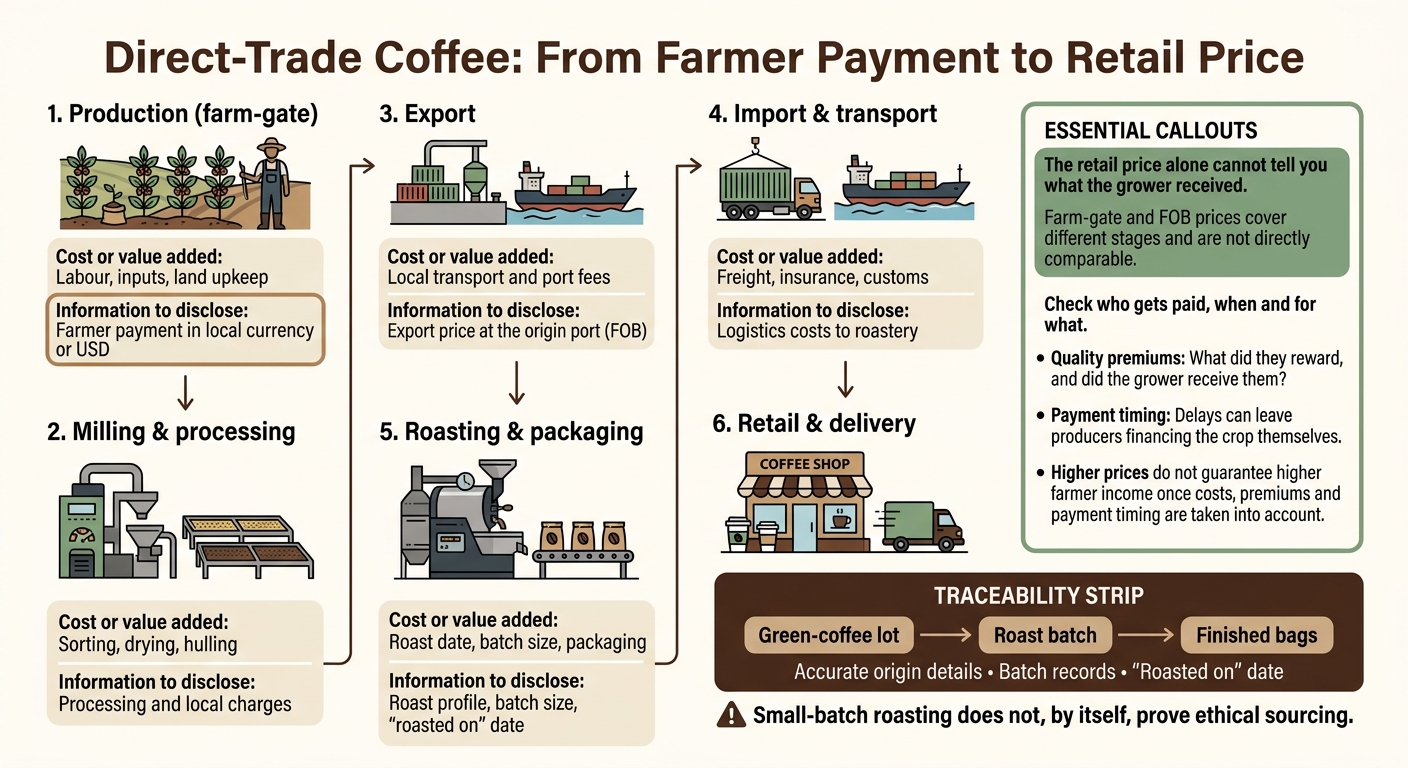
Direct-Trade Coffee: From Farmer Payment to Retail Price
Long-term relationships should show up in the price, not just on the label. Justice means being clear about who gets paid, when and for what.
From Producer Payments to Retail Prices
The retail price alone cannot tell you what the grower received. Check whether the stated figure is the farm-gate price or the export price at the origin port (FOB). These cover different stages and are not directly comparable.
| Supply-chain stage | Cost or value added | Information to disclose |
|---|---|---|
| Production (farm-gate) | Labour, inputs, land upkeep | Farmer payment in local currency or USD |
| Milling & processing | Sorting, drying, hulling | Processing and local charges |
| Export | Local transport and port fees | Export price at the origin port (FOB) |
| Import & transport | Freight, insurance, customs | Logistics costs to roastery |
| Roasting & packaging | Roast date, batch size, packaging | Roast profile, batch size, “roasted on” date |
| Retail & delivery | Overheads and fulfilment | Retail price in £ and delivery charges |
Alongside clear prices, traceability should show the coffee’s journey from lot to bag.
Quality premiums need an explanation: what did they reward, and did the grower receive them? Payment timing matters too. Delays can leave producers financing the crop themselves. Higher prices do not guarantee higher farmer income once costs, premiums and payment timing are taken into account. Honest pricing also shows the roaster’s costs without overstating the support producers receive.
Small-Batch Roasting and Traceability
Traceability should connect each green-coffee lot to its roast batch and finished bags. Accurate origin details, batch records and a “roasted on” date help buyers check that connection - not just how recently the coffee was roasted.
Small-batch roasting describes a method. It does not, by itself, prove ethical sourcing. Payment and sourcing records still need to show fair pricing and long-term relationships.
Creation Coffee’s Stated Commitments
Creation Coffee’s stated practices matter only when they link back to producer payments and batch traceability.
Creation Coffee describes itself as a Christian-based roaster offering small-batch direct-trade single-origin coffees and blends. The company says it uses 100% recyclable LDPE4 packaging. These commitments support craftsmanship and community, but they do not show what growers receive.
How Buying Choices Affect Everyone
Beyond pricing and traceability, your buying habits affect growers, roasters and how much coffee you use.
Benefits, Duties and Limits
Regular orders help roasters predict demand. For growers, that demand helps when it leads to firm buying commitments across harvests. Christian values call for honesty, stewardship, justice and care for others. Paying more alone does not prove greater impact.
| Assessment | Growers | Roasters | Customers |
|---|---|---|---|
| Benefits | Agreed prices and volumes help stabilise income and support planning. | Repeat orders improve demand forecasts and cash flow. | Traceability helps people make informed buying choices. |
| Responsibilities | Meet agreed quality and sustainable farming requirements. | Honour buying and payment terms; explain costs. | Check claims and avoid waste. |
| Limitations | Harvest losses and market risks remain. | Sourcing and delivery costs can change. | Subscriptions do not guarantee purchases from a particular producer. |
| Without pricing or relationship evidence | Income benefits remain uncertain. | Claims of lasting support remain unverified. | It is harder to judge where the money goes. |
These benefits depend on the buying terms. Direct trade does not remove harvest or market risks.
A Direct-Trade Buying Checklist
Use these benefits and limits to check the claims behind your coffee.
Focus on producer identity, payment evidence and harvest-to-harvest buying commitments. Ask who produced the coffee, how it was bought, what was paid and what commitments are in place.
For claims about land, resources or livelihoods, ask for dated records showing what changed and who benefited. Missing information limits confidence, but it does not automatically prove misconduct.
Choosing Bag Size and Delivery Frequency
Once the sourcing checks pass, match your order to how much coffee your household drinks.
Choose 250 g, 500 g or 1 kg bags based on actual use - not just the lowest price per gram. Check how much you drink in a normal week and how much storage space you have. Order only what you can use while the coffee is at its best, and reduce or pause deliveries if bags start piling up.
Creation Coffee’s subscription options offer convenience and a stated 10% saving. Before ordering, check current prices, delivery charges, and the terms for pausing or cancelling. Set deliveries around your household’s needs, not a free-delivery threshold.
Conclusion: Putting Christian Values into Practice
Direct trade should be judged by the evidence, not the label. Christian values should show through honest pricing, long-term commitment and careful roasting. Look at producer relationships, prices paid and repeat buying.
Before ordering, check Creation Coffee’s origin details and producer commitments. If anything is unclear, ask how it sets prices and supports growers over time. Does it buy from the same producers across multiple harvests? Hand-roasting in Weaverham, Cheshire, tells you how the coffee is produced. It doesn’t show how growers benefit or prove they receive fair treatment.
Creation Coffee also states that it donates 10% of all profits to Compassion UK. Charitable giving and fair producer pay are separate duties. Check each separately when deciding whether the coffee matches Christian ethics.
FAQs
How can I assess fair grower pay when prices are undisclosed?
Look for clear sourcing details: the farm or cooperative, harvest year and processing methods. Ask how the roaster ensures fair pay, and whether its direct trade agreements put producer-led pricing ahead of volatile commodity market rates.
Check how long the roaster’s grower partnerships last. Multi-year commitments can offer more stability than spot buying. Look for openness about sourcing practices and ask how the business helps farmers earn a living income.
How should Christian values guide buying after a poor harvest?
After a poor harvest, Christian values put stewardship, long-term commitment and solidarity ahead of short-term profit. For roasters, that means standing by farming partners and maintaining stable direct trade relationships. These ties help farmers cope with market volatility and receive fair compensation, even when yields fall.
Keeping those commitments respects farmers’ dignity and well-being. It means treating the supply chain as a partnership built on integrity, generosity and shared responsibility.
How can I tell whether my subscription benefits growers?
Look for named farms or cooperatives, clear details of what producers are paid compared with local production costs, and records of long-term partnerships rather than one-off purchases. Vague ethical claims aren't enough.
At Creation Coffee, your subscription supports farmers through direct, honest relationships that cut out middlemen, with premiums linked to quality. We also donate 10% of our profits to support children in coffee-growing regions.