


I use altitude as a clue, not a roast recipe. Before choosing heat settings, I check bean density, moisture and size - and test 1 change at a time.
Here’s what matters for your coffee:
- Growing altitude: Higher-grown beans often have brighter acidity; lower-grown beans may lean towards body and chocolate. Neither guarantees a better cup.
- Roasting altitude: The roastery’s elevation affects air pressure and heat transfer, so a copied profile may need testing.
- Roast and taste: I match heat and airflow to the beans, log temperatures in °C and compare cups under the same brewing conditions.
- Buying: I check producer, processing and harvest details, plus evidence behind sourcing claims - not just the altitude or price.
My rule: <u>let measurements and taste guide the roast</u>, and check brewing before blaming a sharp or bitter cup on roast settings.
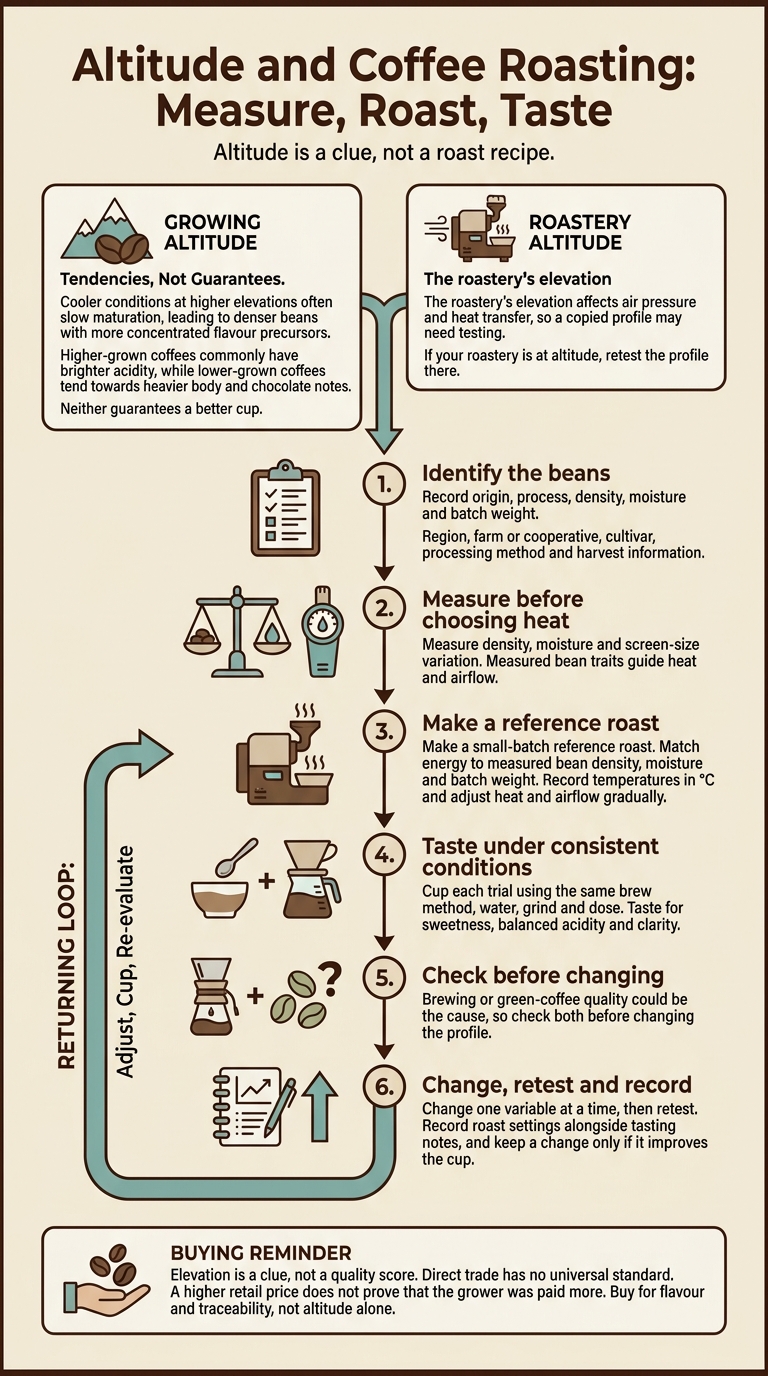
Altitude and Coffee Roasting: Measure, Roast, Taste
How Growing Altitude Affects Green Beans
Slower Maturation, Bean Density and Flavour Precursors
Altitude helps predict bean structure and roast behaviour, but it doesn’t determine flavour on its own. Cooler conditions at higher elevations often slow maturation, leading to denser beans with more concentrated flavour precursors. Higher-grown coffees commonly have brighter acidity, while lower-grown coffees tend towards heavier body and chocolate notes.
Typical Roast Responses at Different Elevations
Use these tendencies as a starting point for heat and development, then refine your approach through cupping. A medium roast can help balance acidity and body.
| Relative elevation | Bean traits to check | Initial roast approach | Possible cup expression |
|---|---|---|---|
| Lower-grown | Check density, moisture and screen size; beans may be less dense | Apply gentler heat; test medium development | Heavier body and chocolate tones |
| Higher-grown | Check density, moisture and screen size; beans may be denser | Supply enough early heat, then control development; test a light roast | Brighter acidity, floral, citrus or stone-fruit notes |
| Either elevation | Measure density, moisture and screen-size variation | Adjust heat to measured traits; test a medium roast | A balance of acidity and body |
Measured bean traits guide heat and airflow. Denser, higher-grown beans usually need a more controlled roast profile. Less dense beans often need gentler heat to avoid dull, flat flavour.
Origin details add context; their role in buying decisions comes later. Next, match heat and airflow to these bean differences in the roast profile.
sbb-itb-cca2aed
How Roast Adjustments Change Flavour
Matching Heat and Airflow to the Beans
Use the density, moisture and size checks above to set your first roast profile. Match energy to measured bean density, moisture and batch weight, rather than growing altitude alone.
Record temperatures in °C and adjust heat and airflow gradually. Too little development can leave sharp or vegetal flavours in the cup. Too much surface heat can scorch the beans or add burnt notes.
Using Cup Flavour to Diagnose Roast Problems
The cup tells you whether your roast changes worked, but flavour alone doesn’t prove a roasting fault. Brewing or green-coffee quality could be the cause, so check both before changing the profile.
Use flavour to judge development: underdevelopment leaves sharp, vegetal notes, while overdevelopment reduces sweetness and adds bitterness.
| Observation | Possible cause | Sensory risk | Conservative adjustment |
|---|---|---|---|
| Sharp, underdeveloped cup | Insufficient heat or development | Low sweetness; harsh acidity | Review early energy before extending the roast |
| Bitter finish | Excessive roasting or brewing issues | Bitterness masking sweetness | Check brewing first, then reduce development slightly |
Testing Small-Batch Roast Adjustments
Record origin, process, density, moisture and batch weight. Keep trials small and change one variable at a time. Log temperatures in °C to compare roasts under the same conditions.
Cup each trial using the same brew method, water, grind and dose. Record the result alongside the roast data. These trials show whether the profile suits the beans.
Adjusting for Roastery Altitude
Growing altitude and roastery altitude call for separate decisions. Bean traits shape the profile, while roastery altitude also affects heat transfer through changes in air pressure.
If your roastery is at altitude, retest the profile there. Check roast settings against origin details rather than copying them without testing.
Why Origin Details Matter When Buying Coffee
Reading Altitude, Producer and Processing Details
Look for region, farm or cooperative, cultivar, processing method and harvest information, as well as growing altitude. These details help you predict how the beans may behave in the roaster and what flavours to expect.
Read altitude alongside processing details and tasting notes to judge how the coffee might roast and taste in the cup. Elevation is a clue, not a quality score. Together, these details guide roast decisions as well as buying choices.
Check harvest information separately from the roast date: one tells you about the crop; the other tells you when the beans were roasted. Once you understand the label, check whether the sourcing story is just as clear.
Checking Traceability and Sourcing Claims
Origin details matter most when you can verify them.
Direct trade has no universal standard, and a farm name alone does not prove that producers receive fair returns. Ask who the sourcing partners are, how long they’ve worked together and what evidence backs claims about payment, land care and community impact. A higher retail price does not prove that the grower was paid more.
Conclusion: Altitude Is a Starting Point
Once you’ve checked origin details and roast data, altitude becomes a clue, not a recipe. Roast level and development shape what reaches the cup. A lighter roast can preserve origin character, while more development can move the flavour towards body and chocolate notes. Growing altitude and roastery altitude are different things. Base adjustments on measured bean properties and tasting results, not elevation alone.
Identify, Measure, Roast, Taste
The test is in the cup, not on the label. Identify the beans, measure their density, moisture and size, then make a small-batch reference roast. Taste for sweetness, balanced acidity and clarity, keeping the brewing dose and extraction consistent.
Change one variable at a time, then retest. Record roast settings alongside tasting notes, and keep a change only if it improves the cup. Buy for flavour and traceability, not altitude alone.
FAQs
How can I measure bean density before roasting?
Inspect a 300–350 g sample of green coffee for uniformity, cracked beans and signs of ageing. To gauge density, the most effective approach is to roast small test batches and watch how the beans respond to heat. This helps you understand their density and moisture levels before scaling up production.
Track moisture content too. Aim for 9%–13% to support stability during roasting.
Which roast setting should I test first at altitude?
Start with small test batches to check bean density and moisture levels. Beans grown at high altitudes tend to be denser, with brighter acidity and floral or citrus notes. Pay close attention to heat management when roasting them.
Record Rate of Rise (RoR) and bean temperature at yellowing and first crack, which occurs at approximately 196°C. Adjust the gas or airflow to keep the roast profile steady and avoid stalling or scorching.
What evidence supports ethical direct-trade claims?
Evidence includes clear origin details - farm names, processing methods and altitude - alongside independent certifications such as B Corp, Fairtrade and Rainforest Alliance. Some roasters also use isotope ratio analysis to check that beans come from the stated origin.
Ethical direct-trade claims also carry more weight when backed by documented, long-term farm relationships and payments above market rates. These payments help fund community infrastructure, including on-site schools and employee health clinics.