


Neither compostable nor recyclable coffee bags win by default. I’d first check whether your council or collection scheme accepts the finished bag, then check that it protects your coffee for the shelf life you need.
My comparison comes down to three checks:
- Disposal: Recyclable bags need an accepting collection route. Compostable bags need the right composting route: EN 13432 covers industrial composting, not home composting.
- Coffee protection: I’d check oxygen, moisture and light barriers, plus valves, zips and seals. Ground coffee needs tighter oxygen control than whole beans.
- Carbon and fit: I’d compare the exact bags’ weight, production, transport, coffee waste and disposal. Then I’d match pack size, print runs and storage time to your sales channel - not simply whether you sell single origins or blends.
<u>A material label alone is not enough.</u> I’d ask for finished-bag certification, shelf-life test results and clear disposal instructions before ordering.
Quick Comparison
| Check | Recyclable coffee bags | Compostable coffee bags |
|---|---|---|
| UK disposal | Accepted kerbside service or soft-plastic drop-off | Accepted industrial route, or home composting if certified |
| Whole bag | Check acceptance of film, valve and zip | Check certification covers all parts |
| Coffee protection | Test barriers, closures and filled-pack shelf life | Apply the same tests |
| Carbon impact | Compare the exact pack and likely disposal route | Same check; compostable does not mean lower-carbon |
| Sales channel | Match pack size and protection to stock turnover and storage | Same approach for retail, subscriptions and direct delivery |
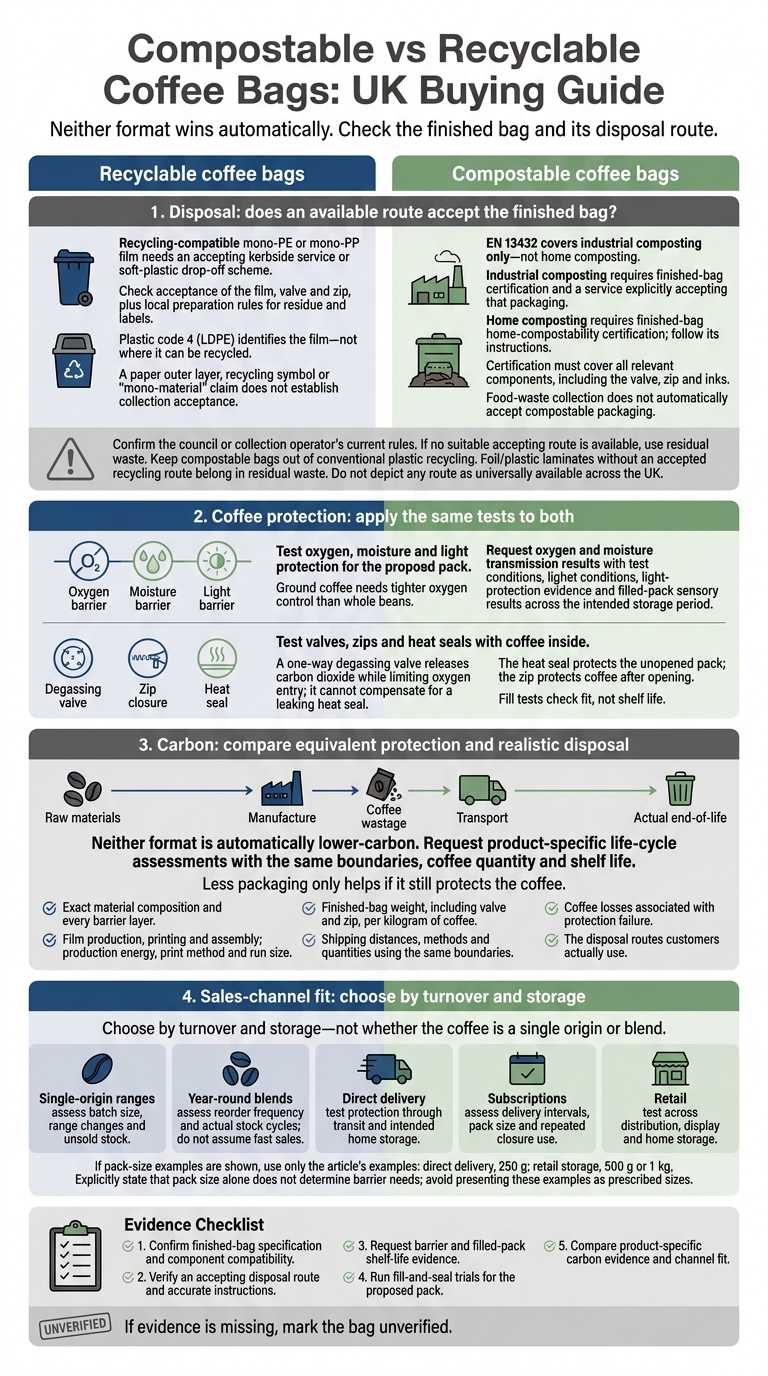
Compostable vs Recyclable Coffee Bags: UK Buying Guide
Compostable vs Recyclable Bags: UK Disposal Routes
A disposal claim only works if the local service accepts the finished bag. Check your postcode and the operator’s packaging list before choosing wording for the pack.
| Bag construction | Treatment needed | Household access | Suitable disposal wording |
|---|---|---|---|
| Recycling-compatible mono-PE or mono-PP film | Plastic sorting and reprocessing | Accepted kerbside service or soft-plastic drop-off | Recycle with bags at large supermarket |
| Finished bag certified for industrial composting | Industrial composting facility | Only through a service that explicitly accepts that packaging | Compostable in industrial facilities |
| Finished bag certified for home composting | Home composting | Suitable home compost heap | Home Compostable |
| Foil/plastic laminate without an accepted recycling route | Residual waste treatment | Residual waste | Dispose of in residual waste |
Compostable Bags: Certification and Disposal
EN 13432 covers industrial composting only. PLA or cellulose alone does not prove that a bag is compostable. Ask the supplier for certification covering the finished bag, including its valve, zip and inks.
| Disposal route | What qualifies | What to do |
|---|---|---|
| Industrial composting | Finished bag certified to EN 13432 | Use only a collection service that accepts that packaging |
| Home composting | Finished bag with home-compostability certification | Follow its composting instructions; do not rely on EN 13432 alone |
| Food-waste or garden-waste collection | Packaging explicitly accepted by that operator | Check the operator’s rules for compostable packaging |
| Residual waste | Compostable bag with no suitable accepting route available | Use the residual-waste bin; keep it out of conventional plastic recycling |
A food-waste collection is not automatically a compostable-packaging collection.
Recyclable Bags: Kerbside and Drop-Off Rules
Plastic code 4 (LDPE) identifies the film, not where you can recycle it. Recycling-compatible PE or PP bags differ from foil/plastic laminates, which standard kerbside collections do not accept.
“Mono-material”, a paper-like finish or a recycling symbol does not confirm that a collection service accepts the bag. You still need to check its rules.
| Disposal route | Construction requirement | Local restrictions and preparation |
|---|---|---|
| Kerbside paper recycling | Paper bag with no plastic or foil lining, accepted locally | A paper outer layer does not make a lined bag paper-recyclable; check contamination rules |
| Kerbside flexible-plastic recycling | Recycling-compatible PE or PP accepted by the council | Empty out coffee residue; follow local instructions for labels, zips and valves |
| Supermarket soft-plastic drop-off | Bag type accepted by that specific scheme | Check the operator’s list; do not assume every flexible coffee bag qualifies |
| Residual waste | Unaccepted mixed-material or foil laminate, or no available recycling route | Keep it out of paper and plastic recycling |
Check the Recycle Now locator, then confirm the council or drop-off operator’s current rules for residue, labels, zips and valves.
Once the disposal route is clear, check whether the bag’s barrier and fittings protect the coffee’s flavour and aroma.
sbb-itb-cca2aed
Coffee Protection: Barriers, Shelf Life and Valves
Judge the finished pack, not the label. Check barrier data, closure fit and performance with coffee inside. Start with oxygen control, then assess moisture and light protection.
| Check | Recyclable bag | Compostable bag | Evidence to request |
|---|---|---|---|
| Oxygen and moisture transmission | Assess the film, thickness and barrier layers | Assess the complete compostable structure | Oxygen and moisture transmission results, including test conditions |
| Light protection | Depends on opacity and printing | Depends on opacity and construction | Light-protection data for the proposed bag |
| Shelf life | Test with the actual coffee and closures | Test with the actual coffee and closures | Finished-pack sensory results across the intended storage period |
| Valve compatibility | The valve must not weaken the claimed barrier | The valve must not weaken the claimed barrier | Component specifications and valve test results from filled packs |
Barrier Needs for Whole-Bean and Ground Coffee
Oxygen makes coffee stale, while moisture and light also damage flavour. Ground coffee needs tighter oxygen control because grinding exposes more of it to oxygen. Then check how the closure handles gas release.
Pack size alone does not determine barrier needs: test the filled pack. Match protection to delivery time, storage conditions and how long the customer will keep the bag after opening. Direct delivery cuts storage time, but still needs a shelf-life test.
| Setting | Recyclable pack | Compostable pack | Finished-pack testing |
|---|---|---|---|
| Direct delivery, 250 g | Film specifications and closure fit | Complete film specifications and closure fit | Filling, sealing and sensory checks through delivery and intended storage |
| Retail storage, 500 g or 1 kg | Oxygen, moisture and light protection | Equivalent protection data | Seal integrity and sensory checks throughout the intended retail period |
| Ground coffee, any pack size | Evidence that the film limits oxygen exposure | Equivalent evidence for the compostable film | Oxidation and sensory testing with the actual ground coffee |
| Whole beans, any pack size | Film specifications and valve performance | Film specifications and valve performance | Carbon dioxide release, valve function and seal checks |
Degassing Valves, Zips and Seals
Roasted coffee releases carbon dioxide. A one-way degassing valve lets this gas escape while limiting oxygen entry and bag swelling. Test the valve on filled bags: it cannot make up for a leaking heat seal.
The heat seal protects the unopened pack; the zip protects the coffee after opening. Ask for fill-and-seal trials using the proposed film, valve and zip. Once protection is settled, compare the carbon cost of each format.
Carbon Trade-Offs Across the Bag Life Cycle
Neither bag format is automatically lower-carbon. Ask for a product-specific life-cycle assessment (LCA) that covers raw materials, manufacture, transport and end-of-life, with the same boundaries for both formats.
Compare bags that protect the same coffee for the same shelf life. Material claims alone do not prove a lower carbon footprint. The LCA must also reflect how customers actually dispose of the bags. This makes carbon comparison a packaging question, not a material-label question.
| Carbon factor | Recyclable coffee bag | Compostable coffee bag | Evidence to request |
|---|---|---|---|
| Material production | Assess the specified polymer, such as LDPE | Assess the specified polymers; do not assume bio-based means lower emissions | Material composition and production emissions for the finished bag |
| Manufacturing | Include film production, printing and assembly | Include film production, printing and assembly | Production energy, print method and run size |
| Bag weight | Compare packaging weight per kilogram of coffee | Compare the same quantity of coffee | Finished-bag weight, including valve and zip |
| Transport | Include deliveries of materials and finished bags | Use the same transport boundaries | Shipping distances, methods and quantities |
| All layers | Include every layer, not just the main polymer | Include the complete barrier structure | Full specification and equivalent protection data |
| Coffee wastage | Account for coffee discarded when protection fails | Use the same wastage assumptions | Filled-pack results and recorded losses |
| Actual end-of-life treatment | Use the customer’s actual collection route in the LCA | Use the customer’s actual collection route in the LCA | Realistic treatment assumptions |
Less packaging only helps if it still protects the coffee’s quality. Compare packaging weight per kilogram of coffee alongside the shelf life it provides. Use those figures to guide the choice between single-origin runs and faster-turnover blends.
Choosing Bags for Single-Origin Coffees and Blends
Once you’ve checked shelf life and carbon, match the bag to the sales channel. Choose by turnover and storage, not coffee type. Check storage time, pack size and whether customers can use the intended waste route.
Range Size, Stock Turnover and Delivery
Small batches and changing origins suit digital printing and lower minimum order quantities. Larger runs need reliable packing performance. Track how long coffee stays in stock, in transit and in use after opening. If customers open and close a pack over several weeks, test the zip as well as the unopened seal.
Use these checks to distinguish short-run single-origin packs from high-turnover blend packs.
| Range or channel | Turnover and storage to assess | Shelf-life evidence needed | Customer disposal access |
|---|---|---|---|
| Single-origin ranges | Batch size, range changes and unsold stock | Filled-pack tests covering the expected selling period | Check waste routes for customers buying each release |
| Year-round blends | Reorder frequency and storage time between orders | Tests covering the actual stock cycle, rather than assuming fast sales | Confirm customers can access a route before repeating disposal claims |
| Direct deliveries | Dispatch timing, transit and home storage | Protection through delivery and the expected consumption period | Provide instructions customers can check locally |
| Subscriptions | Delivery interval, pack size and use after opening | Unopened shelf life and closure performance during repeated use | Don’t assume subscribers can use kerbside film collections |
| Retail sales | Warehouse delays, shelf time and storage conditions | Evidence covering distribution, display and home storage | Instructions must work without extra guidance |
Decision Table: Assessing a Proposed Coffee Bag
Assess the finished pack by sales channel, not material alone.
| Check | Proposed recyclable bag | Proposed compostable bag |
|---|---|---|
| Accepted waste route and instructions | Check that the named kerbside or drop-off scheme accepts the complete bag; explain any component-removal steps | Check finished-pack certification and access to the matching route; specify home or industrial composting and any component-removal steps |
| Tested barriers | Check filled-pack results against the channel’s storage period | Apply the same test; compostability does not establish shelf life |
| Valve and zip compatibility | Check component compatibility and seal performance | Check that components are covered by the finished-pack claim and work correctly |
| Consistent packing performance | Run physical fill and seal tests for each pack size | Run the same trials using the supplier’s heat and pressure settings |
| Carbon evidence for this exact bag and route | Check that evidence matches the proposed specification and disposal route | Check that evidence matches the proposed specification and disposal route |
If evidence is missing, mark the bag unverified.
Conclusion: Check the Finished Bag and Disposal Route
Once you’ve compared disposal options, barrier strength and carbon, check whether the finished bag works in your local system.
Neither format wins automatically. Choose a bag that your local disposal route accepts and that protects the coffee throughout its shelf life.
Use this checklist to rule out bags without evidence for the exact pack, its components and the intended disposal route.
Final Checklist for UK Roasters and Buyers
- Check the specification: Ask for details of every material, barrier layer, valve, zip and ink. Request physical samples and run fill tests before ordering.
- Check protection and claims: Verify oxygen and moisture transmission data, plus shelf-life evidence for the intended whole-bean or ground coffee. Fill tests check fit, not shelf life. Carbon and waste claims must reflect the actual pack and disposal route.
- Check the disposal wording: Confirm local acceptance and any council or drop-off restrictions. Check whether composting means home or industrial composting, and whether valves or zips need removing. An LDPE4 label alone does not prove kerbside acceptance.
FAQs
How can I verify a coffee bag’s compostability certification?
Check the packaging or product documentation for certifications showing that the material meets established standards. Home and commercial composting are different: bags labelled commercially compostable are not suitable for home composting.
You may not have access to a local commercial composting facility. Each supply chain has different requirements, so test the bag directly under your specific conditions to check its suitability. Don’t rely on general guidelines alone.
What if my customers have different disposal options?
Recycling options depend on where customers live, so encourage them to check their local council’s current recycling guidelines. Creation Coffee uses LDPE4 plastic for all its coffee bags, designed for recycling through standard kerbside collections. Many UK local recycling programmes accept this plastic, but customers should confirm that their council can process the bags before putting them out for collection.
How can I test whether a bag keeps coffee fresh?
Choose a resealable closure that limits contact with oxygen, which breaks down coffee’s oils and aromatic compounds. Fill sample bags to check the material structure and test how well the closure works.
Look for a clearly printed roast date - the most reliable guide to how recently the coffee was roasted. Coffee is best dispatched within days of roasting, rather than kept in a warehouse.