


I don’t treat direct trade or charity donations as proof that coffee farmers earn a living income. Before buying, I check what producers receive, compare household income with local living costs, and put prices and payment dates in writing.
Here’s what I check - and what you can ask your supplier for:
- Traceability: where each lot comes from and who handles it.
- Prices: producer payments, premiums, fees and any living-income gap.
- Contracts: purchase commitments, delivery duties and payment receipts.
- People: household income, worker pay, safety and complaints routes.
- Charity claims: recipients, donation calculations and transfer records.
- Review: a recorded buying decision, missing records and checks each harvest.
For example, Creation Coffee states that it donates 10% of profits to Compassion UK. That is not 10% of sales, and it does not establish farmers’ income.
My rule: <u>keep sourcing claims, charity payments and measured income outcomes separate</u> - then make sure customer-facing claims match the records.
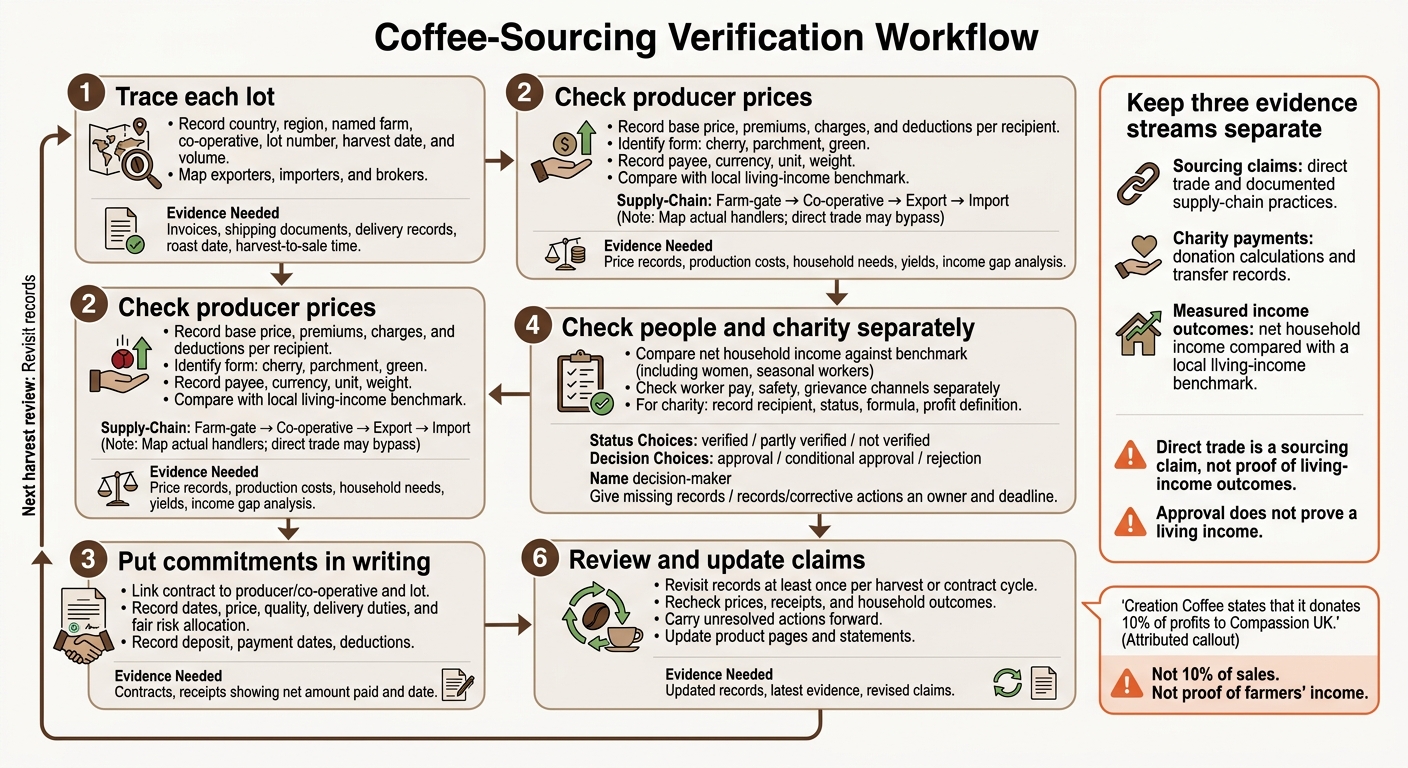
Living Income Coffee Sourcing: Evidence Checklist
Checklist: Trace Coffee and Check Producer Prices
Record Origins and Supply-Chain Documents
- [ ] Identify each lot: record the country, region, named farm, co-operative or washing station, lot number, harvest date and volume. For blends, record every component.
- [ ] Map every handler: name exporters, importers and brokers, and note any direct trade that bypassed intermediaries. Match invoices, shipping documents and delivery records to the full shipment. Use the roast date to check the time from harvest to sale.
Separate Prices, Premiums and Charges
Record the base price, premiums, charges and deductions separately for each recipient, using the fields below. State whether each payment covers cherry, parchment or green coffee, and record the weight used.
| Supply-chain stage | Product form | Base price | Premium | Charges | Payee | Currency | Unit | Evidence |
|---|---|---|---|---|---|---|---|---|
| Farm-gate | Cherry, parchment or green coffee | Record amount | Record separately | Record deductions | Named producer | Currency | Unit | Purchase record and producer receipt |
| Co-operative | Confirm form sold | Record amount | Record separately | Record fees | Named co-operative | Currency | Unit | Payment record |
| Export | Confirm form exported | Record amount | Record separately | Record export charges | Named exporter | Currency | Unit | Export invoice and shipping record |
| Import | Confirm form delivered | Record amount | Record separately | Record import charges | Named importer | Currency | Unit | Import invoice and delivery record |
Check the Living-Income Price Benchmark
- [ ] Compare the proposed producer price with a local living-income benchmark, where one is available.
- [ ] Match the named producer to the recorded price. Check whether it covers production costs and household needs, taking yields and other income sources into account.
If the price falls short, record the gap before moving to contract terms and payment timing.
sbb-itb-cca2aed
Are coffee farmers in Ethiopia earning a living income?
Checklist: Set Contracts and Payment Terms
Turn the price check into enforceable commitments. Put the agreed price, timing and risk terms already recorded into the contract.
Record Producer Relationships and Contract Length
Name the contracting parties and record the contract’s start and end dates. Link each contract to the named producer or co-operative for the lot.
Agree Quality and Delivery Duties
Put quality expectations and delivery responsibilities in writing. Avoid clauses that unfairly pass shipping risks, harvest losses or other risks beyond the producer’s control onto producers.
Confirm Payment Dates and Receipts
Record the payment currency, any deposit or pre-finance, payment dates and deductions. Keep clear receipts showing the net amount paid and the date of payment.
Checklist: Check Social Impact and Charity Claims
Once you’ve checked price and payment, assess household income, worker welfare and charity claims separately.
Measure Household Income and Worker Welfare
Compare net household income against the local living-income benchmark. Speak with women and seasonal workers as well as farm owners. Check worker pay, safety and confidential grievance channels separately from household income.
Check Charity Recipients and Donation Records
Record who receives the donation, their charitable status, the reporting period and the donation formula. A percentage of profits is not a percentage of sales. Define profit in writing, then match the calculated donation against transfer records or receipts.
Link to the recipient’s official website and, where available, its entry on the relevant charity register, such as the Charity Commission for England and Wales.
Check Creation Coffee’s Stated Commitments
Apply the same checks to brand-specific claims.
Creation Coffee says it sources through direct trade and donates 10% of profits to Compassion UK, a children’s charity.
Before publishing detailed donation claims, confirm the recipient, reporting period, receipts and supporting links. Present these as stated commitments - not verified living-income outcomes. Direct trade is a sourcing claim, not proof of living-income outcomes.
Conclusion: Record Your Decision and Review Each Harvest
Complete the Sourcing Check Matrix
Use this matrix to turn the checks above into a final sourcing decision.
Record the buyer, supplier, origin, crop year and purchase date. Replace each dash with an evidence reference, a named owner or a review date, as appropriate. Mark each check verified / partly verified / not verified.
| Checklist item | Required records | Records received | Responsible person | Status | Review date |
|---|---|---|---|---|---|
| Traceability | Farm/cooperative name, origin location, sourcing reports | - | - | - | - |
| Producer prices | Published green price and price transparency records | - | - | - | - |
| Living income | Local benchmark, household income assessment | - | - | - | - |
| Contracts | Relationship history, contract length and stability terms | - | - | - | - |
| Payments | Payment dates, transfer records, producer receipts | - | - | - | - |
| Worker welfare | Evidence of fair pay, dignified treatment, visit notes or certification notes | - | - | - | - |
| Charity claims | Donation calculation, profit percentage, recipient organisation and receipts | - | - | - | - |
Record approval, conditional approval or rejection, along with the decision-maker’s name. If approval is conditional, give each missing record or corrective action an owner and a deadline. Pause or reject purchases if the supplier withholds evidence needed for the decision. Approval does not prove a living income.
Update Purchasing Records and Customer Claims
Use the recorded decision as the starting point for the next harvest review.
Revisit the matrix at least once per harvest or contract cycle, and whenever costs, suppliers or terms change. Recheck producer prices, payment receipts and household outcomes. Carry any unresolved actions into the next review.
Update e-commerce product pages, subscription descriptions and sourcing statements so they reflect the latest evidence. Keep documented sourcing practices separate from measured income outcomes: approval alone does not justify a living-income claim.
FAQs
How can I assess living income without a local benchmark?
Choose producer-led pricing over commodity market prices, which often don’t cover basic production costs. Talk openly with farming partners about labour, fertiliser and fuel costs. Then compare those costs with the farmgate price to check whether the payment allows producers to cover their costs and earn a living over time.
Look for roasters who share farmgate prices alongside the harvest year, lot size and quality scores. These details help you judge whether prices reflect producers’ needs rather than shifts in the market.
How can I verify income data while protecting farmers’ privacy?
Use aggregated, anonymised reports rather than publishing individual financial records. To show that growers receive fair pay, share the premiums paid above the global Arabica price, or compare farmgate prices with local production costs.
Direct, long-term relationships, multi-year contracts and open communication help confirm a liveable income while keeping financial details private. Third-party checks or independent pricing benchmarks can support accountability.
How should I adjust prices when farmers’ living costs rise?
Set prices around production costs, not volatile commodity markets. Keep an open dialogue with farming partners about what they spend on labour, fertiliser and fuel. Use those costs to guide pricing agreements rather than market fluctuations.
Long-term contracts give farmers predictable income and help them plan ahead. Stay in direct contact so price adjustments reflect producers’ needs and coffee quality, ensuring they’re paid fairly.