


If you want to buy coffee well over many harvests, keep your process simple: set a clear brief, test each lot the same way, price by total landed cost, track every document, and review each order with data.
I’d boil the whole guide down to five checks:
- Cup quality: does it suit espresso, filter, or blend use?
- Total landed cost: what does it cost in £/kg after freight, duty, storage, and delivery?
- Lot traceability: can I trace the coffee back to the named lot, farm, or co-op?
- Supplier reliability: do they reply clearly, ship on time, and match what was approved?
- Shared responsibility: are payment, claims, and producer support handled with care and honesty?
A few hard numbers matter from the start:
- Green coffee often sits best at 10–12% moisture
- Water activity above 0.60 aw can point to spoilage risk
- Many roasters use 80+ SCA as a minimum quality mark
- Storage is often kept near 22°C and 60% RH or lower
In plain terms, this is not just about finding a coffee you like. It is about making sure the lot you cup is the lot that lands, stores well, roasts well, sells well, and is worth buying again.
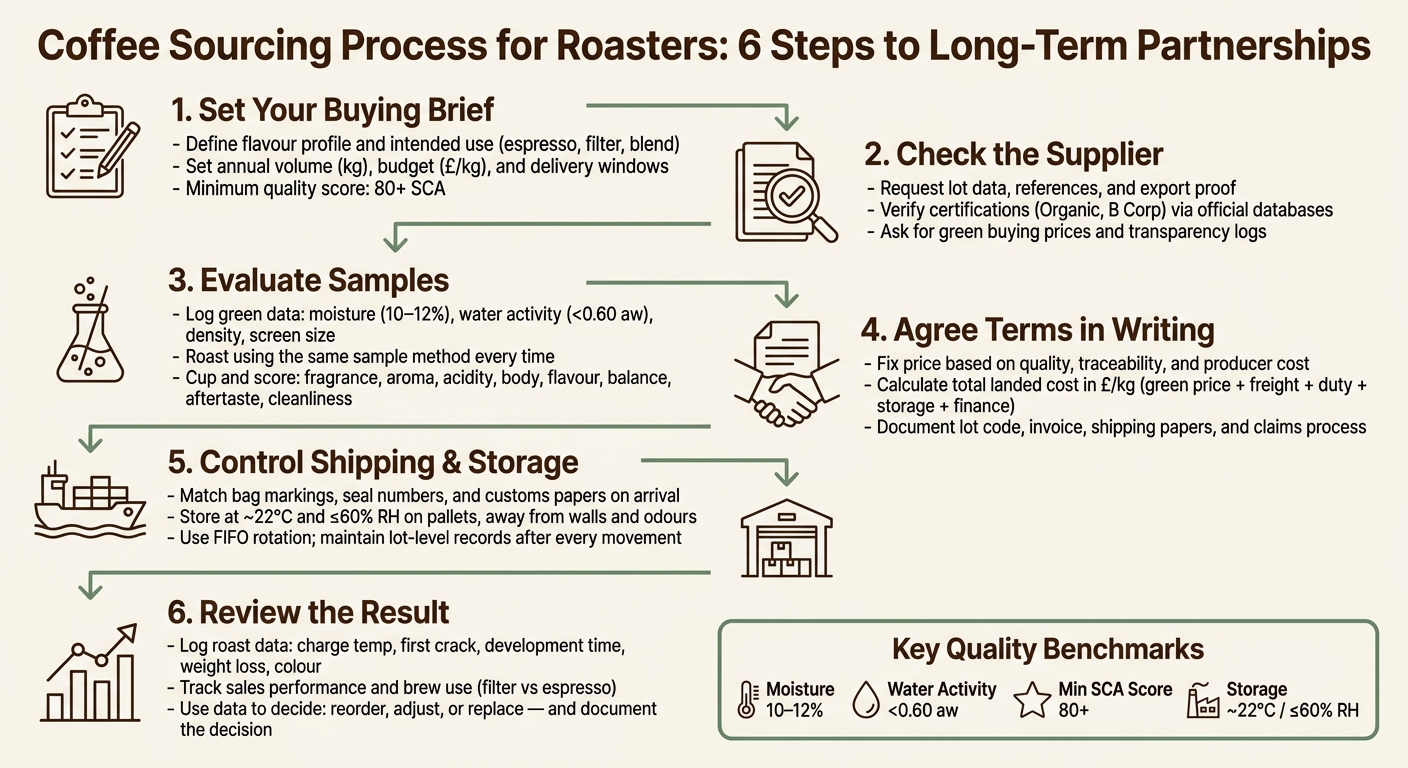
Coffee Sourcing Process for Roasters: 6 Steps to Long-Term Partnerships
Quick overview
- Set your buying brief: flavour, volume, process, delivery window, and budget in £/kg
- Check the supplier: ask for lot data, references, price records, and export proof
- Review samples: log green data, roast the same way each time, and cup for the end use
- Agree terms in writing: volume, claims, payment, delivery term, and trace records
- Control shipping and storage: match bags, seal numbers, customs papers, and stock records
- Review the result: use roast logs, sales, and brew use to decide what to do next
This guide works best if you treat each order as a repeatable buying decision, not a one-off purchase.
sbb-itb-cca2aed
Build a sourcing partnership before the first purchase
Define your buying brief and operational limits
Before you send a single email, get clear on what you need. A buying brief doesn't need to be a formal document, but it should answer the questions that come up in every early chat with a producer or exporter.
Start with your target flavour profile and intended use, whether that's espresso, filter or both. Then set a realistic annual volume in kg, a budget range in £ per kg, your preferred processing methods, such as washed, natural or honey, and your expected delivery windows based on harvest timing. Include a minimum quality score, such as 80+ SCA.
These limits make it much easier to judge whether a producer fits your brief. They also give you a simple way to test cup quality, landed cost, traceability, reliability and shared responsibility. In practice, this brief becomes your filter for every sample, pricing chat and logistics decision that follows.
Research the producer and make a clear first approach
Once your brief is set, research the producer, cooperative or exporter before you get in touch. Look at varieties, export capacity and buyer references.
Ask for the exact processing method, varieties and quality standard you need.
Your first message should be clear and specific, not a generic enquiry. Say how you plan to use the coffee, the volume you're looking for, your preferred processing methods and your minimum quality expectation. Ask whether samples are available and what lead time to expect.
That first message tells you a lot, fast. If the reply is vague, slow or doesn't match your brief, that's useful information. If the producer looks like a good fit, ask for samples before you get into price.
Verify claims and set communication expectations
Treat direct-trade and ethical claims as unproven until you've checked them. Ask for the documents and details behind the story.
| Information to Request | Why it Matters | How to Verify |
|---|---|---|
| Processing methods and varieties | Shows whether the coffee matches your flavour brief | Request samples and cupping reports |
| Green buying prices | Confirms fair compensation and financial transparency | Look for sourcing reports or transparency logs |
| Certifications (Organic, B Corp, etc.) | Adds third-party proof for social or land-use claims | Search official certification databases or request certificates |
| Export capability and past buyers | Shows the producer can manage logistics to the UK | Request references from other UK or international roasters |
| Social impact initiatives | Checks claims about community support | Verify partnerships with charities |
Once you've checked the basics, set communication rules early. Agree on response times, sample timelines and who makes which decisions on each side. That keeps the relationship honest, disciplined and accountable from the first exchange. If those basics hold up, move to sample review.
Evaluate samples with a repeatable quality protocol
After the origin check, test the lot against your brief. Use the same protocol every time so you can compare one lot with another and tell the difference between a coffee fault and a testing mistake. The brief sets the target. The sample shows whether the lot matches it.
Check green-coffee identity, condition and measurements
Before you roast anything, record the lot details in full. Note the lot code, crop year, processing method, bag condition, odour and any physical defects. Then take the same core measurements each time: moisture percentage, water activity, density and screen size. These figures help you plan storage and shape the roast.
Moisture outside the 10–12% range can point to mould risk or age, while water activity above 0.60 aw increases microbial risk. Density is especially useful for roast planning because it helps you choose charge temperature and airflow.
Roast, cup and score for the intended use
Use the same sample-roast method for every lot, and label each sample clearly before it goes in. Log the full roast, then rest each sample for the same cupping interval before cupping.
Cup each sample on the same sheet, then score fragrance, aroma, acidity, body, flavour, balance, aftertaste and cleanliness. Judge the coffee by intended use as well as score. Filter, espresso and blends each ask for different things.
| Quality Factor | Target Range | Action if Outside Specification |
|---|---|---|
| SCA Score | 80+ points | Reject or re-evaluate for blending |
| Moisture Content | Typically 10–12% | Check for mould risk or age; adjust storage |
| Water Activity (aw) | Below 0.60 aw | Higher mould risk; monitor closely or reject |
| Physical Defects | Within SCA Speciality Grade limits | Downgrade to blend or reject lot |
| Odour | Clean, fresh, characteristic of process | Reject if fermented, musty or chemical-like |
| Cleanliness | No taints or faults | Reject lot |
Separate coffee faults from testing errors
If the cup disappoints, check your process first. A stale sample, the wrong rest time or a poor cupping setup can all make a good coffee taste bad. If the roast log shows an inconsistency, roast the sample again before making the call. Only mark it as a fault in the coffee once the preparation has been checked.
Agree fair prices, volumes and contract terms
Once a sample clears your quality checks, the conversation shifts from the cup to the deal itself: price, volume and terms. And this is where loose verbal agreements can come back to bite you. If the coffee is approved, get the deal down in writing.
Set pricing and volume on realistic assumptions
Price coffee based on quality, traceability and producer cost - not just the commodity market. That keeps the price tied to what the coffee is and what it took to produce it, rather than treating every lot like a line on a screen.
Your volume commitment needs the same level of discipline. Only agree to what your sales data can support. It’s easy to get carried away when a coffee tastes great, but overcommitting creates pressure later on - in stock, cash flow and sell-through.
Write contract terms that reduce disputes
Clear contract terms save a lot of back-and-forth later. Set out the quality standards, delivery window, payment terms, agreed delivery term, claims process and traceability records in plain language.
That traceability record should name the lot code, invoice, shipping papers and claim terms. If something goes wrong, those details give both sides a clear reference point instead of turning the issue into a guessing game.
Calculate landed cost before confirming the order
The offer price per kilogram is only part of the picture. Before you confirm the order, work out the landed cost in £/kg by adding freight, import charges, handling, storage and finance costs to the green price.
That total is the number that matters for planning. Use it to shape your shipping, intake and margin decisions in the next stage. If you skip this step, the price may look fine on paper but tell a very different story once the coffee lands.
Manage logistics, traceability and green-coffee storage
Once price and terms are fixed, the next job is simple in theory and easy to get wrong in practice: make sure the coffee that arrives is the same coffee you approved.
That means controlling the handover points, paperwork, customs entry and storage conditions from origin to your roastery.
Track the lot from origin to UK arrival
Create a shipment file for every lot. It should include the purchase contract, invoice, packing list, transport document, origin and certification papers, insurance, export clearance and UK import entry.
Before you book the container, confirm the customs details with your agent. Check the commodity code, duty and VAT treatment, required declarations and any controls. Do not assume the exporter knows UK import rules.
Record the Incoterm and named place in the contract. This sets transport, insurance and risk transfer. It does not set quality terms or claims terms.
Assign an internal lot code before the coffee arrives. Link it to the supplier's lot number, contract reference, origin, producer or exporter, crop year, process, grade, bag type, bag count, net weight, container number and seal number.
The table below shows who handles each stage, which record you need and where risk tends to sit.
| Stage | Responsible party | Required document or record | Key risk | Verification point |
|---|---|---|---|---|
| Lot preparation and packing | Producer/exporter | Packing list, lot specification, quality report | Wrong lot, bag count or weight | Match marks and count to the contract |
| Export clearance | Exporter or origin agent | Export declaration and supporting documents | Shipment held at origin | Obtain clearance confirmation |
| Main carriage | Party named in the agreed Incoterm | Bill of lading or sea waybill | Delay, loss or damage | Check vessel, container and estimated arrival |
| Cargo insurance | Party assigned by the contract or Incoterm | Insurance certificate or policy reference | Uninsured loss or unclear exclusions | Confirm insured value, route and claim procedure |
| UK customs entry | UK importer or appointed customs agent | Import declaration and commercial documents | Incorrect commodity code, duty or VAT treatment | Review the submitted entry and import reference |
| Port, haulage and delivery | Freight forwarder, haulier or importer | Delivery order, transport record and receipt | Demurrage, missed collection or damage | Reconcile delivery details with warehouse booking |
| Warehouse intake | Roastery or third-party warehouse | Goods-in record, inspection report and photos | Hidden damage or quantity discrepancy | Sign only after count and condition checks |
| Ongoing storage and use | Roastery or warehouse operator | Location register, stock ledger and batch records | Mix-up, deterioration or lost traceability | Monthly stock and condition review |
Before the shipment leaves origin, build a simple arrival-risk plan. Use recent roast records to calculate your average weekly usage. Then set:
- the latest arrival date you can accept
- a buffer based on route reliability, seasonal port congestion, cash limits and the cost of changing a blend
That small bit of planning can save a lot of pain later.
Inspect, store and rotate stock correctly
Once the coffee lands, storage discipline is what keeps the approved cup profile intact.
Do not clear a delivery until you've counted every bag, checked the seal number, photographed the container condition and matched the bag markings to the packing list. Look for torn or wet bags, punctures, caking, staining, mould-like odours, odd clumping, signs of insects or rodents and any label that doesn't match the approved lot.
If something is off, stop and investigate. Don't accept a driver's handwritten amendment as if that settles it. If bags are missing or water-damaged, quarantine the coffee at once, label it clearly as HOLD - DO NOT USE, and notify the exporter, carrier and insurer in writing within the contract's claims period. And don't mix suspect coffee into conforming stock while you're waiting for an answer.
Store green coffee in a clean, dry, well-ventilated and odour-free area on pallets or racking. Never place bags straight on the floor. Keep them away from external walls, roof leaks, radiators, boilers, direct sunlight, chemicals and strongly scented materials.
ISO 8455 guidance recommends approximately 22 °C and relative humidity of 60% or below for bagged green coffee. Green coffee loses moisture in dry air and absorbs it in humid air, so the practical goal is to keep humidity steady within that range.
Use FIFO unless your quality data supports a different rotation method. Mark each pallet with the lot number, intake date, quantity left and location. Update that record after every movement.
Maintain lot-level records after intake
Storage falls apart fast if the lot stops being identifiable after intake.
Every roast batch should trace back to the original shipment without anyone having to rely on memory. Your system needs to trace a finished batch back to the original lot, and a lot forward to every finished batch.
If you can't trace both directions quickly, fix that gap before a quality problem does it for you.
Turn a purchased lot into a lasting partnership
Once the lot is in the warehouse and on roast, the work doesn’t stop. In many ways, this is where sourcing gets tested. Roast logs, brew performance and sales data tell you whether the coffee should be reordered, tweaked or swapped out next time.
Use roast data and customer response to improve future buying
Record each production batch with the roast date, batch size, charge temperature, first crack, development time, drop temperature, weight loss, colour and defects. That record gives you something solid to compare across harvests, and it makes the next buying decision far less guesswork.
Just as important, test the coffee under production conditions, not only on the cupping table. A coffee can score well in a tasting and still be awkward in service. It might be lovely as filter, but harder to balance as espresso. Or it may lose what makes it special once milk enters the picture. That gap matters when you’re deciding whether to reorder, change the profile or use the coffee in another way.
Data has to lead to action. Otherwise, it’s just notes sitting in a file. Use the results to speak with the producer, not only to fine-tune the recipe. Be specific. For example, say that the lot sold well as filter coffee at 12 kg a week, but its acidity made espresso harder to balance.
Apply faith-led sourcing principles to the annual review
Once the figures are clear, step back and review the relationship itself. For Creation Coffee, that annual review should also ask whether the relationship reflects Christian stewardship and fair dealing.
"Sustainability also means fair treatment, honest payment and long-term care for producers."
Build the review around three checks:
- Were producers treated with dignity?
- Were payment terms fair and paid on time?
- Are social-impact claims documented?
Write those commitments down and test them at each review. If the relationship falls short on stewardship, fairness or honesty, it should not be renewed unchanged.
Conclusion: Keep sourcing documented, realistic and repeatable
Use roast, sales and feedback records to decide whether to reorder, adjust or replace the coffee. Keep quality issues separate from logistics issues. And before drawing conclusions, separate green-coffee traits from roasting, brewing or packaging effects.
Treat each reorder as a documented decision, not something done out of habit. If the coffee is reordered unchanged, record why. If it is adjusted, blended or replaced, record that as well.
Document each decision, give honest feedback, and let the next purchase reflect what the last one taught you.
FAQs
How do I compare coffee lots fairly?
Compare coffee lots side by side for sensory quality and physical consistency. Use the SCA scoring system to assess cup quality, and check origin-specific grades such as Kenya AA, Colombia Supremo, or Brazil’s COB for bean size, moisture, and defect counts.
Then look at the supply chain paperwork, compare prices against production costs, and factor in farmgate or FOB price, lot size, harvest year, and processing method to judge value in a fair way.
What should I include in landed cost?
Include every cost involved in moving green coffee from the exporter to your roastery, such as:
- international freight
- marine insurance
- port fees
- customs clearance
- drayage
FOB covers milling, local transport, and export paperwork at origin. Landed cost adds the costs tied to international transit and clearance.
When should I reject a coffee lot?
Reject a coffee lot if it doesn't meet the quality or physical standards you agreed upfront.
That can mean:
- one primary defect in a 350 g sample
- moisture outside 10% to 12%
- a cupping score below 80 points
You should also reject the lot if the sourcing can't be checked properly. For example, if origin details are missing or there's no producer-cost data, you don't have the transparency needed to verify ethical sourcing.