


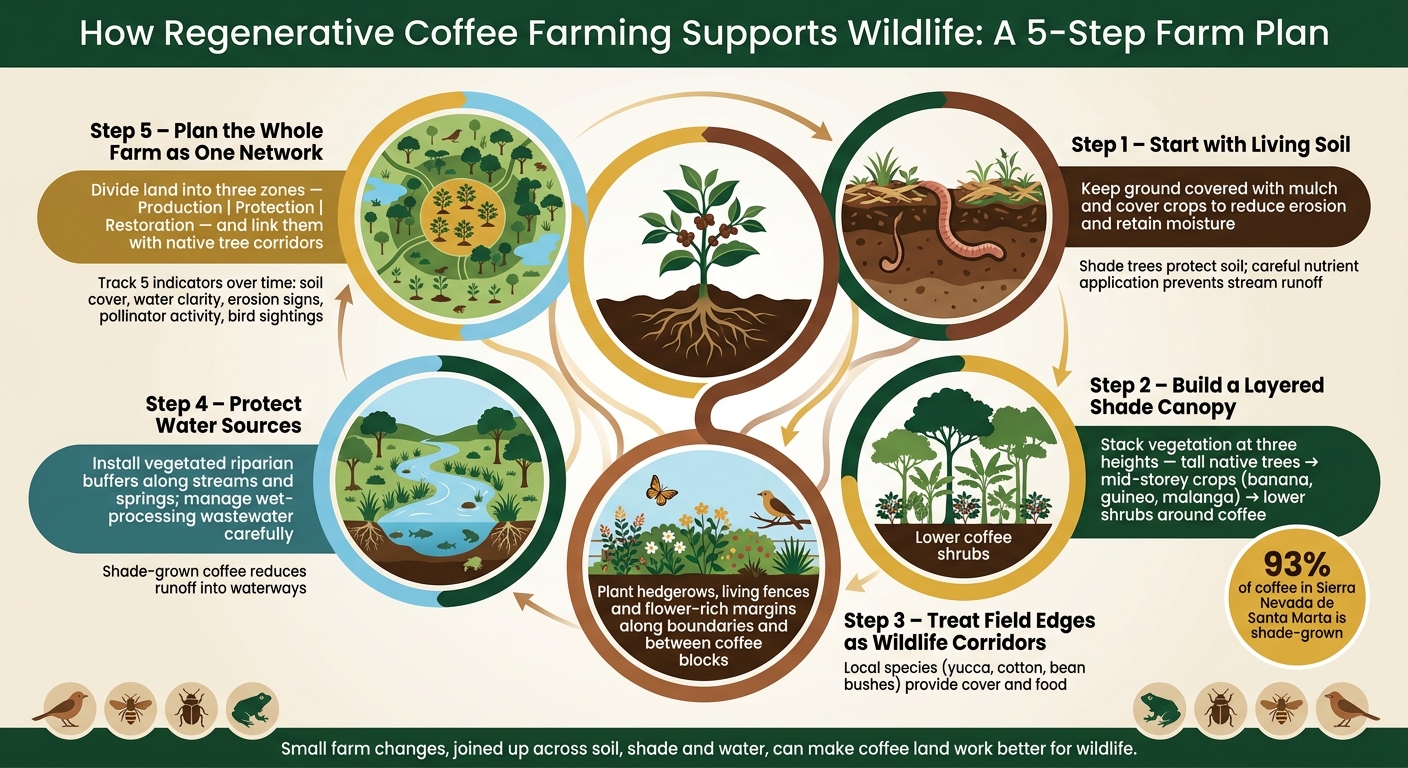
A coffee farm can support birds, insects, soil life and clean water at the same time. From the article, the main idea is simple: if I keep soil covered, build layered shade, protect streams, and link habitat across the farm, wildlife has more places to feed, nest and move.
Here’s the short version:
- Start with soil: keep ground covered to cut erosion and hold moisture.
- Use layered shade: mix tall native trees, mid-level crops and lower plants around coffee.
- Treat field edges as habitat: hedgerows, living fences and flower-rich margins help wildlife move through the farm.
- Protect water: keep buffers along streams and handle processing wastewater with care.
- Plan the whole farm: map production, protection and restoration areas, then link them with tree corridors.
- Track a few signs over time: bird sightings, pollinator activity, soil cover, erosion and stream clarity.
One figure stands out: in Sierra Nevada de Santa Marta, 93% of coffee crops are grown in shade. That shows how tree cover can sit at the centre of coffee farming, not at the edge of it.
What I take from this is clear: small farm changes, joined up across soil, shade and water, can make coffee land work better for wildlife.
Regenerative Coffee Farming: 5-Step Wildlife Habitat Plan
From Forest to Cup - Transforming Coffee Landscapes through Regenerative Agroforestry
sbb-itb-cca2aed
1. Start with living soil
Start with the soil. If the ground is in good shape, the rest of the farm has a much better base to grow from. Healthy soil supports the life above it, and the life below it too. Shade trees help keep the soil covered and cut erosion, while soil organisms support insects, fungi and other organisms that feed birds and wider wildlife. Once the soil is covered and stable, the farm can support more complex habitat above ground.
Check the soil and keep it covered
Shade trees keep the soil covered, conserve moisture and reduce erosion. Keep the soil covered to cut erosion and hold onto moisture. It’s a simple step, but it does a lot of heavy lifting. That same cover also gives shade trees and field-edge habitat a better base later on.
Apply nutrients carefully
Apply nutrients with care so they do not wash into streams. With the soil protected, the next step is to build habitat above it.
2. Build habitat through canopy layers and field edges
Once the soil is covered, the next step is to build upwards. Adding layers of vegetation creates shelter, food sources and nesting spots for birds.
Create a multi-layered coffee canopy
A mixed canopy at different heights works well: tall native trees at the top, mid-storey plants such as banana, guineo and malanga, then lower shrubs around the coffee plants. In Sierra Nevada de Santa Marta, coffee is grown under this sort of varied canopy.
Shade does more than help wildlife. It also protects coffee shrubs from heat stress. When pruning shade trees, the goal is to let enough light reach the coffee shrubs without tearing apart the canopy that birds and other wildlife rely on.
Add hedgerows, living fences and flower margins
Field edges matter more than many growers think. They act as wildlife corridors, helping animals move between habitats. Hedgerows and living fences along boundaries and between coffee blocks can link parts of the farm that would otherwise stay cut off.
Shrubs such as yucca, cotton and bean bushes, planted within and around coffee plots, add both cover and food. Local species tend to work best, because they fit the conditions of each growing area.
Regional examples from coffee-growing areas
Different coffee regions show how local species and shade patterns can support wildlife while keeping farms productive.
| Region | Canopy approach | Key species used |
|---|---|---|
| Sierra Nevada de Santa Marta, Colombia | Multi-layered shade-grown coffee; 93% of coffee crops are grown in shade | Banana, guineo, malanga, yucca, cotton, bean bushes |
| Ghana | Smallholder shade-grown systems that support birds and other wildlife | Native shade trees alongside Arabica and Robusta |
These setups tend to work best when the canopy, field edges and the rest of the farm connect into one linked habitat.
3. Protect water and plan the farm as one wildlife network
Healthy canopy and soil only go so far if water sources are in poor shape. Streams, springs and wet ground need to be treated as part of the same habitat network, not as separate bits of land.
Protect streams, springs and wet areas
Begin at the water's edge. Vegetated riparian buffers - strips of native trees and shrubs planted along watercourses - work like a natural filter and help protect streams and springs. They also keep cover and travel routes in place for birds and other wildlife. Shade-grown coffee cuts runoff into waterways.
Wet-processing wastewater is a direct risk to water quality. During processing, cherries are fermented and washed in water to remove the mucilage. That wastewater needs careful handling so it does not flow into a stream or spring.
Map zones for production, protection and restoration
A simple farm map can do a lot of heavy lifting. Start by marking coffee plots, forest remnants, native trees, water sources, eroded patches, roads and buildings. Then split the land into clear zones.
Use the map to connect protection areas, not just label them.
| Zone | What it includes | Purpose |
|---|---|---|
| Production | Coffee plots intercropped with food crops | Maintains soil nutrients through crop diversity |
| Protection | Native shade trees, forest remnants, riparian buffers | Protects habitat and water |
| Restoration | Degraded or eroded areas replanted with shade-grown saplings and cover crops | Rebuilds soil health and helps prevent further erosion |
Link these zones with corridors of native trees. When a corridor joins forest remnants to riparian buffers, wildlife can move across the farm with far less risk.
Manage seasonally and track results
Farm management should follow the seasons. Align monitoring and pest control with the local harvest period. Pruning, monitoring and pest control all work better when timed to the farm's seasonal cycle. Integrated pest management (IPM) - monitoring for pests like the coffee borer beetle and using targeted controls rather than broad-spectrum chemicals - helps protect the wider wildlife network.
A small set of indicators can show whether the plan is working over time:
- soil cover
- water clarity in streams
- signs of erosion
- pollinator activity
- bird sightings
Track them through regular field checks.
4. Put the plan into practice
Step-by-step farm planning sequence
Start with the map from the previous section and work through the farm in a clear order. First, survey the land. Then protect the habitat that already exists. After that, restore damaged patches so birds, insects and small mammals can move more easily between habitats. Once those links are in place, diversify the production blocks and keep checking what happens next.
The map should guide what you protect, restore and diversify first. That order matters. Protect existing habitat before you begin restoration work elsewhere. If you skip that step, you risk losing the parts of the farm that are already doing the heavy lifting for wildlife.
When restoration is under way, intercrop coffee with food crops such as beans, banana or yucca. This adds more layers to the farm system and helps support soil health. To keep things practical, follow a small set of indicators during regular field checks: soil cover, soil health and pest pressure.
Wildlife planning table
Use this table as a quick planning check.
| Regenerative practice | Wildlife benefit | Where to apply it | Management note |
|---|---|---|---|
| Mulch and cover crops | Supports soil organisms | Between coffee rows and on slopes | Check regularly for the coffee borer beetle |
| Contour planting and barriers | Reduces erosion; stabilises slopes | Steep or degraded hillsides | Use planting patterns as natural barriers on high ground |
| Diverse shade canopy | Habitat and temperature regulation | Sunny slopes and production zones | Maintain high shade cover with native and fruit trees |
| Polyculture | Food sources; habitat diversity | Between coffee rows | Include yucca, beans and banana alongside coffee |
| Riparian buffers | Protects streams | Along streams, springs and wet areas | Keep coffee away from the water's edge; prevent runoff |
| Forest patches and corridors | Connects habitats across the farm | Farm edges, restoration zones and links between protection areas | Use native species suited to the local microclimate |
| Integrated pest management (IPM) | Reduces chemical impact on beneficial insects | Across the whole farm | Monitor pests; avoid broad-spectrum sprays |
Conclusion: Small farm changes can build stronger wildlife habitat
Taken together, these steps can turn a coffee farm into connected habitat. The idea is simple: link soil, shade, water and habitat across the farm so each part supports the others. Work at ground level helps the next stage, and whole-farm planning ties it all together.
A clear example comes from Colombia. In the Sierra Nevada de Santa Marta, 93% of coffee crops are grown in the shade. That shows how bringing trees into the farm system can support birds and help conserve soil.
The details will differ from one region to another. But the core idea stays the same: protect what is already there, restore what has been damaged, and track results season by season.
FAQs
How much shade is too much for coffee?
Too much shade can hurt coffee production. It slows sucker growth, cuts yields, and can create the kind of damp, sheltered conditions that help pests like the Black Coffee Twig Borer spread.
The fix is fairly simple: farmers need to prune shade trees on a regular basis. That helps keep a healthy balance in the field and stops shade trees from competing too heavily with coffee plants for water and nutrients.
Which wildlife benefits most from hedgerows and corridors?
Hedgerows and corridors mainly help birds and other wildlife by giving them shelter, food and safer places to move through farmland.
When these features link broken-up habitats, species can travel, feed and nest with less risk across the farm. That supports biodiversity across the whole landscape.
How can a small coffee farm start regenerative changes?
A small coffee farm can get started with agroforestry by planting native shade trees that form a canopy over the crop. That canopy does more than add cover. It can help improve soil health, hold moisture in the ground, and create habitat for wildlife. It also helps regulate temperature and humidity, while cutting soil erosion.
Other helpful steps include mulching, contour terracing, and water-retention bands. A farm can also use rain-harvested water systems, plus hedgerows or cover crops around field edges, to support biodiversity and protect the land.